Escalating conflict in the Middle East is disrupting critical air freight routes, exposing vulnerabilities across the pharmaceutical supply chain, from temperature-sensitive biologics to low-margin generics
Words by Dr Meetal Jotangia
The pharmaceutical industry could be facing one of its most severe stress tests of the decade. Following the US–Israeli military strikes on Iran on 28 February 2026, and subsequent retaliatory drone attacks across the region, the Middle East has been thrust into active conflict, deepening global geopolitical instability. The effects are already being felt across the pharmaceutical supply chain, with some warning of looming worldwide disruption.
Supply lines under strain
As of mid-March 2026, the primary arteries of pharma trade have constricted. Until late February, Frank Van Gelder, Secretary General of Pharma.Aero, a global platform connecting pharma manufacturers with the aviation industry, tells EMJ GOLD it was essentially “business as usual”. However, escalating tensions have since forced a rapid and disruptive shift away from established air freight routes.
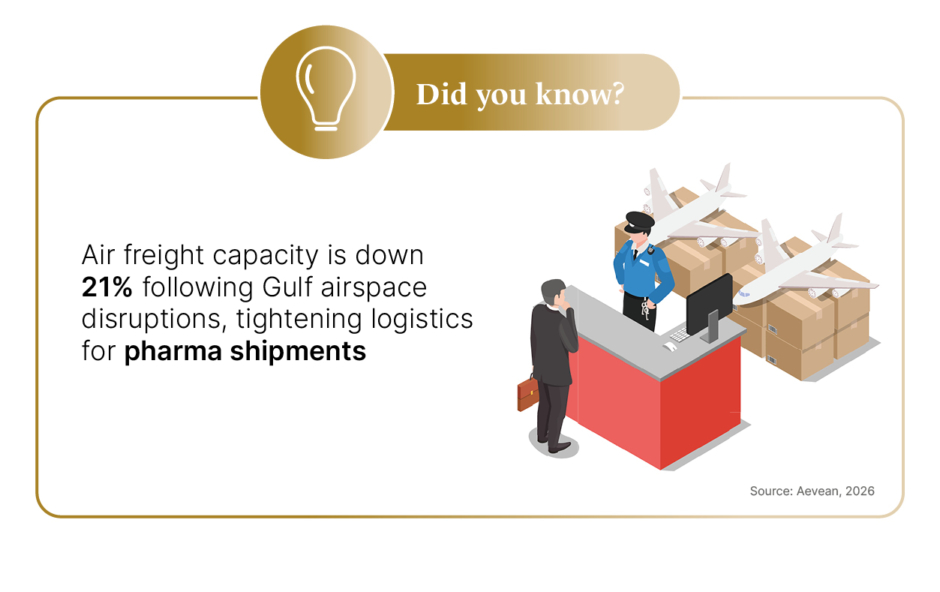
The network is severely compromised by the closure or restriction of major aviation hubs, including Dubai, Abu Dhabi, and Doha – some of the world’s most critical cargo “super-hubs” linking Europe with Asia and Africa. As Van Gelder puts it, the region represents “a very important choke point”, accounting for around 11% of all air cargo movements.
The region represents a very important choke point
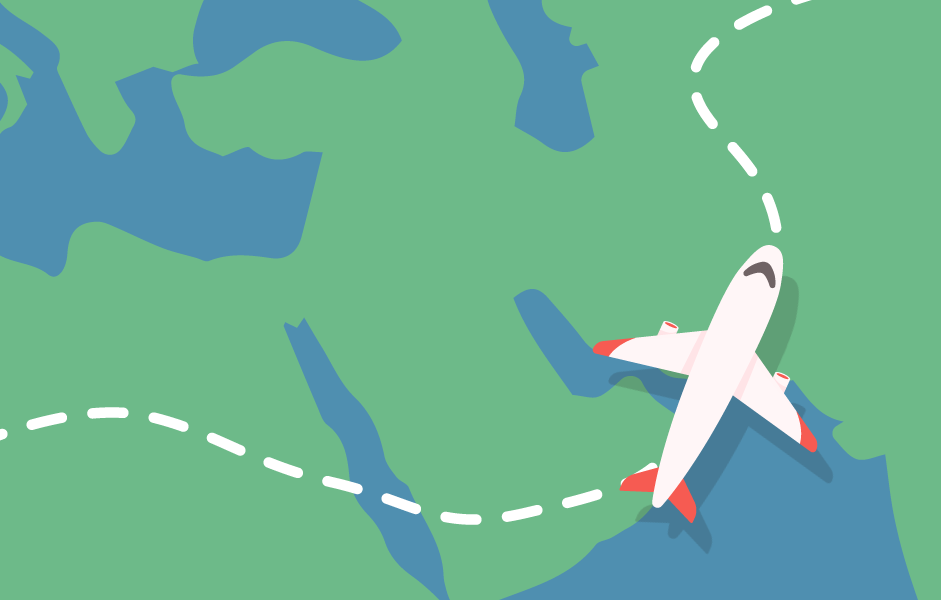
In a bid to mitigate drug shortages, Van Gelder notes that, as “air cargo is an extremely flexible mode of transport”, this flexibility has been leveraged to find safer, more reliable air routes that bypass Middle Eastern airspace. However, avoiding these areas “adds one and a half to two hours’ flight time”, which has its own repercussions.
“Aircraft fuel is going up,” he notes, stating that this could make medicines more expensive in the long term. While pharma companies may absorb some of the initial impact, Van Gelder fears that “at the end of the day… it’s going to be the patient that pays for it”.
As a result, companies are now scrambling for ‘Plan B’ options, rerouting shipments through Istanbul and Oman, or trucking supplies overland from Saudi Arabian hubs such as Jeddah and Riyadh. However, as Van Gelder warns, these alternatives are not just complex – they take longer and increase the risk of disruption, particularly for time-sensitive medicines.
Cold chain at risk
Data from Think Global Health, referenced by Prashant Yadav, Senior Fellow for Global Health at the Council on Foreign Relations, confirms that “ultra-cold chain shipments” are the most vulnerable to the conflict. Overland trucking through the desert heat of the Arabian Peninsula makes it difficult to maintain the strict temperature conditions required for biologics such as monoclonals and immunotherapy agents.
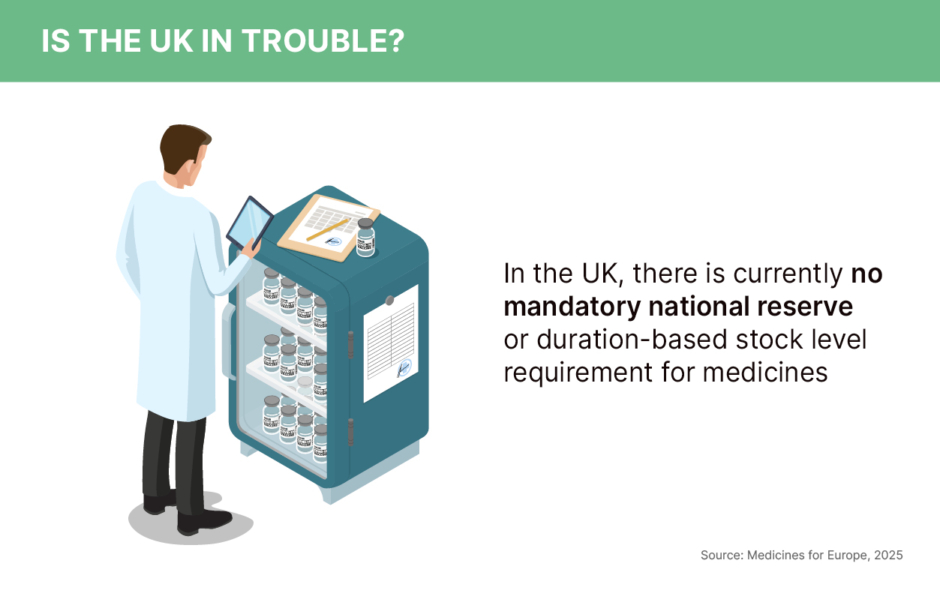
Yadav adds that the impact could be particularly severe in “low-resource markets in the Global South, where credit provision is not that straightforward”. In these settings, countries may struggle to afford holding high-cost medicines in reserve. Even in higher-resource markets such as the EU, where strategic reserves of 4–6 weeks are typically maintained, this buffer is significantly shorter for biologics with limited shelf lives.
“For very temperature-sensitive and expensive medicines, 45 days is the average storage time. This means a pharmacy, for example, does not want to keep a very high-end product, like a PCSK9 for cardiovascular disease, in large quantities,” confirms Yadav.
For very temperature-sensitive and expensive medicines, 45 days is the average storage time
Generics under pressure
Beyond biologics, there are also concerns about how the conflict will affect the supply of essential generic medicines. Although these drugs are less sensitive to temperature instability, they operate on extremely thin margins. Yadav notes that this leaves “manufacturers with little room to absorb the 55–70% spike in freight rates seen in early March 2026”.
“If I’m a very thin, single-digit margin generic medicine producer… I have to pass on the price relatively quickly. So the [cost] absorption is lower,” he says.
As a result, Yadav points to a looming humanitarian crisis driven by “money and credit”. In low-resource markets, where financing is already constrained, price hikes on generics could be “devastating”, effectively pricing life-saving antibiotics and chronic care medicines out of reach for the most vulnerable populations.
The crisis is also “materials-driven”, adds Yadav. “Anything that is a petrochemical-derived starting material or key input for a medicine – its prices are up 15–20%.” This challenge links to wider disruption in the oil and petrochemical markets in the Middle East, where the conflict is driving up energy prices, constraining supply and increasing insurance costs. This creates a secondary squeeze: even if the active ingredient is available, medicines may not be finished or shipped.
A shifting landscape
How long will this last? For Van Gelder, the “volatility of the unknown” remains the industry’s greatest adversary. He points to a recent poll of fellow experts, in which more than half believe it will take “at least a year before everything stabilises again”. He goes on to say that the sector has already moved beyond a temporary “wait-and-see” approach. The repeated “ping-ponging” of conflict since 2022 has forced a structural shift, where contingency planning – once a backup – is becoming standard operating practice.
The volatility of the unknown remains the pharma industry’s greatest adversary
At the same time, the impact is likely to be unevenly distributed. China, which benefits from continued access to Russian airspace, may gain a competitive advantage over Western manufacturers facing war-risk surcharges and higher fuel costs. What has begun as a logistical disruption could therefore evolve into a more lasting realignment, highlighting how geopolitical instability may not only constrain supply chains, but also reshape who holds an advantage within the global pharmaceutical landscape.