Characterisation of Natural Killer Cell Subsets and Antibody-Dependent Cellular Cytotoxicity Function in a Case of Sustained HIV Remission After Allogeneic Stem Cell Transplantation (2nd Berlin Case) - European Medical Journal

This site is intended for healthcare professionals

Characterisation of Natural Killer Cell Subsets and Antibody-Dependent Cellular Cytotoxicity Function in a Case of Sustained HIV Remission After Allogeneic Stem Cell Transplantation (2nd Berlin Case)

Download PDF
Authors:
Timo Trenkner , 1,2 Samad Kor , 3-5 Tom Kraus , 1,2 Henning Gruell , 6 Philipp Schommers , 7-9 Olaf Penack , 3,4,5,10 Christian Gaebler , 11,12 * Angelique Hoelzemer 1,2,13
  • 1. First Department of Medicine, University Medical Center Hamburg-Eppendorf, Germany
  • 2. Institute for Infection and Vaccine Development (IIRVD), University Medical Center Hamburg-Eppendorf, Germany
  • 3. Department of Hematology, Oncology and Tumor Immunology, Charité – Universitätsmedizin Berlin, Germany
  • 4. German Cancer Consortium (Deutsches Konsortium Für Translationale Krebsforschung, DKTK), Berlin, Germany
  • 5. National Center for Tumor Diseases (NCT), Berlin, Germany
  • 6. Laboratory of Experimental Immunology, Institute of Virology, Faculty of Medicine and University Hospital Cologne, University of Cologne, Germany
  • 7. Department I of Internal Medicine, Faculty of Medicine and University Hospital Cologne, Germany
  • 8. German Center for Infection Research (DZIF), Cologne, Germany
  • 9. Center for Molecular Medicine Cologne (CMMC), University of Cologne, Cologne, Germany
  • 10. Berlin Center for Translational Vascular Biomedicine, Germany
  • 11. Laboratory of Translational Immunology of Viral Infections, Department of Infectious Diseases and Critical Care Medicine, Charité – Universitätsmedizin Berlin, Germany
  • 12. Berlin Institute of Health, Germany
  • 13. German Center for Infection Research (DZIF) – Site Hamburg-Lübeck-Borstel-Riems, Germany
*Correspondence to [email protected]
Disclosure:

Gaebler has received support for the present manuscript from the HJH Foundation, the Hector-Foundation, the National Institutes of Health (REACH Delaney grant UM1 AI164565 subaward), and the DZIF (German Center for Infection Research, TTU 04.823); honoraria for lectures from GSK; support for attending meetings from Gilead; and is a Charité-Foundation Recruiting Grantee. Hoelzemer has received support for the present manuscript from the Federal Ministry of Research, Technology and Space (01KI2110), the iSTAR program from the Federal Ministry of Research, Technology and Space, and the DZIF (German Center for Infection Research, TTU 04.823). Penack has received grants from José Carreras Leukämie-Stiftung (23R/2021), Deutsche Krebshilfe (70113519), Deutsche Forschungsgemeinschaft (PE 1450/7-1, PE 1450/9-1, PE 1450/10-1, PE 1450/11-1) and Stiftung Charité BIH (BIH_PRO_549, Focus Group Vascular Biomedicine), with payments to the institution; consulting fees from Apogepha, Alexion, Equillium Bio, Jazz, Gilead, Novartis, MSD, Omeros, Orca Bio, Priothera, Sanofi, Shionogi, and SOBI; payment or honoraria for lectures, presentations, speakers bureaus, manuscript writing, or educational events from Alexion, Gilead, Jazz, MSD, Neovii, Novartis, Pfizer, and Therakos; research support from Incyte, Gilead, and Priothera outside of the present manuscript; holds a leadership or fiduciary role as the Chairperson of the EBMT Transplant Complications Working Party; and holds stock/stock options in Orca Bio. Gruell has received payments from the University of Cologne for licensed patent applications relating to HIV neutralising antibodies. Trenkner has received support for the present manuscript from the Federal Ministry of Research, Technology and Space(01KI2110). Schommers has received support for the present manuscript from the German Research Foundation (DFG, Emmy Noether Program Nr. 495793173), the Else Kröner Fresenius Foundation (EKFS), and the German Center for Infection Research (DZIF); and payments from the University of Cologne for licensed patent applications relating to HIV neutralising antibodies. Kraus has received support for the present manuscript from the Federal Ministry of Research, Technology and Space (01KI2110). Kor has declared no conflicts of interest.

Acknowledgements:

The authors thank the second Berlin patient (B2) and all study participants for their willingness to collaborate, and Quirin Hammer for their assistance with the design of the adaptive NK cell panels.

Citation:
EMJ Microbiol Infect Dis. ;6[Suppl 4]:26-28. https://doi.org/10.33590/emjmicrobiolinfectdis/RZQG5710.
Keywords:
Allogeneic stem cell transplant, antibody-dependent cellular cytotoxicity (ADCC), HIV cure, HIV remission, natural killer (NK) cells.

Each article is made available under the terms of the Creative Commons Attribution-Non Commercial 4.0 License.

BACKGROUND AND AIMS

Natural killer (NK) cells are increasingly studied in HIV cure research as certain subsets have been linked to natural HIV control, enhanced antibody-dependent cellular cytotoxicity (ADCC), and reduced viral reservoirs.1-6 Elite controllers (EC) often display higher envelope (Env)-specific ADCC activity,7 and the only moderately successful HIV vaccine trial to date, RV144, identified ADCC as a correlate of reduced acquisition risk.8

METHODS

Based on these findings, the authors performed in-depth phenotyping and functional testing of NK cells from the second Berlin individual (B2), who displayed sustained HIV remission after allogeneic stem cell transplantation with heterozygous CCR5Δ32 donor cells. Peripheral blood mononuclear cells were genotyped for killer-Ig-like receptor genes, and NK cells were analysed by multiparameter flow cytometry, as well as standardised ADCC assays, against rituximab-coated target cells. HIV-1-specific ADCC capacity was tested in longitudinal plasma samples from B2, employing a degranulation assay against immobilised Env protein, in comparison with plasma from ECs and broadly neutralising antibodies (Figure 1).
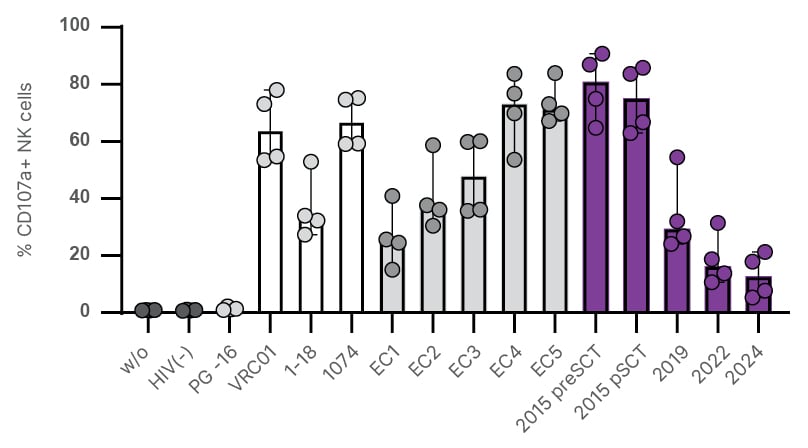
Figure 1: HIV-specific antibody-dependent cellular cytotoxicity activity of the second Berlin individual’s plasma.
Summary of cumulative ADCC responses. NK cells (N=4 biological replicates) were incubated with Env-coated wells treated with PBS, plasma from a donor who is HIV-negative (1:1000 dilution; black), bnAbs (PG-16, 1–18, VRC01, and 10–74; 10 µg/mL; white), plasma from five ECs (1:1000; dark grey), or longitudinal B2 plasma samples (1:1000 dilution; purple). The bar shows the median with the IQR.
ADCC: antibody-dependent cellular cytotoxicity; B2: second Berlin individual; bnAbs: broadly neutralising antibodies; CD: cluster of differentiation; EC: elite controllers; Env: envelope; IQR: interquartile range; NK: natural killer; PBS: phosphate-buffered saline; SCT: stem cell transplant; w/o: without.

RESULTS

B2 displayed an NK cell phenotype with a markedly higher frequency of natural killer group 2 member A (NKG2A)⁺ cluster of differentiation (CD)57⁺ NK cells compared to controls who were HIV-negative and cytomegalovirus-positive, and previously published data on allogeneic stem cell transplantation recipients.9 This subset did not undergo downmodulation of promyelocytic leukaemia zinc finger and Fc ɛ receptor γ chain characteristics of adaptive-like NK cells, but nonetheless contributed substantially to ADCC-activity upon encountering rituximab-coated targets. Around transplantation, B2’s plasma mediated high HIV-specific ADCC activity, surpassing EC plasma (N=5) and monoclonal broadly neutralising antibodies. ADCC activity mediated by B2’s plasma declined substantially in the years following transplantation (Figure 1).

CONCLUSION

Taken together, the authors observed an NK cell phenotype in B2 characterised by the expansion of mature NKG2A+ NK cells, alongside potent HIV-specific plasma ADCC activity. These data, together with findings from the first case of HIV-1 remission after transplantation with wild-type CCR5 donor cells (the Geneva Case),10 suggest a potential contribution of NK cell-mediated mechanisms to modulate the HIV reservoir, independent of CCR5Δ32 homozygosity.

References
Trenkner T et al. Characterization of NK cell subsets and ADCC function in a case of sustained HIV remission after allogeneic stem cell transplantation (2nd Berlin Case). Abstract PS07.4.LB. EACS Conference, 15-18 October, 2025. Essat A et al.; ANRS PRIMO cohort; VISCONTI study. A genetic fingerprint associated with durable HIV remission after interruption of antiretroviral treatment: ANRS VISCONTI/PRIMO. Med. 2025;6(8):100670. Huot N et al. SIV-induced terminally differentiated adaptive NK cells in lymph nodes associated with enhanced MHC-E restricted activity. Nat Commun. 2021;12(1):1282. Gondois‐Rey F et al. NKG2C+ memory-like NK cells contribute to the control of HIV viremia during primary infection: Optiprim-ANRS 147. Clin Transl Immunology. 2017;6(7):e150. Martin MP et al. Epistatic interaction between KIR3DS1 and HLA-B delays the progression to AIDS. Nat Genet. 2002;31(4):429-34. Tomescu C et al. Identification of the predominant human NK cell effector subset mediating ADCC against HIV‐infected targets coated with BNAbs or plasma from PLWH. Eur J Immunol. 2021;51(8):2051-61. Lambotte O et al. Heterogeneous neutralizing antibody and antibody-dependent cell cytotoxicity responses in HIV-1 elite controllers. AIDS. 2009;23(8):897-906. Haynes BF et al. Immune-correlates analysis of an HIV-1 vaccine efficacy trial. N Engl J Med. 2012;366(14):1275-86. Horowitz A et al. Regulation of adaptive NK cells and CD8 T cells by HLA-C correlates with allogeneic hematopoietic cell transplantation and with CMV reactivation. J Immunol. 2015;195(9):4524-36. Sáez-Cirión A et al. Sustained HIV remission after allogeneic hematopoietic stem cell transplantation with wild-type CCR5 donor cells. Nat Med. 2024;30(12):3544-54.

Rate this content's potential impact on patient outcomes

Average rating / 5. Vote count:

No votes so far! Be the first to rate this content.