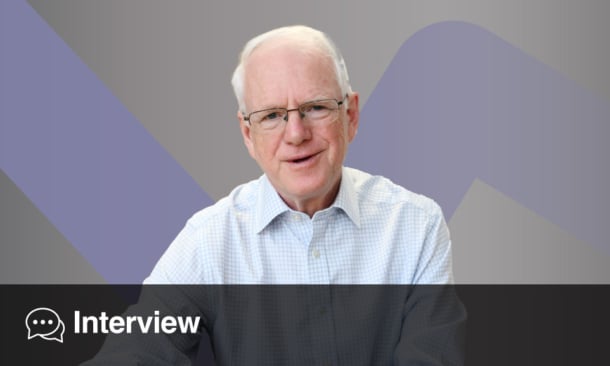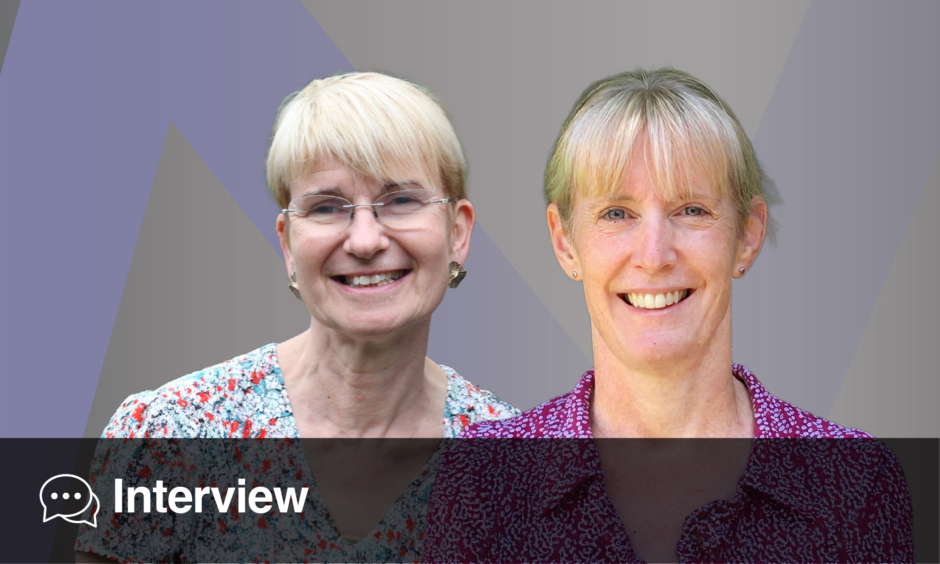
Clare Morlidge | Consultant Renal Pharmacist, East and North Hertfordshire NHS Trust, UK; Co-President, UK Kidney Association.
Katie Vinen | Consultant Nephrologist, King’s College Hospital NHS Foundation Trust, London, UK; Co-President, UK Kidney Association.
Citation: EMJ Nephrol. 2026; https://doi.org/10.33590/emjnephrol/2201G06I

What first inspired you to dedicate your career to kidney care, and how did that early interest shape the way you approach your professional work today? Were there specific patients, experiences, or mentors that shaped your path?
Morlidge: For me, it was really mentors. As a junior pharmacist, rotating around different wards, I was given the kidney ward to look after, and the people that were there, the patients, sort of inspired me to take part and get involved. The team were really welcoming, and I hadn’t experienced that with any other team I’d worked with. That was really good for me. Then, the mentors I had, other pharmacists in other units, the conversations, and the networking opportunity gave me the support network needed to get involved, even on a national level.
Vinen: I would very much concur. For me, when I look back at medical school, the subjects I enjoyed most fit very well. Immunology and physiology were the things I particularly enjoyed, and it’s a very immunological, physiological specialty. I would also agree with Morlidge, absolutely, it is ultimately for people. For me, it was about finding a specialty where I felt people were really committed to the patients. There was an atmosphere within it, for all its challenges, that this was a group of professionals who really wanted lifelong care, long relationships with patients, to solve problems, to work together, and a heavy research basis, whilst also always striving for excellent clinical care. I suppose it aligned with the reasons we went into medicine. I felt that they were trying to do what I wanted to do.
How did your journey to becoming Co-President of the UK Kidney Association (UKKA) come about? Was leadership always something you had in mind?
Vinen: I think leadership is something I’ve always been drawn to throughout my life, because I see that it’s a way of, hopefully, making a difference. But again, I think people are really important. Today, we had a lecture that was named after Donald O’Donoghue, who was a real grandfather of nephrology and an inspirational mentor. I became a clinical director of my own unit, and that led me to meet other clinical directors and run what we call the ‘Clinical Directors Forum’ at UKKA. O’Donoghue and other past presidents, Graham Lipkin and Paul Cockwell, have all, effectively, acted as mentors to me, encouraged me very strongly to step forward for things, hugely supported me through both successes and failures, and made sure they were there to pick me up if needed. I think it’s about looking above the level at which you work with individual patients and saying, how can I make a difference at a system level?
Morlidge: Yeah, I definitely think very similarly. Again, pharmacy is really embedded within renal medicine. There’s a lot of impact you can have with patients, and with clinicians as well, so that was my interest. Having that national view with the Renal Pharmacy Group was really important for me, the mentors there and the opportunity to be able to get involved. If you don’t get involved in things, you don’t effect change. So, being able to do that and having those people within the pharmacy world to support me was really important. Looking outwards on that, there were mentors, like O’Donoghue, who enabled people like pharmacists to take that next step into leadership roles nationally, which was really important. It shows people that you can make a difference, encourages you to step forward, and supports you when it doesn’t go well. It is really important.
Looking ahead, what are the most important policy changes in kidney care that you would like to see implemented over the next few years?
Morlidge: I suppose there are lots of opportunities to think about at the moment within the government’s 10-year plan. How can we get involved? How can we raise awareness about the profile of kidneys? We’ve got it into some aspects of national policy, but how can we get it into more of those national policies? For me, being able to get kidneys to the forefront of what’s going on in regard to the government policy for the NHS would be really important, for both professionals and for the patients themselves as well.
Vinen: Similarly, I think we feel very strongly about advocacy and leadership, and giving us a national profile. If you think of cancer, maternity, or accident and emergency wait times, you see signs about it everywhere. I think public information about kidney disease should be part of that. You need to start with, does the public understand? Then, does the government support?
I think it’s really about seizing our opportunities in the clinical space, perhaps particularly in prevention therapies and rare disease therapies. We don’t use our data well enough yet. We’re a very data-rich specialty; we have the registry, we have RaDaR, and we are enormously privileged to have two world-class databases, but we’re not yet using them to their full potential, perhaps because our renal units do not yet understand their value. We need to do a piece of work to help them understand that value. The other thing that I think is very underused at the moment is the patient resource. By that, I mean we have not valued the education of patients properly, and we need to take education to patients in a format they can understand, not a format we can understand. This is a co-managed specialty, and if we do not get that co-management right between the patient and the clinician, we will not be able to use the resources we have most effectively.
Kidney care is inherently multidisciplinary, involving doctors, pharmacists, nurses, and allied health professionals. From your experiences, what have been the most effective ways to foster collaboration across these different roles, and what challenges remain?
Vinen: In terms of fostering (collaboration), 5 years ago, we combined two societies. We made a very strong professional and political statement that we, the renal community, believed that we were all important in care. I think one of the really important things about that was that we created a co-presidency model. These are equal roles, and we have tried to live that vision. I think that’s really important. I also think it’s really important, for me as a medic, to both make sure I continue to support my own professional group (doctors), because they need to drive things in medicine. They often have greater leadership and research experience, and we mustn’t lose that, whilst, at the same time, understanding that our multidisciplinary team (MDT) colleagues have huge amounts of different experience to give. They often understand the patients better and have greater trust from the patients, but we also need to provide proper training for them. We train a renal registrar in a very particular way, over a long period of time, with a lot of support, and I think we don’t yet do that for the MDT. I think we’re starting to do it for the MDT. We have some fabulous examples of the people who are the early adopters, but we need to make sure that’s universally available.
Morlidge: I agree. I think it’s about that communication, it’s about keeping everybody involved. As I said at the start, it’s always been about being part of a big team and that everybody is valued. In some other areas, that is not the case. I think we need to remember that we need to communicate, and we need to keep building and getting better at what we do. I think we’ve all got a place in that team.
Vinen: I think as we become more mature, we understand that we don’t have to be the same to be valued. Early on, there was a feeling that every session, for instance at UKKA, should speak to everyone. I think, as we become more mature and more confident, we understand, yes, there’s a huge overlap, but not every session. We have sessions that speak to a particular group or another particular group, and we have more confidence to do that and understand that each of them is valuable, and the sum is much greater than our parts.
What has been the most rewarding aspect of serving as Co-President, and what has surprised you the most along the way? Are there moments or achievements that stand out as particularly meaningful?
Morlidge: Again, I think it’s the people that I’ve been able to work with. If I had not done this role, I wouldn’t have worked with such an amazing group of people. Everybody has something to offer. What I offer might be different to what Vinen brings, both are important. Things that have surprised me along the way? I think the imposter syndrome that somebody said ‘you can do this’ and then encouraged me to blossom and to do. It has been really beneficial.
Vinen: The first thing I’d say is it’s a huge privilege to do it, and I’m not under any illusions about that. To have your community trust you to lead something like that, that has to be a standout moment. What have I been surprised by? I’ve been surprised by how important it is and how much you do by simply recognising the value of a particular professional group. For example, I’ve just been to the Manager’s Group, because we try, between us as trustees and particularly Morlidge and I, to make sure that we drop in on every special interest group in every committee. We know they’re run by brilliant people locally, but it’s really important that we give them our support. Just realising how much that means and how much confidence that gives. For me, it’s been a journey of understanding that different groups are at different levels of maturity, and there’s nothing wrong with that. It’s about enabling everyone to get to the next layer of maturity and how we achieve that. The Renal Pharmacy Group is such a strong group, and it’s really helped me to see those really strong groups and to see what we can add to that as well. The political advocacy, I think, has been really important, trying to get us noticed at a national level.
How has UK Kidney Week (UKKW) evolved over the years, in terms of scale, focus, or audience? Looking ahead, how do you envision UKKW evolving in the next 5–10 years, particularly around inclusivity, digital engagement, and innovation in kidney care?
Vinen: I’m smiling because it’s completely different. I remember going to the Renal Association when I was a registrar, which is a long time ago now, and it was a group of academics: relatively small, but massively important. We stand on their shoulders, and a lot of the innovations come from their research, their ideas, their drive, but it was a club, if you like, of those people doing the thing that they do brilliantly. I think what’s evolved is that we’re now much broader. We recognise that it is an absolute core function, but around it, there are many other functions that make up UK nephrology. We’ve brought in a lot more professional groups, a lot more diversity, a lot more clinicians working with academics, because we’ve understood that, if you don’t implement ideas, you’re very much limiting the value of the ideas you created.
Morlidge: For me, it’s got stronger as we’ve come together and blended ideas. There’s more collaboration and there’s more respect for everybody, because we’re seeing each other at the conference and are able to swap ideas and listen to what other people are doing. That does lead to moving forward. A few years after the merger, I think we can now be braver and say, we don’t need to have everything for everybody, and that’s not going to get the best for everybody. We need to think, ‘some sessions should just be the basic science, some sessions should just be this’, but that doesn’t mean that other people can’t go in and listen, but we can have something that’s really focused and enables those people to flourish. As a whole conference, we can have the right education sessions for everybody and get the best for everybody, but it doesn’t all have to be the same for everybody.
Vinen: I suppose we have to think about what the ultimate pillars of what we’re trying to achieve are, and I think it is constantly evolving. We are educating, we are developing, we should be bringing on the next generation of people, presenting posters, understanding opportunities, coming together, and being trained. We’re innovating, so you see the new designs. We’re collaborating and connecting, so how do you get from the idea to the actual implementation and the actual workforce? Then we’re looking at the challenges and thinking about how to solve them together. The final one, which is really important: we’re celebrating. It’s a tough NHS out there, and I think, for the community, you can feel the buzz in the room. Everyone here has the right to celebrate all the things that they’ve achieved, all the things they do every day in their daily life, and the difference it makes. Yes, we should never be complacent, but we also need to sometimes step back and look at what we have done.
What advice would you give to early-career clinicians, pharmacists, and other professionals who are interested in pursuing a career in kidney care? Are there lessons or insights about professional development that you would like to pass on?
Morlidge: Say yes to things. When doors open for you, say yes. Get involved. Share your work. What you’re doing at your base is really important, and share that with people and inspire other people to get involved, because there is a place for everybody. It’s a tough world out there, and we need to celebrate the work we do. Bring your work here to showcase it and spark ideas for other people in other places.
Vinen: I would say step forward. I would say, what we alluded to earlier, you will never be ready for the role, so you have to, to a certain extent, “jump into the abyss”. I also think that you should give it your all. You have a professional responsibility to commit to and to work hard. Ultimately, some things may fail, and the world will not stop turning (if they do). It’s probably something I’ve learned too late in my career. You will change things because you’re prepared to sometimes take a risk. Being a leader is often likened to a swan: you see a leader, the bit that they show above the water, gliding, but the legs underneath are frantic. There were plenty of times when I didn’t know what I was doing, but you learn, and if you are humble, people will teach and help you. That way, you develop, and you can help to develop others.