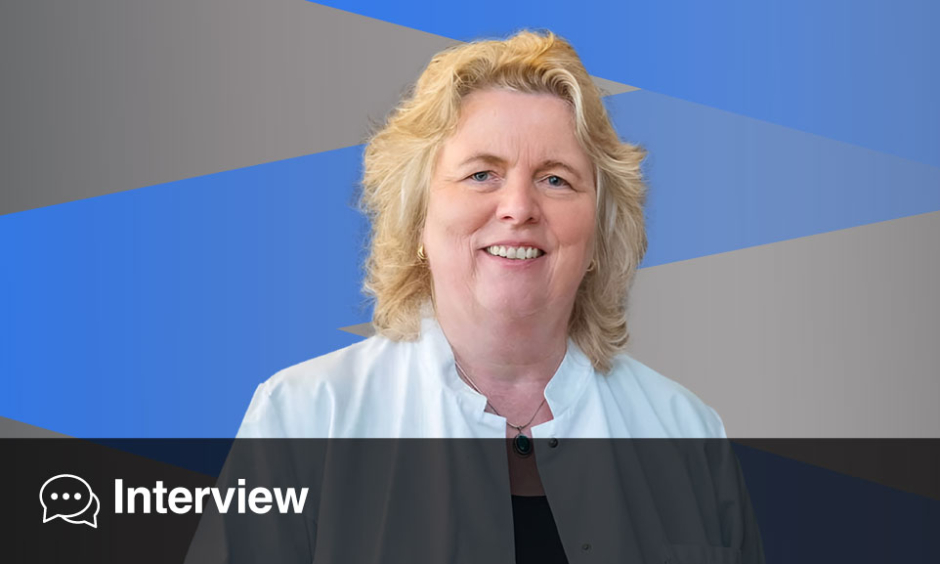
Nadia Harbeck | Director, Breast Center, LMU University Hospital, Munich, Germany.
Citation: EMJ Oncol. 2026; https://doi.org/10.33590/emjoncol/244OAUJ2

From your perspective, what were the most clinically impactful data presented at the European Society for Medical Oncology (ESMO) Asia 2025 Congress across oncology disciplines?
Maybe I’m prejudiced because I was one of the speakers, but I think the ESMO Congress highlights that we selected and the original speakers brought from the main ESMO Congress were the highlights, because we had some breakthrough advances in oncology that we featured at the ESMO Congress in Berlin, Germany, last year. But also, in the highlight session, for example, for breast cancer, we had the DESTINY-Breast11 study, which was the first time that trastuzumab deruxtecan was used in the neoadjuvant, i.e., in the curative setting. Also, we featured the TROPION-Breast02 study, which looked at first–line datopotamab deruxtecan in patients with triple–negative disease without an indication for immunotherapy. So, those were my highlights, because I think they’re globally applicable, although there will be differences in access and speed of access in the individual countries.
ESMO Asia often brings regional practice patterns into focus. Which studies or discussions at ESMO Asia 2025 do you feel were particularly relevant for clinical practice across Asia Pacific healthcare settings?
There are some scheduled parts in the ESMO Asia Congress that we do every year, and I think these are also important. For example, we have discussion sessions on the Pan-Asian adaptations of the ESMO guidelines, the Pan-Asian Guidelines Adaptations (PAGA), with the Asian authors and some European authors, where we go through the new guidelines and feature the highlights. I think that is a regional practice highlight. The keynote lecture last year, by Elaine Poon from Singapore, focused on early-onset cancers in young adults and what is specific to treating young adults in the supportive care area.
I think these were highlights that showed us where problems in the regions lie, but also gave us some solutions. There was also a specific session on palliative care, looking at ESMO guidelines, but also looking at what’s available regionally. So, I think we try to make the Congress interesting, both from a point of view where we look at what is specific for Asia in clinical management and clinical practice, but then also look at data that is very interesting for the region.
For example, in some of the mini oral sessions, we looked at large international trials, but looked at Asian subgroups, in particular, and looked at patient-reported outcomes in the Asian context. So, trying to give the audience an idea of what the situation is in their environment.
You served on the Steering Scientific Committee for ESMO Asia 2025 as Education Co-Chair. How do the educational priorities and learning objectives of ESMO Asia differ from those of the main ESMO Congress?
We have a steering committee, we have the conference chairs, and it’s usually one European colleague and one Asian colleague. From that, we try to find topics in the educational programmes, which we do a little bit earlier than the scientific programme. We’ve tried to find topics that are interesting for the Asian community, be it certain types of patients with cancer, for example, the keynote lecture with the young adults. Also, for example, in the breast cancer session, we looked at young patients and the optimal therapy for young patients, but we also looked at fertility issues. We try to pick up what is important in Asia and then try to build the programme around this. We have a scientific committee consisting of disease–specific working groups, and they put together their disease–specific programme. Then we add the most important abstracts and try to see which ones we can place in orals, mini orals, or poster sessions.
For clinicians who may not be familiar with the process, could you describe how the scientific and educational programme for a congress, such as ESMO Asia, is developed?
We have two committees: an educational committee with two co-chairs, whose names you can find from last year’s programme, and then we have the Scientific Committee. The Scientific Committee makes sure that there is a balance between Europe and Asia among the speakers who are invited because we want to hear as many voices as possible, and the Congress shouldn’t be dominated by a certain region or a certain disease entity. Next to these disease–specific areas, we also try to integrate novel topics, like AI or biomarkers, etc. We also try to have sessions where we look at ESMO frameworks, for example, in precision medicine and AI large language models, and we try to get the Asian perspective on that.
Translational research remains a cornerstone of ESMO meetings. Which laboratory to clinic insights presented at ESMO Asia 2025 stood out to you as having the greatest future clinical potential?
I think we try to include translational research and attract abstracts with translational research, and try to integrate that into the programme, but we also have colleagues talk about biomarkers from a more modern point of view in precision medicine, because that topic is really thriving in Asia. There is some really good research coming out of Asian cancer centres. We’re looking at tumour characteristics, and also how to implement AI into the process of making the most out of these biomarkers.
We had a session where we talked about the development of novel therapeutics, where we looked at both the novel medicines, as well as the precision medicine that goes along with that.
We also had a joint session with the American Association for Cancer Research (AACR), where we looked at early drug development, next-generation sequencing testing, AI biomarkers, and precision oncology, and discussed that from a European point of view, but also in the context of Asian countries. So, I think some Asian countries may start to implement that. I think that it is very important to run what is ‘state-of-the-art’ by our colleagues, so they can see how they can implement that in their home countries. You cannot transfer results from European to Asian countries, one to one, but you can pick the things that are easy to implement, and I think that is what is important about these sessions.
ESMO Asia 2025 saw more than 4,500 participants, over 170 speakers, 71 scientific sessions, and more than 940 submitted abstracts. Why do you think this Congress continues to grow and remain a landmark event in oncology?
I think it’s important to have a Pan-Asian cancer Congress, and I think that the strengths of ESMO Asia brings together the strengths of ESMO as an international society, which has developed beyond being just a European society. Now, I think, as of the end of last year, we hit 50,000 members, and one-third of these members are from Asia. I think our colleagues have to come together in Asia. The new drug development is very strong in Asia, and so is precision medicine, and I think it’s important that colleagues from Asia realise their strength. I think ESMO Asia is quite a good vehicle to talk about advances internationally but also advances from the region.
I think it’s attractive for our colleagues because they see the newest science. They can also get access to the ESMO highlights. Some of them may not have been able to travel to Europe for the ESMO Congress, so to be able to talk to the speakers from the main ESMO Congress in Singapore is a very good way of bridging the gap between the continents and bringing the most important clinical advances to Asia. We are also looking at Asia-specific subgroup analysis; there are different toxicity patterns in Asian patients, and they are usually younger than European patients. So, there are a lot of things we have to look into to make sure that the data we present at major conferences are also applicable to the Asian population.
Lastly, I think there is also a big educational component there. As I said before, we talk about the guideline adaptations, and that’s different. Every year, ESMO guidelines are going to be adapted with all the Asian societies into the PAGA guidelines. Discussing that and seeing what is relevant for their own therapeutic context is, I think, what makes this Congress a success. The number of participants has grown over the years, and I think that we found the right balance between education and science, but also featuring ESMO achievements that resonate with the audience in Asia.
Education and guideline dissemination were key themes at ESMO Asia 2025. Were there any guideline updates or educational messages that you believe are particularly important for clinicians to take back into daily practice?
At ESMO Asia, we had lung cancer, hepatocellular carcinoma, and pancreatic carcinoma. So, there are some differences in genetics and biology, but also in practice between Western countries and Asian countries. I think that highlighting these differences, but also making sure that global advances, such as new drugs that work independent of patient ethnicity, are supported in their implementation in the individual countries.
I think, this year, one of the guidelines will be for metastatic breast cancer. So, we change the topics and make sure that the most recent tumour guidelines from ESMO are adapted in Asia, if the tumour entity itself is relevant for Asian countries. These are very strong sessions. And Asia is not just one country; it’s many diverse countries with different health technology assessment systems. So, I think what we’re aiming at is also using that as a little bit of political pressure to say, these are the advances that need to be prioritised on a country level because they change the fate of the patients, and these are advances that may be expensive and may not be such a high priority.
Looking ahead, which research gaps or unmet clinical needs highlighted at ESMO Asia 2025 should help shape the next generation of oncology trials globally?
We’ve seen some really exciting drug development trials coming out of mostly China: new antibody–drug conjugates, new small molecules, etc. I think it’s important that we find a way to take these interesting molecules global at a very early stage. So, that’s why I think it’s important to discuss early phases, and then, together with the industry, create worldwide uptake of these novel drugs so we don’t have redundant development, but take the most promising agents forward, no matter where they have been discovered and where they come from. I think that’s an interesting point.
I think we’re also seeing, and I can talk as a breast cancer expert, these two practice-changing studies that we presented at ESMO: DESTINY-Breast11 or DESTINY-Breast05. About half of the patients were from Asia, the rest were from Europe, and then from the USA. So, in this global drug development, we’re also seeing more Asian patients in these trials. So, I think what we need to focus on is the specific efficacy, but also toxicity patterns that evolve, and we must look at that early. ESMO Asia gives us a very good context: in these proffered paper sessions or mini oral sessions, we can look at the Asian populations from these large international trials, and then we can also see which drugs are most feasible to be implemented in this context. I think young patients with cancer is also something that will resonate with future ESMO Asia congresses, because that is something where the situation in Asian is somewhat distinct from what we see in Europe.