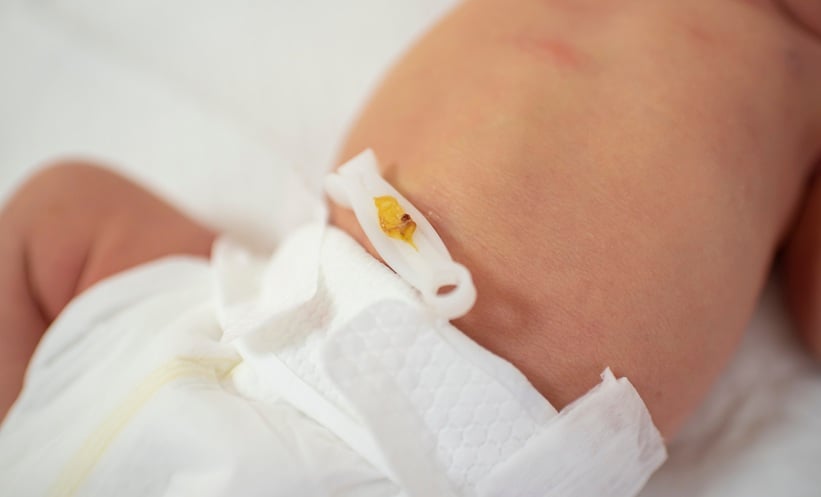
APPLYING antiseptics to the umbilical cord likely reduces the risk of cord infection and may reduce neonatal mortality in low- and middle-income countries, a 2026 systematic review and meta-analysis has found.
Topical application of 4.0% chlorhexidine to the cord, however, probably delays separation by around 2 days.
Importance of Umbilical Cord-Care
The umbilical cord, when cut after birth, usually dries and falls off on its own within 5–15 days.
During this period, the area can easily become colonised by bacteria from the infant’s skin or environment, researchers reported.
As the stump contains dead tissue, bacteria can grow and cause omphalitis.
In extreme cases, this can develop into septicaemia.
Chlorhexidine Results
The review included 143,150 newborns in both low- and high-income settings.
In low- and middle-income settings, it was found that applying chlorhexidine: may reduce the risk of newborn deaths by around three per 1,000 live births, likely reduces cord infections by 25 per 1,000 live births, and increases average time for the cord stump to fall off by approximately 2 days.
In high-income countries, chlorhexidine exhibited uncertain evidence around cord separation time and was not studied for the prevention of newborn deaths.
70% Alcohol Results
In low- and middle-income countries, 70% alcohol was not studied in terms of mortality and gave uncertain evidence surrounding cord infection and time taken for the cord to fall off.
In high-income countries, however, 70% alcohol likely increased the average time for the stump to fall off by nearly 2 days.
Implications for Neonatal Care
Current evidence overall supports the use of chlorhexidine as an effective antiseptic for preventing cord infection in neonates, researchers reported.
This is particularly apparent in settings where neonatal mortality and infection risk are high.
Alternatively, in setting with a low risk of infection, clean and dry cord-care is still an effective approach.
Researchers, therefore, suggested that clinicians should consider local epidemiology, availability of health services, and existing newborn-care practices when assessing the benefits of antiseptics in this context.
Reference
Imdad A et al. Umbilical cord antiseptics for preventing sepsis and death among newborns. Cochrane Database Syst Rev. 2026;DOI:10.1002/14651858.CD008635.pub3.
Featured image: Ruslan Russland on Adobe Stock