Oral Glucocorticoid Treatment for Checkpoint Inhibitor Associated Inflammatory Arthritis Does Not Affect Progression Free Survival: A RADIOS Registry Cohort Study - European Medical Journal

This site is intended for healthcare professionals

Oral Glucocorticoid Treatment for Checkpoint Inhibitor Associated Inflammatory Arthritis Does Not Affect Progression Free Survival: A RADIOS Registry Cohort Study

1 Mins
Rheumatology
Download PDF
Authors:
* Deanna Jannat-Khah , 1 Pankti Reid , 2 Maria Suarez-Almazor , 3 Noha Abdel-Wahab , 3 Jeffrey Sparks , 4 Tawnie Braaten , 5 Cassandra Calabrese , 6 Alexa Meara , 7 Minerva Nong , 8 Kyle Ge , 1 Laura Cappelli , 9 Ami Shah , 10 Clifton Bingham , 11 Anne R. Bass 1
  • 1. Hospital For Special Surgery, New York, USA
  • 2. University of Chicago Medical Center, Ilinois, USA
  • 3. MD Anderson Cancer Center, Houston, Texas, USA
  • 4. Brigham and Women's Hospital, Boston, Massachusetts, USA
  • 5. University of Utah, Salt Lake City, USA
  • 6. Cleveland Clinic Foundation, Cleveland Heights, Ohio, USA
  • 7. The Ohio State University Wexner Medical Center, Columbus, USA
  • 8. Columbia University, New York, USA
  • 9. Johns Hopkins University School of Medicine, Baltimore, Maryland, USA
  • 10. Johns Hopkins Rheumatology, Baltimore, Maryland, USA
  • 11. Johns Hopkins University, Baltimore, Maryland, USA
*Correspondence to [email protected]
Disclosure:

Shah has received a grant from the National Institutes of Health, with payments to his institution. Meara has received consulting fees from Abbvie, Sanofi, Astrazeneca, and Amgen; support for attending meetings from Abbvie, Sanofi, and Amgen; payments for expert testimony from Davis, Levin, and Livingston; and is a board member for the Foundation for Autoimmune Cancer Support. Cappelli has received consulting fees from Bristol Myers Squibb, Abbvie, Amgen, and Sanofi. Calabrese has received consulting fees and honoraria from Sanofi-Regeneron. Bass is treasurer for the American College of Rheumatology and Rheumatology Research Foundation. Jannat-Khan has declared a Discovery Grant to the Hospital for Special Surgery Department of Medicine; has received a travel award from the ACR/EULAR research exchange program; participated in two data safety monitoring boards: Phase II Trial of Abaloparatide vs. Placebo in Post-Menopausal Women Receiving Initial Spinal Fusion Surgery, and Topical Epidural Steroid Usage in Patients Undergoing Posterior Lumbar Decompression: A Randomized Control Trial; is a member of the ACR Committee on Registries and Health Information Technology (RHIT), ACR RHIT representative on the ACR Annual Meeting, and member of the ACR subcommittee on Publications and Research; and has stock in Cytodyn and Astrazeneca. Abdel-Wahab has received a grant from the National Insitutes of Health/National Institute of Allergy and Infectious Diseases; received institutional support from The University of Texas MD Anderson Cancer Center (2018–July 2025), including the Cancer Survivorship Seed Fund, Institutional Research Grant, Prioritizing Research Innovation & Mentoring Excellence Award, Division of Internal Medicine Development & Translational Science Award, Bridge Funding Award, Cyrus Scholar Award for Outstanding Clinical Research, Melanoma SPORE Career Enhancement Program Award, and the Melanoma Boat Walk Seed Fund, for research around the subject matter; has participated in advisory boards, consulted, and received honoraria from ChemoCentryx; and is a Chair of the Alliance for Clinical Trials in Oncology Immuno-Oncology Toxicity (IOTOX) Working Group & Executive Committee Member of the Alliance for Support and Prevention of Immune-Related adverse Events (ASPIRE), unpaid. Bingham has received consulting fees from Abbvie, Avalo, BMS, Eli Lilly, Janssen, Pfizer, Sanofi, and Tonix; participated on Boards for Eli Lilly; and is President Elect of the PROMIS Health Organization. Sparks has received grants from the National Institute of Arthritis and Musculoskeletal and Skin Diseases, National Heart, Lung, and Blood Institute, Rheumatology Research Foundation, Arthritis Foundation, R. Bruce and Joan M. Mickey Research Scholar Fund, Gordon and Llura Gund Foundation, Bristol Myers Squibb, Boehringer Ingelheim, Johnson & Johnson, and Sonoma Biotherapeutics; and consulting fees from Abbvie, Amgen, Anaptys, AstraZeneca, Boehringer Ingelheim, Bristol Myers Squibb, Fresenius Kabi, Gilead, Inova Diagnostics, Invivyd, Johnson & Johnson, Merck, MustangBio, Novartis, Optum, Pfizer, Recor, Sana, Sobi, and UCB. Suarez-Almazor has received a grant from Novartis, unrelated to this paper; and consulting fees from Syneos Health and Set Point Medical. The other authors have declared no conflicts of interest.

Citation:
AMJ Rheumatol. ;2[1]:38-40. https://doi.org/10.33590/rheumatolamj/EASZ3104.
Keywords:
Cancer, glucocorticoids, Immune checkpoint inhibitors (ICI), inflammatory arthritis (IA), rheumatology.

Each article is made available under the terms of the Creative Commons Attribution-Non Commercial 4.0 License.

BACKGROUND AND AIMS

Immune checkpoint inhibitors (ICI) are efficacious treatments for various cancers. As approvals for ICI treatment increase for additional cancers, the prevalence of rheumatologic immune related adverse events (irAE) also grows. First-line treatment for these irAEs is glucocorticoids; however, there is a lack of standardization in dosing, tapering, and duration of treatment. There are varying results published on ICI-treated patients on the association of oral glucocorticoids on progression-free survival (PFS).1

MATERIALS AND METHODS

Data from a prospective USA multi-center rheumatic irAE cohort (RADIOS) were utilized. Inclusion criteria for this study were the following: patients enrolled since February 2023; treated with an ICI for cancer; diagnosed with ICI-inflammatory arthritis (ICI-IA), defined as inflammatory arthritis, arthralgia, or polymyalgia rheumatica; and treated with glucocorticoids. Patients with pre-existing autoimmune disease, or treatment for another irAE with glucocorticoids, were excluded. Data on demographics, cancer and cancer treatment, disease-modifying anti-rheumatic drugs, and glucocorticoid treatment were collected. Glucocorticoid dosage was converted to prednisone equivalents. Cumulative glucocorticoid exposure and the average daily prednisone dose was calculated at different time points and displayed in a box plot. Descriptive statistics were performed. Thirty-day landmark Kaplan-Meier plots were drawn to investigate glucocorticoid treatment and cancer progression using time from glucocorticoid initiation to radiographic cancer progression or death (PFS). Time-varying Cox proportional hazard models were also performed using time from ICI initiation to glucocorticoid treatment. Adjusted models included the following covariates: age, irAE grade at baseline, cancer type (melanoma, non-small cell lung cancer, renal cell cancer), cancer stage, and ICI combination therapy.

RESULTS

The analytic cohort consisted of 206 patients with a mean age of 65 years (SD: 12.36), 48.5% were female, and 85.9% were White (Table 1). The most frequent cancers were melanoma (32.5%), renal cell cancer (18.4%), or non-small cell lung cancer (11.7%), and were Stage 3 (26.7%) or 4 (58.3%). Time from ICI-IA diagnosis to glucocorticoid initiation was a median of 24.5 days (interquartile range: 3–63). Median time from glucocorticoid initiation to cancer progression was 82.5 days (interquartile range: 70–283) among the 46 patients (22.3%) who progressed. In a landmark Kaplan-Meier curve the median glucocorticoid dose in the first month of treatment was not associated with PFS (log-rank p value 0.99). Similarly, using quartiles of glucocorticoid dose, there was also no association between glucocorticoid use and PFS (log rank p value 0.31). Lastly, all of the adjusted Cox models were not significant.
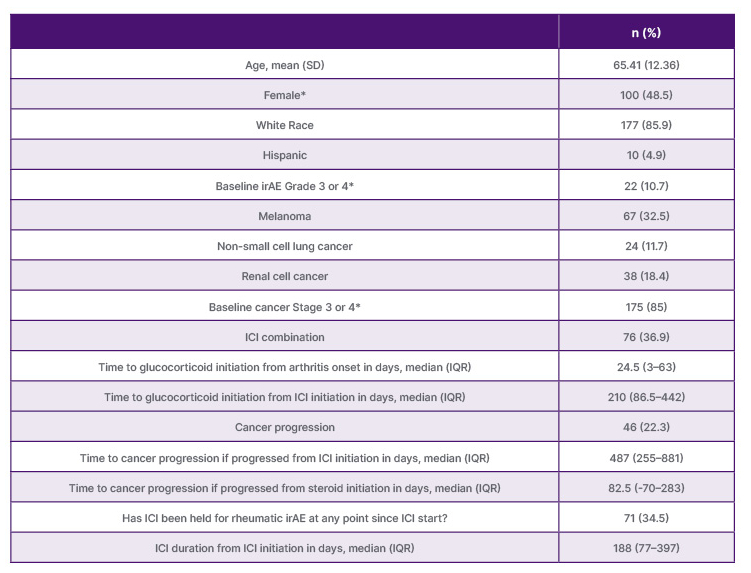
Table 1: Demographic and cancer characteristics (N=206).
*Missing data: N=1 for female; N=40 for baseline irAE grade; N=17 baseline cancer stage.
ICI: immune checkpoint inhibitor; IQR: interquartile range; irAE: immune related adverse events.

CONCLUSION

Using data from RADIOS, the authors found no association between glucocorticoid treatment and PFS in patients with ICI-IA. Rheumatologists often prescribe glucocorticoids at lower doses than oncology guidelines recommend. These findings suggest that glucocorticoid treatment by rheumatologists for ICI-IA may not have a substantial impact on cancer outcomes.


References
Jannat-Khah D et al. Oral glucocorticoid treatment for checkpoint inhibitor associated inflammatory arthritis do not affect progression free survival: a RADIOS Registry cohort study. Abstract 1730. ACR Convergence, October 24-29, 2025.

Rate this content's potential impact on patient outcomes

Average rating / 5. Vote count:

No votes so far! Be the first to rate this content.