Abstract
Introduction: Blue toe syndrome (BTS) manifests as a sudden onset of blue/violaceous discoloration on the toe that is often associated with pain. The etiology of this condition is multifactorial, but it is distinguished by its occurrence in the absence of trauma or generalized cyanosis. The differential diagnosis of BTS can include factors such as vascular obstruction, autoimmune conditions, hyperviscosity syndromes, infections, drug-induced occurrences, and vasospasm. The authors describe a case of a 71-year-old female who presented with a 2-year history of bilateral toe cyanosis and was found to have positive c-anti-neutrophil cytoplasmic antibody (ANCA) with high titer proteinase 3 (PR3; 735 mean fluorescence unit), Type III cryoglobulinemia, and positive cryofibrinogen. She had no other symptoms associated with ANCA vasculitis. Further rheumatologic workup was unremarkable, including investigations for atheroembolic disease and infections. The patient was prescribed azathioprine with near complete resolution of symptoms within 1 year.
Methods/Results: To further understand this condition, the authors performed a literature review of PubMed/Scopus/Medline using the following combination of keywords: “vasculitis” AND (“Blue” OR “purple” OR “cyanosis” OR “necrotic” AND “toe”). This search yielded only one other case of this manifestation.
Conclusion: In this report, the authors identify, to the best of their knowledge, the first documented case of PR3-ANCA vasculitis presenting with BTS as the sole and primary manifestation.
Key points
1. The authors aim to raise awareness in the medical community about atypical presentations of ANCA-associated vasculitides, and in this case, how it can present solely as Blue Toe Syndrome.2. The authors presented a case of a 71-year-old female with the first documented case of PR3-ANCA vasculitis presenting with Blue Toe Syndrome as the sole and primary manifestation.
3. The report highlights the importance of a careful history and physical examination, in addition to discriminatory laboratory tests as the differential diagnosis is quite broad but can present with a very similar clinical picture.
INTRODUCTION
Blue toe syndrome (BTS) presents as a sudden development of localized blue or purple discoloration of one or more toes, typically associated with tenderness.1 The phenomenon arises from diverse underlying causes and is distinguished from generalized cyanosis or trauma-related change.2 Other conditions resulting in generalized cyanosis can lead to this clinical presentation but, importantly, pedal pulses are preserved.3 When a patient presents with blue/purple toes, in keeping with the diagnosis of BTS, it is important for clinicians to perform a careful history and physical examination in addition to discriminatory laboratory tests, as the differential diagnosis is quite broad but can present with a very similar clinical picture. The differential diagnosis for BTS can be thought to encompass multiple different etiologies that include autoimmune conditions.2,4 The authors describe what appears to be the first reported occurrence of BTS serving as both the initial and exclusive manifestation of the leukocyte protein proteinase 3 (PR3)-anti-neutrophil cytoplasmic antibody(ANCA)-associated vasculitis. While ANCA-associated vasculitis often presents with palpable purpura, ulcers, and splinter hemorrhages, BTS is only occasionally part of the clinical presentation.5
CASE PRESENTATION
A 71-year-old East-Asian female presented with a 2-year history of constant bilateral cyanosis of all toes (Figure 1A-B), not influenced by temperature changes. Her medical history was significant for deep venous thrombosis (unprovoked, left leg), dyslipidemia, hypertension, osteoporosis, baker’s cysts, osteoarthritis, and rotator cuff tendinopathy. Her family history was non-contributory. She reported minimal alcohol exposure and no history of smoking or recreational drug use. She reported a burning sensation and one episode of blistering on the right second toe (Figure 1C). These symptoms preceded the COVID-19 pandemic. She denied finger involvement, erythromelalgia, or other rashes. There were no signs of ANCA-associated vasculitis, including no constitutional symptoms, sinusitis, hemoptysis/cough, palpable purpura, hematuria, frothy urine, or neurologic symptoms. She had tried acetylsalicylic acid 81 mg without improvement and nifedipine 30 mg with mild relief before seeking rheumatological evaluation.
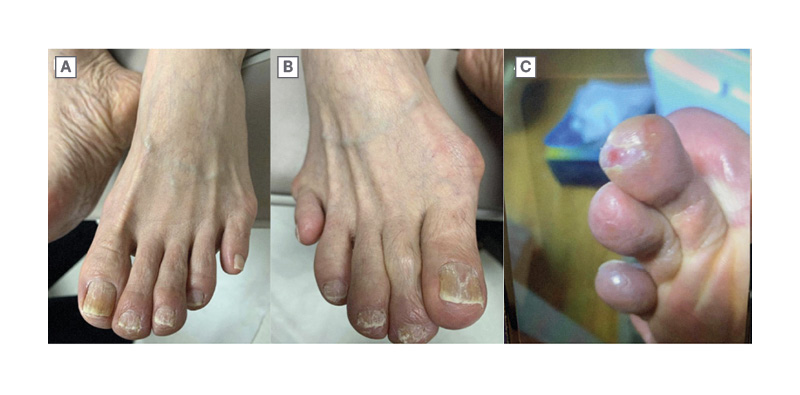
Figure 1: Blue toe syndrome in a patient with proteinase 3-anti-neutrophil cytoplasmic antibody vasculitis.
This figure illustrates blue toe syndrome in a patient with PR3-ANCA vasculitis, as described in the case report. (A) and (B) depict bilateral toe cyanosis, while (C) shows the blistering episode on the right second toe. All photos were taken before initiating treatment with azathioprine.
ANCA: anti-neutrophil cytoplasmic antibody; PR3: proteinase 3.
Her laboratory investigations were remarkable for positive c-ANCA with a high titer PR3 of 735 mean fluorescence unit, confirmed by two separate tests (assessed via multiplex bead immunoassay). Other rheumatologic investigations, including antinuclear antibody, extractable nuclear antigens, rheumatoid factor (tested multiple times), anti-cyclic citrullinated peptide, anti-double stranded DNA, scleroderma panel, and anti-phospholipid antibodies, were negative. There was no evidence of monoclonal protein on protein electrophoresis, and quantitative Ig measurements showed a low IgM level. The complement system was not evaluated. No abnormalities were noted on a chest CT; specifically, there was no evidence of interstitial lung disease, and no mediastinal, hilar, or neck lymphadenopathy. Ophthalmological assessment ruled out uveitis. General chemistry parameters, including creatinine, urinalysis, C-reactive protein, creatine kinase, and coagulation profile, were within normal limits.
She was found to have Type III cryoglobulinemia and positive cryofibrinogen. Both were weakly positive, with a cryocrit <5%. Quantitative measurement in g/L was not provided by the laboratory. Hematology was consulted for a full workup of her positive cryoglobulins, which were all unremarkable. The patient denied a skin biopsy. There was no underlying connective tissue disease and no hepatitis or HIV infection. She did not have an assessment of her complement levels given the absence of clinical signs or laboratory findings indicative of underlying connective tissue disease or cryoglobulinemic vasculitis. The patient declined a bone marrow biopsy, although she did have a low pre-test probability of underlying hematologic malignancy.
Although her disease was limited to her toes, she was eventually started on azathioprine due to concerns about developing systemic features. She was seen in follow-up after a year of being on azathioprine 75 mg with a significant decrease in cyanosis of her toes and a decrease in PR3 titer to 3.7. She was only experiencing intermittent cyanosis of the right second toe.
METHODS
For determination of prior case reports, the authors performed a review of Medline/PubMed/Scopus using the following combination of keywords: “vasculitis” AND (“Blue” OR “purple” OR “cyanosis” OR “necrotic” AND “toe”). The search included studies published from the database inception to December 2023. The authors also searched for other cases by reviewing the references of relevant papers. Cases were reviewed and the ones that had cyanosis of the toes, in addition to other vasculitic manifestations, were excluded. Cases with blue toes secondary to connective tissue disease, COVID-related cases, drug-induced cases, and cases with ischemia-related to arterial disease were excluded.
RESULTS
A total of 60 results were retrieved and, after removing duplicates, 25 unique results remained for the initial title and abstract screening. Of the 25 studies screened, six reports described vasculitis blue toe case reports. In these cases, two studies described BTS as the initial, but not the sole, manifestation of PR3-ANCA vasculitis.
DISCUSSION
BTS can result from numerous etiologies that produce nearly identical clinical features; however, the authors’ report describes what they believe to be the first instance of PR3-ANCA-associated vasculitis presenting exclusively with BTS and no extracutaneous manifestations. Two other published cases have described BTS as the initial sign of PR3-ANCA vasculitis; however, these instances differed as the patients progressed to have other manifestations such as mononeuritis multiplex, renal impairment, and hemorrhagic sinusitis.6,7 In contrast, the authors’ patient’s presentation remained confined to her toes, without involvement of other organs, highlighting the unusual and noteworthy nature of this case. The differential diagnosis for BTS encompasses a wide range of vascular and inflammatory conditions, including embolic, thrombotic, vasospastic, autoimmune, and drug-induced etiologies. The authors’ differential diagnosis was guided by a systematic framework for evaluating BTS.2 In this case, the patient did have a history of a previous deep vein thrombosis, as well as risk factors such as dyslipidemia and hypertension. However, several features argued against an embolic or occlusive process: the patient’s peripheral pulses were intact, vascular imaging revealed no evidence of an occlusive disease such as atheroembolism, and there was no history of vascular procedures or endocarditis. Additionally, the patient’s lifelong nonsmoking status made thromboangiitis obliterans an unlikely diagnosis. Although the patient also had positive cryoglobulins, the authors were not suspicious of this being the culprit as these findings were not consistent with clinically significant cryoglobulinemic vasculitis. Mixed cryoglobulinemia typically correlates with temperature-dependent symptom fluctuations and elevated rheumatoid factor, neither of which were part of this clinical presentation.8 This aligns with current literature cautioning against labeling patients with low-level cryoglobulin positivity as having true cryoglobulinemic disease.9,10
After a 2-year history of constant bilateral cyanosis of all toes, the patient was started on azathioprine. To date, the patient still has no systemic features and only experiences intermittent cyanosis of the right second toe. The presence of a high-titer PR3-ANCA, confirmed on two separate occasions, in conjunction with the absence of secondary causes and marked improvement on azathioprine therapy, further corroborates the diagnosis of PR3-ANCA–associated vasculitis presenting solely as BTS.
PATIENT PERSPECTIVE
Dealing with persistent blue discoloration in my toes for 2 years has been frustrating. The burning sensation and blistering were alarming, especially since they started long before the pandemic. Despite trying medications like aspirin and nifedipine, I found little relief. Seeking help from Dr Yacyshyn was a turning point for me.
Starting treatment with azathioprine brought me hope. After a year, I noticed significant improvement, with much less discoloration. While I still experience occasional symptoms, I’m grateful for the progress I’ve made. I’m also thankful that my experience is being shared to inform other clinicians, as it comforts me to know my journey might help others facing similar challenges.
CONCLUSION
BTS is a cutaneous manifestation with a broad list of differential diagnoses, including vasculitis. Before the diagnosis can be made, a clinician should be suspicious of an underlying malignancy, infection, and conditions that predispose patients to an embolus or thrombus, as well as factors such as drug-induced BTS. The patient case reported here also encourages clinicians to consider rare presentations of known causes of BTS.