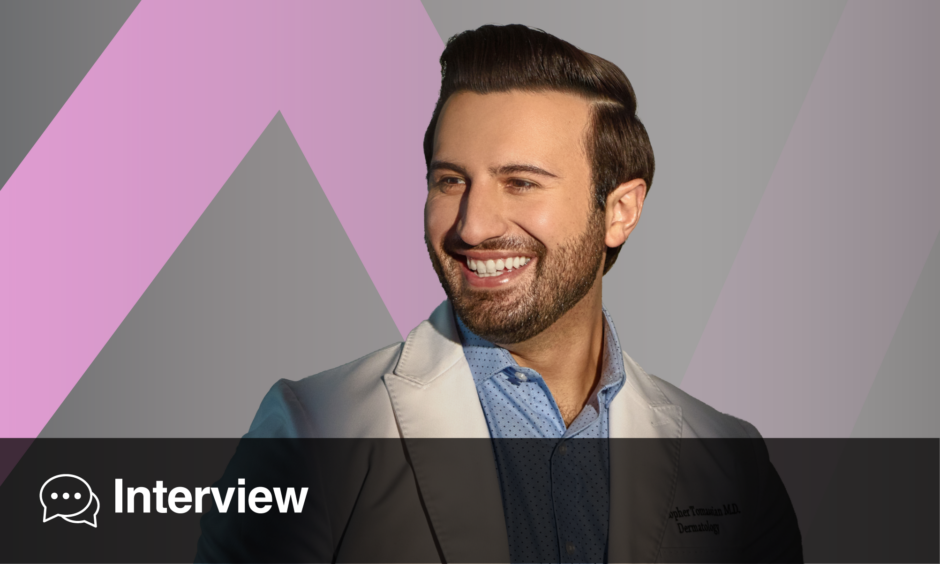
Christopher Tomassian Founder/CEO, The Dermatology Collective, Glendora, California, USA
Citation: Dermatol AMJ. 2026; https://doi.org/10.33590/dermatolamj/0H3512J8

What drew you into dermatology? How did your training at the University of Kansas Medical Center, Kansas City, USA, where you served as Cosmetic Chief and were later recognized as Best Dermatologist in Kansas City, shape your clinical philosophy going into private practice?
Dermatology has always been a specialty I’ve been drawn to because of its variety and the hands-on skill set it demands. Unlike many conditions in medicine, dermatologic disease is visible and having the knowledge to look at something, quickly diagnose it, and treat it was deeply appealing to me. The blend of cosmetics and surgery also made for a career that was never dull and was always evolving.
My residency training prepared me well for private practice. We were seeing 45–50 patients a day in a setting that functioned much like a private office, so the transition felt natural. I was fortunate to train under one of the best dermatologists I’ve encountered, Anand Rajpara, Department Chair of Dermatology, University of Missouri–Kansas City, USA, who shaped not only how I approach clinical care but how I connect with patients. His bedside manner was something I studied closely and carried with me.
I always knew I wanted to be in private practice, even before training began. That clarity pushed me to be intentional throughout residency, paying attention to what worked, what didn’t, and what I would do differently. My goal was always to have full ownership of the patient experience and to redefine what “going to the doctor” could and should feel like.
Having opened a private practice shortly after residency, what are the most consequential operational mistakes you made early on, and what advice would you give dermatologists who want to grow their practice while maintaining evidence-based patient care?
Hire slow, keep your team lean, and always keep margins in mind. When I first started my practice, I wanted all the newest lasers and a full team, but you can put yourself in a financial hole very quickly.
For any new dermatologist looking to open a practice, my advice is this: first, learn the business. Understand your baseline costs and know what every supply and material is running you: this is non-negotiable. Second, hire key team members intentionally and build a standard operational procedure that clearly defines your expectations for each role. This keeps both you and your staff accountable. Third, get out into your community and network. It may feel old-fashioned, but it’s still one of the most powerful things you can do. I recommend personally visiting every local personal care provider in your area, asking to speak directly with the physician, handing them your phone number, and telling them to text you anytime they need a patient seen urgently. That single habit was instrumental in building my practice.
You built an impressive TikTok (Los Angeles, California, USA)/Instagram (Meta Platforms, Menlo Park, California, USA) audience that centers around patient education. How do you ensure that short-form content is translated into measurable clinical benefit (e.g., better adherence, triage, fewer unnecessary visits)?
I always made my content not to replace a doctor’s visit, but to give patients a chance to try to improve their skin with evidence-backed products and ingredients. The more value you give to a patient online, the more they want to come and see you in person.
What safeguards do you use to maintain scientific accuracy and mitigate ethical concerns and criticism on short-form content?
At the end of the day, social media is an extension of what I do, but my primary role is as a dermatologist, and that keeps me grounded. I try to keep my short-form content fun and engaging while making sure it’s always evidence based. When I make a mistake or recommend a product that turns out to have issues, I own it and I’m transparent with my audience. It takes years to build authority and seconds to destroy it.
Which recent advances in energy-based therapies have meaningfully impacted how you approach treatment decisions, and where do you see the next substantive shifts coming from?
I don’t think there’s been a dramatic shift in energy-based technologies themselves, but what’s producing more meaningful results is how we’re combining them. Using ablative, non-ablative, vascular, and picosecond technologies together allows us to give patients a truly global improvement in their skin rather than addressing one concern at a time.
There continues to be a clear shift toward non-invasive, minimal-to-no-downtime procedures like radio frequency and ultrasound technology. What I’m most excited to see is how these platforms begin incorporating AI software to make treatments more seamless, more personalized, and, ultimately, more effective.
When working with brands and media, what is your decision framework for endorsing products or participating in sponsored content so that recommendations remain evidence-based and ethically sound for both colleagues and patients?
I only work with brands and, more specifically, products I believe in, use myself, and would normally recommend to my patients in the clinic. It is easy to get carried away with opportunities from companies, especially when you start, but if you want to keep your authority in the space you have to make sure that what you are promoting is legitimate.
For dermatology clinicians who want to build a patient education or digital outreach program from their practice, what safeguards are essential to ensure online content remains medically accurate, ethically responsible, and beneficial for patient care?
Every physician today should have some presence on social media; the need to combat misinformation alone makes it worth it. The guardrails are simple: be professional, be ethical, and remember that you are always in control of what you put out into the world. The internet is forever, so be deliberate. And if you’re sharing any patient photos, always secure both verbal and written consent, no exceptions.