Abstract
Allergic reactions associated with sexual activity are under-recognised and have been primarily attributed to vaginal contact with seminal glycoprotein or a contaminating drug or food. The authors describe a case of anaphylaxis in a woman following oral contact with her husband’s semen, despite having previously tolerated such exposure without adverse reactions. This incident occurred while the husband was receiving cephalexin therapy. She has a history of respiratory allergy and urticaria to penicillin. The evaluation included skin testing with penicillin reagents, cefazolin solution, and her husband’s seminal plasma. The couple consented to further investigation by having the husband taking cephalexin for 2 days, and the drug level was measured in his serum, urine, and seminal plasma before and after administration. The wife’s skin test results were positive for penicillin but negative to cefazolin and her husband’s seminal plasma. Cephalexin was undetectable in the husband’s serum, urine, and seminal plasma samples obtained before the drug administration. Post-administration specimens showed high concentrations in the urine, followed by a lower concentration in the serum. However, the drug was below the detectable level in the seminal plasma (the assay’s sensitivity was 6.25 µg/mL). The patient was counselled regarding preventive measures whenever her husband takes penicillin or first-generation cephalosporins. To the best of the authors’ knowledge, this seems to be the first reported case of allergy in a woman with oral exposure to semen contaminated with cephalexin. Healthcare providers should be aware of allergic reactions associated with oral sex, and that the causative allergen may not be the seminal plasma glycoprotein but a contaminating drug or food. Other potential causes include environmental substances or factors related to intimate interaction.
Key Points
1. Allergic reactions associated with intimate behaviours are markedly underdiagnosed and rarely reported, suchthat patients may not reveal or suspect a relationship between their allergic reactions to sexual activity.
2. The anaphylaxis reaction presented here was believed to be associated with oral exposure to semen from a partner receiving cephalexin.
3. Whenever the cause of an acute allergic reaction is not obvious, the differential diagnosis should include the potential route of oral sex that warrants greater clinical awareness.
INTRODUCTION
Hypersensitivity reactions associated with intimate sexual activity are probably underdiagnosed and frequently go undiagnosed. Reported cases have most commonly occurred following vaginal intercourse, with the causative allergen typically identified as the seminal plasma glycoprotein and less frequently as a contaminating drug or food excreted in semen.1,2 Allergic reactions may also occur through kissing by drug or food allergens in the saliva of a non-allergic partner.3 A particularly unrecognised route of exposure is fellatio, as illustrated by the present case. Compared with other common allergic disorders, hypersensitivity reactions related to intimate sexual activity may have substantial psychosocial consequences, adversely affecting quality of life and interpersonal relationships.4
CASE PRESENTATION
A 37-year-old woman developed a systemic allergic reaction following oral exposure to her husband’s semen. Approximately 10 minutes after semen ingestion, she developed oral pruritus, wheezing, anxiety, nausea, and flushing of the face and upper chest. She took oral diphenhydramine 50 mg; however, symptoms continued to worsen, peaking at 50 minutes, then gradually subsided over an hour. Previously, the couple had fellatio, with semen oral contact, without any adverse reactions. However, in this incident, the husband was taking cephalexin (a first-generation cephalosporin) tablet 500 mg four times a day for the preceding 2 days. The medication was discontinued and the patient avoided further exposure to semen.
The patient had a history of allergic rhinoconjunctivitis and mild intermittent asthma that was well-controlled. More than 15 years earlier, the patient had an episode of acute generalised urticaria following oral penicillin administration at that time. Penicillin allergy skin testing performed at that time was positive and remained positive when tested 4 years later. Since then, she had not been re-exposed to penicillin reagents or first-generation cephalosporins. The family history was notable for allergic rhinoconjunctivitis in the patient’s mother, sister, and brother.
EVALUATION
Both the patient and her husband shared in the authors’ interest for further investigation of the reaction and consented to the authors’ proposed plan that was submitted to the Institutional Ethics Review Board and was granted an exemption as a clinical case investigation. The patient underwent skin testing with penicillin reagents, cefazolin (first-generation cephalosporin injectable solution), and her husband’s seminal plasma while he was not taking any medications.
The penicillin allergy skin testing followed a standard procedure of using penicillin reagents in graded concentrations of penicillin G, benzylpenicilloyl polylysine, and a mixture of minor determinants prepared by alkaline hydrolysis of benzyl penicillin G. Skin prick tests were negative to the three reagents. Intradermal testing was positive to benzylpenicilloyl polylysine (6×10⁻⁵ mol),but not to penicillin G or the minor determinants mixture.
Because cephalexin is available only in tablet or capsule forms, skin testing was done with cefazolin (another first-generation cephalosporin) sterile injectable solution. Testing was negative to cefazolin 10 mg/mL by skin prick testing and to 3 mg/mL intradermally. She also had a negative skin prick test to her husband’s seminal plasma.
The husband was prescribed cephalexin tablets 500 mg four times daily for 2 days, replicating the regimen he had before the reaction. He provided blood, urine, and semen samples before and after cephalexin. A standard microbiological assay5 was used to measure cephalexin level in the six specimens in duplicate, and the mean of the two measurements was recorded.
The cephalexin concentration was measured in the husband’s serum, urine, and seminal plasma before and after 2 days of drug administration. The drug was not detected in any of the samples obtained before the drug intake. Following cephalexin administration, the drug concentration was highest in the urine (2,400 µg/mL) followed by the serum (12 µg/mL), but below the limit of detection in the seminal plasma; the assay’s sensitivity was down to only 6.25 µg/mL (Table 1).
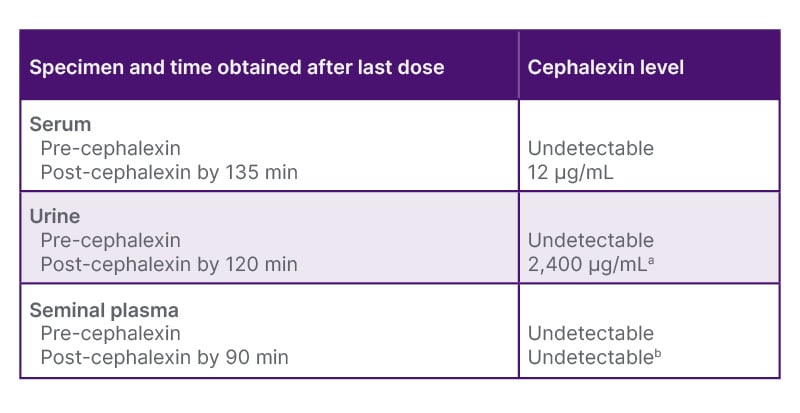
Table 1: Cephalexin level in the husband’s serum, urine, and seminal plasma before and after taking the drug
for 2 days.
a1 mL = 20 tiny drops; 1 drop contains 120 µg.
ᵇThe assay’s sensitivity was only 6.25 µg/mL.
DISCUSSION
This report describes an acute systemic allergic reaction in a woman after oral exposure to the semen of her husband who was taking cephalexin. The patient is atopic and had a history of allergy to penicillin, which she has been avoiding but appeared to remain sensitised to. Per the manufacturer (Pragma Pharmaceuticals, LLC, Locust Valley, New York, USA), cephalexin has up to 10% cross-reactivity with β-lactam antibacterials and is contraindicated in patients with a penicillin allergy.6 Cephalexin’s low cross-reactivity with penicillin and its presumed very low concentration in semen might be behind the limited severity of the reaction that occurred in this patient. The patient’s negative skin reactivity to cefazolin does not rule out allergy to cephalexin. Cross-reactivity between penicillins and cephalosporins varies widely (2–16%), because it is side-chain specific.7,8 Cefazolin in particular has negligible cross-reactivity with penicillins because of its unique side chain.9
The patient was counselled regarding preventive measures. Whenever her husband is taking penicillin or a first-generation cephalosporin, the couple should avoid fellatio and use barrier protection for vaginal intercourse upon initiation of the antibiotic and continuing for a few days after its discontinuation. The half-life of penicillins ranges between 1.0–1.5 hours, whereas cephalexin’s is approximately 0.8 hours.10
The couple supported the authors’ interest in investigating the reaction further and both consented to the authors’ plan that would not expose the wife to risk. Following the husband’s intake of cephalexin, the drug was detected in his serum at 12 µg/mL, which falls within the previously reported range of 0.17–16.55 µg/mL.10 The assay did not detect the drug in the seminal plasma; however, this may have been due to the limited sensitivity of the assay. Previous studies reported very low concentrations in prostatic secretion (0.09–3.00 µg/mL).10 Another possible explanation is that the semen involved in the reaction may have been contaminated with trace amounts of urine. Cephalexin concentration in the urine was 2,400 µg/mL; assuming the volume of 1 mL has 20 small drops, a single drop would contain approximately 120 µg of the drug. Additionally, the low concentration of cephalexin in semen may be related to physicochemical properties. Cephalexin is acid-stable and has low lipid solubility, whereas semen is a lipid-rich alkaline fluid with a mean pH of 8.2±0.3.11
The prevalence of allergic reactions associated with fellatio is unknown, but most likely is higher than currently recognised, as patients are unlikely to suspect or volunteer this information. Also, the limited awareness among healthcare providers of the fellatio route may contribute to its underdiagnosis and consequently to the paucity of reported cases. The authors’ thorough literature search did not identify any case reports similar to the present case. Two case reports may be somewhat relevant. The first was from Croatia in 1997, involving a man with fixed drug eruption to trimethoprim-sulphamethoxazole.12 His lesions recurred at the same anatomical site after sexual intercourse with his wife whenever she was taking the drug orally. The second case report was from Canada in 2021, with fatal anaphylaxis attributed to exposure to a peanut allergen through oral sex between two adolescent males.13 Subject A, who had well-controlled asthma and a peanut allergy, received fellatio by Subject B, who had consumed peanut butter just before performing oral sex on Subject A. The latter developed acute severe bronchospasm that did not respond to a self-administered inhaled bronchodilator and was transferred to the emergency department. He subsequently died despite aggressive treatment.13 The surviving partner denied passionate kissing before the reaction, suggesting that the peanut allergen was transferred from his mouth to the victim’s urethral mucosa.13 In both cases, the exposure to the allergen was through an unconventional route involving sexual oral contact.
CONCLUSION
To the best of the authors’ knowledge, this case may represent the first reported drug systemic allergic reaction by fellatio in a woman. It should alert healthcare providers, particularly allergists, gynaecologists, and emergency medicine physicians, to this substantially under-recognised route of allergen exposure. Affected subjects are unlikely to suspect this route or to voluntarily disclose it during medical evaluation.
Given the diversity of intimate or sexual practices, for allergic reactions of unclear aetiology, the medical history should include a tactful inquiry about any preceding sexual or intimate activity. Recognition of a potential association may facilitate appropriate evaluation and management. If the affected subject has a history of drug or food allergies, the partner should be questioned regarding recent exposure to or ingestion of the suspected allergen during the preceding few days. Our literature search did not identify any reports on allergy to seminal plasma glycoprotein through oral or anal exposure, though both are conceivably possible. Compared to other common hypersensitivities, allergic reactions associated with intimate behaviours can have a substantial psychosocial impact on quality of life and interpersonal relationships. The differential diagnosis should include allergic reactions to exogenous substances associated with intimate activity such as latex, lubricants, spermicides, lotions, and cosmetics. Non-allergenic aetiologies should be also considered, such as cholinergic urticaria (emotional or physical exertion), exercise-induced bronchospasm, or exposure to inhaled irritants (perfumes, scented candles, or tobacco smoke), particularly in patients with asthma.
LIMITATIONS
This case report may be considered to have two limitations. First, though the most suspected cause of anaphylaxis in this patient is cephalexin-contaminated semen, it remains speculative. For safety reasons, replication of the incident was only partial. A definitive proof of a causal relationship would require subjecting the patient to oral challenge with the semen of her husband after his intake of cephalexin. This could carry a high risk that would not be acceptable to the authors, the patient, or the institutional Ethics Review Board, particularly since it is not a part of the standard of care in routine clinical practice. Second, the cephalexin assay had low sensitivity and could not detect the drug in the seminal fluid that was possibly in a concentration below 6.25 µg/mL.