A great therapy can clear every scientific hurdle and still fail to reach the patient. Often, the difference is friction: a series of small barriers that can have major consequences
Words by Isabel O’Brien
The alarm goes off at 6am. You need to be at the gym for 6:30, which in theory leaves plenty of time. Then you have to get out of bed, find your shoes, fill your water bottle, make coffee and locate your keys. Perhaps it is raining. Perhaps, after all that, missing one session doesn’t seem so bad.
None of these things is a serious obstacle. That is precisely why they matter. Friction is rarely a wall: it is a succession of small impediments between an intention and an action, each easy to dismiss until there are enough of them.
Speaking on the EMJ GOLD podcast, behavioural scientist Richard Shotton, author of Hacking the Human Mind, describes friction as the accumulation of “seemingly trivial barriers” that can have a “disproportionate effect on behaviour”. The same is true once a medicine is approved: access depends on what happens next, and each hurdle creates another point at which access can fail.
When approval isn’t access
At the broadest level, the first hurdle is whether an approved medicine is available in a country at all. EFPIA’s Patients W.A.I.T. Indicator 2025 found that, on average, a new medicine takes 597 days to travel from European marketing authorisation to a patient, with 49% of those approved between 2021 and 2024 not yet accessible in Europe.
“Not available” seldom means rejected. More often the medicine is still moving through health technology assessment and price negotiation, or the company has not filed for reimbursement in that country. On average, manufacturers apply in only 16 of the 27 EU member states. Where they do not, the reasons are usually commercial: the patient population may be too small, or a price copied elsewhere through international reference pricing may set an unworkable benchmark.
The result is that where a patient lives determines what they can be prescribed. The same W.A.I.T. data puts average time to availability at around two months in Germany and more than three years in Romania. As Nathalie Moll, Director General, EFPIA, puts it, ensuring medicines reach patients wherever they live in Europe is “a shared ambition and a shared responsibility”.
Finding the patients who could benefit
Near the border and the patient may still be no closer to receiving the right treatment. In precision oncology, a medicine can be licensed, funded and on a hospital formulary, yet an eligible patient may never receive it because it cannot be prescribed until a biomarker is found. The question is no longer whether the treatment exists, but whether the patient can reach the best, most tolerable option for their disease.
“The gap can open at several points,” says Dr Michael Zaiac, Head of Oncology Medical Affairs, Europe & Canada, Daiichi Sankyo. Clinicians may not know a targeted treatment exists, and so never request the test. Congress data may change what is possible, but the clinician treating a given patient may never see those findings.
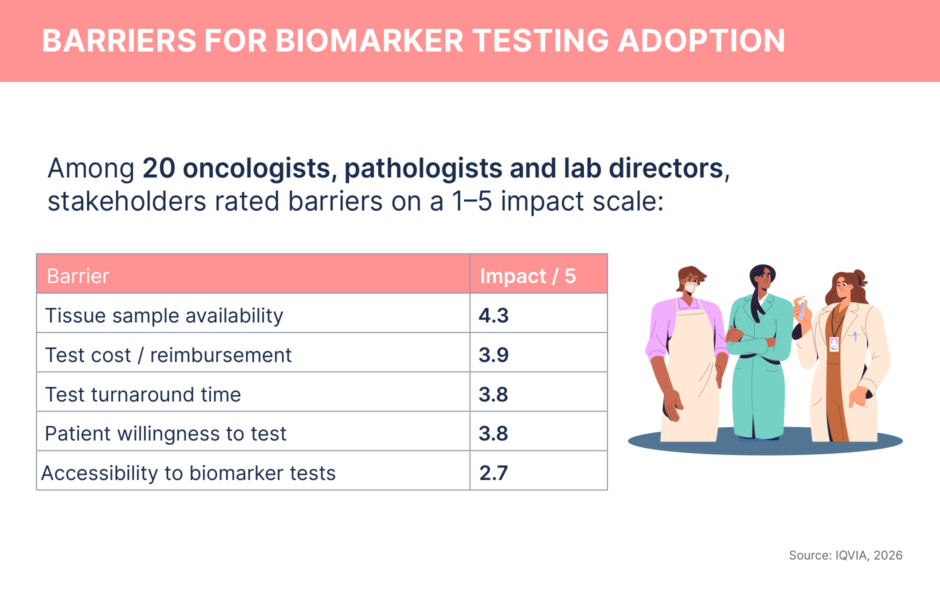
Even when the test is requested, it can fail for reasons that have nothing to do with the medicine. The IQVIA Institute’s 2026 report, Advancing Precision Oncology, found the biggest testing barriers were the availability of usable tissue samples, test cost and reimbursement, turnaround time and patients’ willingness to be tested.
Each behaves like friction rather than a wall. A biopsy may be too small for a full panel, or the tissue may already have been used up by earlier tests, leaving the patient facing another procedure. A result that arrives after the treatment decision is, in practice, a result that never arrived. None of this stops a patient outright; it simply makes the targeted route slightly harder than the conventional one, and the conventional one proceeds.
A Diaceutics analysis published in JCO Precision Oncology found that, in advanced lung cancer, only around 356 of every 1,000 eligible patients were estimated to benefit, with most patients lost from the pathway around the testing stage. The ceiling on a targeted therapy, in other words, is set less by how well it works than by how reliably the system finds the patients it works for.
As Zaiac puts it, “the reality of testing determines the real-world population that can benefit”. His conclusion is that the diagnostic pathway must be treated as part of the product: “Launching a targeted medicine is as much about launching and embedding the biomarker pathway as it is about launching the medicine itself.”
Making the right test the default
That makes pathway design as important as the medicine itself, and small changes to how a decision is presented can shift behaviour at scale. A 2016 JAMA Internal Medicine study by researchers at the University of Pennsylvania found that changing the electronic health record default lifted generic prescribing from around 75% to 98%. Nobody had to be persuaded: the easier option became automatic.
Reflex testing applies the same principle, triggering biomarker testing at diagnosis rather than relying on someone to remember to request it. It does not solve laboratory capacity or who funds the test; those remain questions for health systems. What it removes is the need for a busy clinician to remember to request the test.
Who gets the chance of a cure?
The stakes rise again with cell and gene therapies. Here the question is whether a patient can reach a potentially curative treatment. These are among the most expensive medicines ever made, so it is natural to assume price is what stops them. Price does matter, but it is only the second barrier.
In sickle cell disease (SCD), the first filter is perceptual, according to Sarah Hendry, Franchise Head, Hematology, Spherix Global Insights. “Physicians are making judgment calls about who is and isn’t a good candidate for gene therapy,” she says, “often excluding the patient from that consideration discussion.”
An audit of SCD patient charts cited by Hendry found that around 80% were considered good candidates, yet only about 10% had active plans to proceed. Reasons cited included “patient motivation” and “likelihood to comply”.
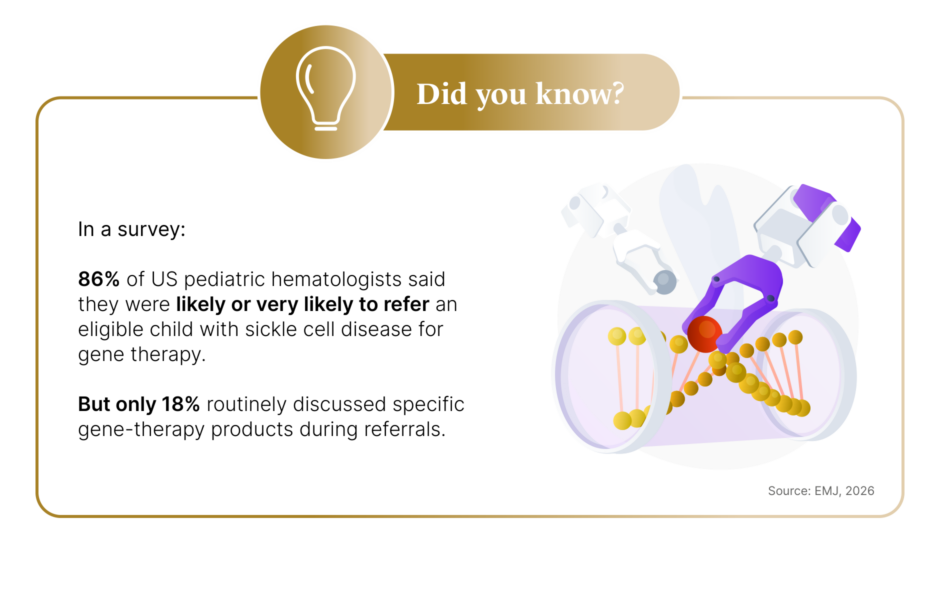
The pattern holds even among clinicians who are broadly supportive. At the 2026 EBMT Annual Meeting, a survey of 138 US clinicians reported that 86% were likely or very likely to refer an eligible child with SCD for gene therapy, yet only 18% routinely discussed specific products during referrals. Willingness in principle does not always become a real conversation or treatment plan.
Some reluctance is rational. The process is long, costly and available at only a handful of accredited centres, so clinicians must consider whether a patient can realistically complete it. But that judgement can still be made before the patient has a say. Hendry argues the responsibility is shared: developers too must “ensure their therapies are accessed by patients who need them most, not just by those who are deemed to be appropriately motivated”.
That makes candidacy perhaps the most complex friction of the three. The answer is not simply better referral pathways but clearer candidacy criteria, better education and, crucially, involving patients in their own care decisions.
Making access the easier choice
Follow an innovative therapy from approval to a patient and hurdles appear at every stage. First a border, where reimbursement stretches out. Then a pathway, where a specialised test goes unordered. Then a consulting room, where a candidacy judgement is made before the patient is part of the decision.
Each creates friction, often driven by unconscious behaviour that makes it easy to miss. The remedy is the same at every level: name the friction, examine its impact and make the better choice easier. For pharma, the task is not to argue the evidence harder, but to find the friction and remove it.
It is not unlike making that 6:30am session: shoes by the door, bottle filled the night before, keys where you can find them. And don’t look out the window.