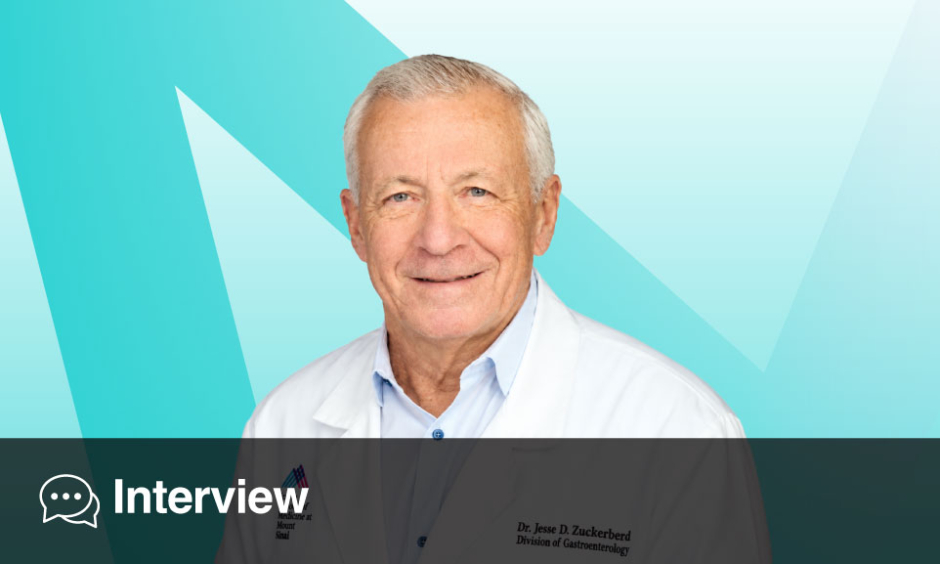
Jean-Frédéric Colombel | Director, Susan and Leonard Feinstein Inflammatory Bowel Disease Clinical Center, Icahn School of Medicine, Mount Sinai, New York, USA
Citation: EMJ Gastroenterol. 2026; https://doi.org/10.33590/emjgastroenterol/L7YZYF3R

What do we mean by a therapeutic ceiling in inflammatory bowel disease (IBD), why do you think we’re reaching it, and what could help us break through it?
There having been an increasing number of biologic and small molecule drugs in the field of IBD over the last decade, which is definitely progress. Despite this increase, we are seeing almost similar efficacy data across all drugs for both induction and maintenance. This concept is known as a therapeutic ceiling.
We are seeing more and more patients who are refractory to one, two, or three drugs, and although the available therapies are safe and useful to our patients, an expanding armament of treatment options in this case is not always the solution.
Why then are we plateauing? I believe it’s because these drugs are targeting the same component of the immune system; broadly they are immunosuppressive drugs. Naturally, this kind of approach will see a plateau in effectiveness.
Combination therapy offers an appealing solution through the use of a rational combination of drugs with different mechanisms of action, resulting in some additive or, even better, synergistic effects.
This is a theory. Unfortunately, so far, the data are not transforming. One recent example is the DUET Crohn’s disease and ulcerative colitis trial, which combined guselkumab, an IL-23 blocker, and golimumab, an anti-TNF.
When looking at the whole patient population, the study was negative. However, it was positive in the subgroup of patients who had already been exposed to at least two advanced therapies suggesting that this combination could be clinically relevant in more refractory patients.
We are still waiting for other combination studies. Ideally, we would like to use different approaches, such as combining immunosuppressive therapy with a drug that can, for example, target the intestinal barrier, enhance mucosal healing, or change the microbiome. So far, these drugs are still in development.
IBD is highly variable. What are the biggest challenges in matching the right treatment to the right patient?
IBD is a very heterogeneous disease, so each patient will have a different experience from one another. It’s amazing how diverse it can be. In this sense, it’s important to find biomarkers to personalise treatment to the individual.
Importantly, we need biomarkers to predict the course of disease allowing us to determine what drug for which patient or to determine if someone actually needs advanced therapy. Some patients may respond much better to an anti-TNF, like infliximab, whereas some patients may respond much better to an IL-23 drug, like guselkumab. This is why prediction is so important. As of yet, though, we don’t have any good predictors.
An interesting observation was made from the LIR!C study in the Netherlands, revealing that some patients with ileal Crohn’s disease can do very well after surgery and may remain free of Crohn’s-related medication for years. However, given that we don’t have good predictors, we can’t know who this approach will work for with absolute certainty. This is analogous to the broader challenge of managing and treating IBD.
I often refer to personalisation as the ‘Loch Ness Monster of IBD’. Everybody is talking about it, but, so far, nobody has really seen it.
You have previously mentioned that your dream is to catch the process leading to disease even before the first symptom appears. How close are we to identifying individuals who will develop Crohn’s disease, and what scientific challenges remain before early prediction becomes possible?
We are developing new drugs, trying to combine different therapies, and looking for predictive markers, but I think the biggest unmet need we have now, especially in the USA, is that many patients are still not diagnosed. In the USA, around 50% of patients have to wait 2 years, or close to 2 years, between their first symptoms and diagnosis.
Often, they are simply not recognised by their doctor. As a young patient, your doctor might attribute symptoms of IBD to stress or burnout. They don’t necessarily think about Crohn’s disease, and many patients also don’t have access to a gastroenterologist, so they are never referred.
The important point is that we now know the disease is progressing. If you wait too long, you will often have complications. So, to me, this is critical. If I had to summarise the treatment of IBD in one word, it would be: early. If you can catch the disease as soon as possible, the prognosis can be transformed.
This was shown again by a brilliant study from the UK, the PROFILE trial. PROFILE compared a top-down approach with step-up treatment in patients with very early Crohn’s disease. They were able to recruit patients within 2 weeks of diagnosis, which was a real tour de force.
With the top-down approach, patients received intensive treatment with infliximab from the beginning. The outcomes were much better, with substantially fewer surgeries after 2 years. Interestingly, the original design of the PROFILE study was based on validating a predictive biomarker, but the biomarker itself did not work.
The most important result, however, was that if you treat patients early, it is a different story. We already had evidence of this from studies such as SONIC and CALM. What really matters is early treatment.
It is a pity because patients are not only being diagnosed late, but even after diagnosis they might be started on multiple cycles of steroids, or started on aminosalicylates for Crohn’s disease, rather than an effective advanced therapy. Meanwhile, the clock is ticking.
After 40 years of practicing, I think this is the most important message for clinicians, and for the wider community. This is not only the responsibility of gastroenterologists, but a problem for GPs and for patients themselves.
If we are able to identify individuals at high risk of developing Crohn’s disease earlier, what opportunities could this create for preventing disease or altering its course before symptoms appear?
There are two different words here. By prevention, we mean that you can prevent the disease in people who are at risk of developing the disease. The second word is interception, meaning that you catch the disease when it is not clinically visible, but there are some markers. This is what I’ve been working on for the last 10–15 years.
We’ve found that IBD doesn’t necessarily start at diagnosis. Biomarkers in blood and stool can be present up to 10 years beforehand. Our vision is to eventually predict the development of disease using a simple blood test, which could allow us to initiate prevention or interception strategies.
We’re currently studying this in a large European programme called INTERCEPT, recruiting around 10,000 first-degree relatives of patients with Crohn’s disease. We’re using blood and stool biomarkers to identify those at the highest risk and investigate whether vedolizumab, a monoclonal antibody that targets the integrin α₄β₇ protein and is already approved to treat IBD, can prevent or delay Crohn’s disease.
This concept has also been explored in other diseases, especially Type 1 diabetes, where teplizumab has been shown to delay progression in high-risk individuals, demonstrating that interception before clinical disease is possible.
But for this approach to become part of clinical practice, we need to be confident that we can accurately identify those at sufficiently high risk to justify intervention.
When thinking about prevention/interception, you can think about different scenarios. If your risk is low, like in the general population, we would simply recommend healthy lifestyle measures. If your risk is higher, for instance having a family history of IBD, but your risk score is low, we might focus on things like diet, smoking cessation, and optimising gut health. But if you have a first-degree relative with Crohn’s and a high-risk score, that could suggest an 80% risk of developing disease within 2 years, then it could make sense to consider an advanced therapy before clinical disease develops.
Looking ahead, what do you think will be the defining breakthrough in IBD over the next decade, and what message would you most like clinicians to take away from the current direction of research?
Some of these breakthroughs will still take many years to become applicable. In the meantime, we need to continue improving care for patients with IBD, including developing new treatments. There is huge interest in approaches such as CAR-T cell therapy, which has been transformative in some other diseases, although there are still risks and it is not yet ready for routine IBD care.
More broadly, I think we still need to understand the mechanisms of the disease much better. When I started seeing patients with IBD, I was fascinated by some very basic clinical observations that we still cannot fully explain.
For example, in Crohn’s disease, why do you see these characteristic skip lesions with severe inflammation in one part of the bowel, then completely normal tissue, then another area of disease? In ulcerative colitis, why can there be such a sharp boundary between severely inflamed and completely normal mucosa? These are things we see every day, yet we still don’t really understand why they happen. Similarly, smoking remains a very strong risk factor for Crohn’s disease and for recurrence after surgery, but we still do not fully understand the mechanisms behind this association. There are also fascinating observations around the appendix and ulcerative colitis that remain controversial and require further investigation.
I think some of the biggest breakthroughs in IBD will come from better understanding the biology of the disease itself. We need to ask more fundamental clinical questions rather than simply following what has already been done. Research can sometimes become driven by new techniques, but we should always start by asking: “What is the clinical question we are trying to answer?”
This is also why prediction and prevention research is so exciting. If we can identify biological changes in people 5 or 10 years before they develop symptoms, we may not only be able to predict who will develop disease but also gain clues about the underlying causes. This could help us move beyond treating established disease towards understanding how IBD develops and, potentially, preventing it before it begins.
Ultimately, I think the most exciting breakthroughs will come from combining these approaches: asking the right clinical questions, understanding the mechanisms that drive disease, and using that knowledge to predict, prevent, and ultimately treat IBD more effectively.