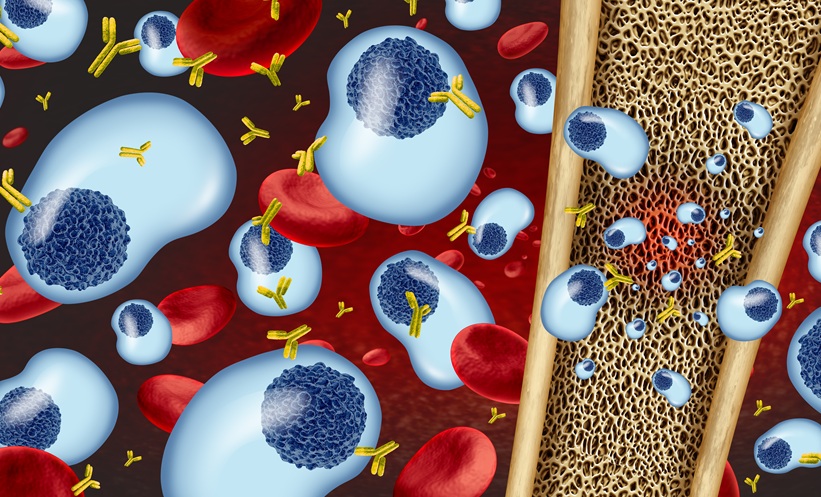
AN INVESTIGATIONAL T-cell engager has shown early antimyeloma activity in a first-in-human study involving patients with heavily pretreated relapsed or refractory multiple myeloma.
The phase 1 trial evaluated MK-4002, a trispecific agent targeting B-cell maturation antigen. Researchers identified 12 mg as a preliminary dose for further investigation, although severe and serious adverse events were common and one treatment-related death occurred.
Establishing a Dose for Further Study
The open-label trial assessed safety, preliminary activity and pharmacokinetics across different dosing approaches. Its purpose was to explore how the treatment behaved in patients and identify a suitable dose for subsequent research.
Among 97 participants, all experienced an adverse event and 79% experienced an event of grade 3 or worse. Serious adverse events occurred in 58%.
Common severe events included anaemia and reduced neutrophil counts. One participant died from a traumatic subdural haematoma considered related to treatment.
Cytokine release syndrome occurred in 30% of participants. Most cases were grade 1–2, while two grade 3 cases occurred following a 24 mg dose.
Response Signals at Different Doses
The overall response rate was 63% in the 12 mg group, compared with 41% in the 2.15–6 mg group and 48% in the 24 mg group. Taking activity and safety together, the investigators selected 12 mg as the preliminary recommended phase 2 dose.
These findings support additional investigation, but the response estimates came from small groups and had wide confidence intervals. The numerical differences should therefore not be interpreted as definitive evidence that one dose is more effective than another.
Balancing Activity and Toxicity
For a first-in-human study, identifying a dose with evidence of activity is an important step. However, the clinical meaning of a response also depends on its duration, associated symptoms and the burden of treatment.
An early-phase, uncontrolled trial cannot establish whether MK-4002 improves survival or offers a better balance of benefits and harms than existing options. Nor can response percentages alone determine where the treatment might eventually fit within care.
The results provide a basis for further clinical evaluation, with particular attention to the selected dose and management of adverse effects. Larger studies will need to clarify the durability of benefit, refine safety estimates and establish which patients are most likely to benefit. For now, MK-4002 remains an investigational approach with encouraging activity alongside substantial toxicity.
Reference
Madan S et al. MK-4002, a B-cell maturation antigen-targeting T-cell engager, in relapsed or refractory multiple myeloma: a first-in-human, open-label, phase 1 study. Lancet Haematol. 2026;13(11):e822–e833. doi:10.1016/S2352-3026(26)00228-0.