Authors: *Andrew Dugue,1 Tyler Ellis Smith1
1. Department of Neurology, NYU Grossman School of Medicine, New York City, USA
*Correspondence to [email protected]
Disclosure: Smith has received research funding from PCORI and is set to receive research funding from Neurogenesis; is set to receive royalties from Es- sential Neurology Board Review Q&A, a book published through Springer; and has participated on the TREAT-MS Trial Study Advisory Committee, funded by PCORI. Dugue has declared no conflicts of interest.
Keywords: Biomarker, central vein sign (CVS), disease-modifying therapy (DMT), McDonald Criteria, multiple sclerosis (MS).
Citation: Neurol AMJ. 2026;3[1]:23-28. https://doi.org/10.33590/neurolamj/G2763DH3

ACROSS the spectrum of multiple sclerosis (MS) care, the American Academy of Neurology (AAN) Annual Meeting 2026 highlighted changes in the diagnosis of MS, impacting both asymptomatic and symptomatic patients. Additionally, a new mechanism of action for the treatment of MS, targeting Bruton’s tyrosine kinase (BTK), showed positive results in both progressive and relapsing MS. Together, these changes, along with updates in biomarkers and upcoming studies on the approach to treatment of MS, underscore the rapid state of change in MS care and opportunities for patients.
INTRODUCTION
Aaron Miller, Icahn School of Medicine at Mount Sinai, New York, USA, reviewed the latest 2024 McDonald Criteria, noting that it was developed through a consensus methodology. The 2024 McDonald Criteria incorporates clinical and radiographic data, as well as biomarkers, to make the diagnosis of MS earlier and in more individuals. Miller emphasized that these criteria maintain accuracy to ultimately reduce the burden of disability among individuals with MS.1
Highlighting a key change to the McDonald Criteria, Laura Balcer, NYU Grossman School of Medicine, New York, USA, presented the inclusion of the optic nerve as the fifth topographical region when evaluating for dissemination in space. Both asymptomatic and symptomatic optic nerve lesions are now included and can be detected with orbital MRI with gadolinium, and optical coherence tomography, along with visual evoked potentials (Table 1).
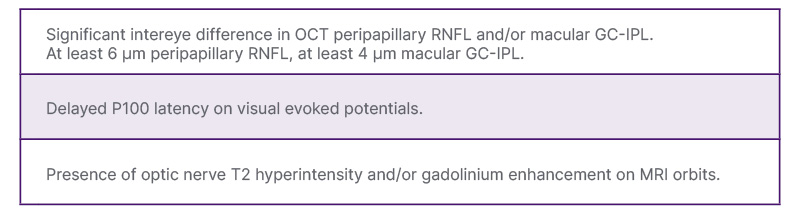
Table 1: Paraclinical test criteria for optic nerve lesions.
Adapted from Dugue A.2
GC-IPL: ganglion cell inner plexiform layer; OCT: optical coherence tomography; RNFL: retinal nerve fiber layer.
The addition of iron-sensitive MRI techniques to detect the presence of a central vein sign (CVS) and paramagnetic rim lesions (PRL) in the 2024 Revised McDonald Criteria were reviewed. The CVS enables the identification of white matter lesions with a central vein, which has demonstrated high sensitivity and specificity for MS, when using the ‘Select 6’ method to identify a sufficient number of CVSs to be consistent with MS. PRLs are thought to indicate chronic inflammation in demyelinating lesions, related to iron-laden macrophages and microglia at the lesion edge. While PRLs have not been as sensitive for the diagnosis of MS as a CVS, they remain highly specific. Together, these biomarkers can increase diagnostic specificity for MS.
In addition to substituting oligoclonal bands unique to the cerebrospinal fluid to fulfil the dissemination in time criteria (present in the 2017 McDonald Criteria), the updated MS diagnostic criteria also allow for the use of kappa free light chains to substitute for dissemination in time. Balcer highlighted the advantages of kappa free light chains: high concordance with oligoclonal bands, while remaining rater-independent. Furthermore, if sufficient criteria are met, dissemination in time is no longer required to diagnose MS in the 2024 McDonald Criteria.
The updated criteria also renovate the diagnosis of asymptomatic patients. As discussed by Miller and Jiwon Oh, University of Toronto, Canada, individuals who would have been diagnosed with radiologically isolated syndrome under the prior criteria will now be diagnosed with MS if they meet the appropriate criteria, despite being asymptomatic.
Miller and Oh both emphasized the importance of applying these latest criteria in an individual with a typical syndrome (such as unilateral optic neuritis, partial myelopathy, focal supratentorial, brainstem, or cerebellar syndrome), and to use caution when examining atypical presentations (e.g., encephalopathy, isolated fatigue). While these updated criteria can be applied across diverse situations, Oh emphasized the need to confirm additional features of MS, such as spinal cord lesions, presence of oligoclonal bands and/or kappa free light chains, and the CVS, in individuals with a higher chance of misdiagnosis (e.g., older patients, younger patients, and those with vascular and headache comorbidities).
Validation of the updated criteria was reviewed by Miller, who presented early data from Brownlee et al.3 demonstrating a substantial increase (28%) in the ability of the 2024 McDonald Criteria to diagnose MS with high accuracy, when compared to the 2017 criteria.
Importantly, individuals who met the prior McDonald Criteria4 will continue to maintain the diagnosis of MS under the 2024 criteria. The latest McDonald Criteria also maintain that the presentation must not be better explained by another disorder. For further reading on a consensus approach to the differential diagnosis of MS, see Solomon et al.5
Ludwig Kappos, University Hospital Basel, Switzerland, presented his thoughts on the inclusion of a spectrum of biomarkers in trials, including blood-derived biomarkers (neurofilament light chain, glial fibrillary acidic protein), imaging biomarkers (quantitative MRI, optical coherence tomography, PET), and digital biomarkers. Additionally, Kappos highlighted the role of progression in MS and advocated for the inclusion of progression independent of relapse activity as a clinical endpoint. Gloria von Geldern, University of Washington School of Medicine, Seattle, USA, elaborated on the concept of progression independent of relapse activity, characterized by “microglial activation and dysfunctional astrocytes, … [resulting] in [central nervous system]-centric inflammation and neurodegeneration” and leading to a progressive decline in symptoms and function without distinct relapse activity, that has characterized the endpoints of trials focused on relapsing MS.
Annette Wundes, University of Washington School of Medicine, Seattle, USA, presented defective oligodendrocyte progenitor cell recruitment as the primary reason that remyelination fails in chronic MS. Remyelination trials are ongoing to look at exercise and vagus nerve stimulation, as well a number of molecules that may be helpful in affecting remyelination.
TREATMENTS
Veronica Cipriani, University of Chicago Medicine, Illinois, USA, presented the importance of high efficacy disease-modifying therapy (DMT) in preventing irreversible disability and decreasing the number of relapses, MRI activity, and atrophy. Based on work by Langer-Gould et al.,6 Cipriani highlighted some key risk factors for long-term disability, including bowel and bladder symptoms at onset, incomplete recovery from first relapse, short interval between first and second relapses, early accumulation of disability, and Black or Hispanic race/ethnicity (Table 2). In addition to preventing relapses, Cipriani presented data supporting the association of higher efficacy treatments with a delay to the development of secondary progressive MS.

Table 2: Risk factors associated with long-term disability.
Adapted from Langer-Gould et al.6
Leslie Benson, Harvard Medical School, Boston, Massachusetts, USA; and Vaishnavi Vaidyanathan, University of California Davis School of Medicine, Sacramento, USA, similarly recommended initial treatment with high-efficacy DMT in pediatric-onset MS (POMS). Vaidyanathan noted that patients with POMS are particularly prone to delays in treatment initiation. She remarked that patients with POMS with the highest risk of disability at 9 years included those with optic nerve, brainstem, and cervical cord lesions, and those with both two new brain T2 lesions and an Expanded Disability Status Scale (EDSS) change in the first 2 years. Benson noted that the PARADIGMS trial led to fingolimod FDA approval in POMS, although potential adverse effects, such as seizures, first dose bradycardia, macular edema, infections, and rebound disease activity with discontinuation, can occur. She cited ongoing trials examining high efficacy DMT in POMS, such as OPERETTA 2 (ocrelizumab) and NEOS (ofatumumab). Elizabeth Wilson, University of Cincinnati College of Medicine, Ohio, USA, highlighted non-pharmacologic treatments in pediatric MS, such as cognitive therapy, cognitive behavioral therapy, the modified Story Memory Technique, aerobic and resistance exercise training multiple days per week, and early referral to physical medicine and rehabilitation. She stressed the importance of baseline and subsequent annual cognitive screening with tools such as the Symbol Digit Modalities Test in management.
Marwa Kaisey, Cedars-Sinai Medical Center, Los Angeles, California, USA, emphasized using an individualized and shared decision-making approach to DMT selection, incorporating pregnancy planning, side effects, method of drug delivery (e.g., intravenous, injection, oral), insurance coverage, efficacy, lifestyle, and co-morbidities, as there is not a standardized protocol for DMT selection at this time.
Ruth Dobson, Queen Mary University of London, UK, presented the final analyses of the MINORE and SOPRANINO trials, which examined the humoral vaccine responses and 1-year follow-up of infants potentially exposed to ocrelizumab during pregnancy (ocrelizumab administered at 0–3 months before last menstrual period or during first trimester, n=16) and breastfeeding. MINORE demonstrated minimal placental transfer of ocrelizumab, normal infant B cell levels at 6 weeks and 13 months of life, and similar positive seroprotective vaccine response to infants not exposed to ocrelizumab. SOPRANINO (n=11) demonstrated minimal transfer of ocrelizumab in breastmilk, normal infant B cell levels at 30 days and 12 months post maternal ocrelizumab infusion, and positive humoral vaccine responses in line with reported rates.
Oh and Amit Bar-Or, Perelman School of Medicine, Philadelphia, Pennsylvania, USA, presented the results of two studies of fenebrutinib, a BTK inhibitor. Bar-Or reviewed the primary results of the Phase III FENtrepid study, comparing the efficacy and safety of fenebrutinib versus ocrelizumab in primary progressive MS. In this study, fenebrutinib demonstrated non-inferiority, with a primary endpoint of composite confirmed disability progression at 12 weeks compared to ocrelizumab. Fenebrutinib had a higher incidence of fatalities compared to ocrelizumab, but these fatal events were thought to be unrelated to fenebrutinib by the investigators. In relapsing MS, Oh presented the results of the FENhance 1 and 2 Phase III trials, evaluating the efficacy and safety of fenebrutinib relative to teriflunomide. The primary endpoint in FENhance 1 and 2 was annualized relapse rate, and fenebrutinib demonstrated superiority versus teriflunomide in reducing relapses and disease activity on MRI. Similar to the FENtrepid study, FENhance 1 and 2 identified an imbalance of fatalities with fenebrutinib, although only two of seven were thought to be related to fenebrutinib. While both FENtrepid and FENhance demonstrated an increased rate of liver enzyme elevations with fenebrutinib, all were reversible.
FUTURE DIRECTIONS
Highlighting the difficulty in treating progressive MS, Kaisey projected excitement regarding BTK inhibitors that may penetrate the central nervous system to target inflammation localized to the area as an untapped treatment target. As one of these novel BTK inhibitors, if fenebrutinib is approved, it will add a novel mechanism of action to the MS treatment armamentarium, and will be only the second DMT to demonstrate efficacy in the treatment of primary progressive MS. Other potential therapies under study include CAR-T cell therapy, hematopoietic stem cell transplant, anti-CD40L, anti-CD3, anti-CD20 ‘brain shuttle’, and mRNA vaccines targeting Epstein-Barr virus.
Daniel Kurz, University of Chicago Medicine, Illinois, USA, among others, reported on neurofilament light chain as a potential biomarker, but caution is advised in older individuals, and BMI and other forms of neurologic disease or injury must be considered, as these can also cause changes to the neurofilament light chain level.
Cipriani highlighted two ongoing trials, TREAT-MS and DELIVER-MS, the results of which will hopefully provide evidence on the best approach to select a DMT: starting with a lower-efficacy treatment and escalating versus starting with a high-efficacy DMT.
CONCLUSION
In the world of MS, the past year has been an exciting one. We saw the publication of the latest McDonald Criteria, the use of the CVS, PRLs, kappa free light chains, and the recategorization of radiologically isolated syndrome as MS in some cases. Additionally, there were positive results for fenebrutinib, a BTK inhibitor, in both relapsing and primary progressive MS trials, which will potentially bring a new mechanism of action to the DMTs available to treat MS. There are ongoing trials targeting progressive MS to prevent disability. Finally, there are innovative trials targeting repair and remyelination, the next frontier in managing the disease.