BACKGROUND AND AIMS
Gadopiclenol is a high-relaxivity gadolinium-based contrast agent (GBCA) that enables reduced contrast doses while preserving lesion conspicuity. In parallel, deep learning (DL)-based contrast boosting algorithms have been developed to enhance contrast signals in post-contrast MRI without increasing gadolinium administration. The purpose of this study1 was to quantitatively assess whether a DL-based contrast boosting algorithm can further amplify the benefits of a high-relaxivity GBCA, improving lesion visualisation and image quality at reduced dose levels in brain MRI.
METHODS
This retrospective study included T1-weighted pre-contrast and standard post-contrast MRI examinations from 20 patients undergoing brain MRI, comprising both 2D and 3D acquisitions. All patients were administered gadopiclenol at a reduced approved dose of 0.05 mmol/kg. Pre-contrast and standard-contrast (SC) images were processed using an FDA-cleared DL-based contrast boosting algorithm to generate contrast-boosted (CB) images. Regions of interest were manually drawn on the largest contrast-enhancing lesion and on adjacent healthy brain parenchyma. Regions of interest defined on SC images were propagated to pre-contrast and CB images through image registration. Quantitative image quality and lesion conspicuity were assessed using contrast-to-noise ratio, lesion-to-brain ratio, and contrast enhancement percentage (CEP), with CEP calculated relative to pre-contrast images. Mean values and percentage increases from SC to CB images were computed. In addition, the performance of CB images obtained with gadopiclenol was compared with previously reported CB results using a conventional macrocyclic GBCA (gadoterate meglumine) administered at 0.1 mmol/kg.
RESULTS
Contrast-boosted images demonstrated a marked improvement across all quantitative metrics compared with standard post-contrast images. Mean contrast-to-noise ratio increased from 2.52±0.85 in SC images to 10.38±1.56 in CB images. Mean percentage increase result to be equal to a 314.19% increase. Mean lesion-to-brain ratio improved from 2.55±1.85 to 5.12±1.03. Mean percentage increase result to be equal to a 118.12% increase. Mean CEP nearly doubled, increasing from 0.99±0.28 in SC images to 1.96±0.35 in CB images. Mean percentage increase result to be equal to a 335.18% increase. Comparative analysis indicated that the percentage increases achieved with gadopiclenol combined with CB are comparable to those observed for gadoterate meglumine at standard dose,2 also showing a noticeable amplification when CB is applied to a high-relaxivity contrast agent.
CONCLUSION
Quantitative analysis demonstrates that the DL-based contrast boosting algorithm significantly enhances lesion conspicuity and image quality when used in combination with gadopiclenol at a reduced dose. The observed increase in contrast enhancement suggests that CB images obtained with 0.05 mmol/kg gadopiclenol are quantitatively comparable to a doubled contrast dose (Figure 1). These findings support the synergistic use of high-relaxivity contrast agents and DL-based contrast boosting as a strategy for gadolinium dose reduction while maintaining or improving diagnostic performance.
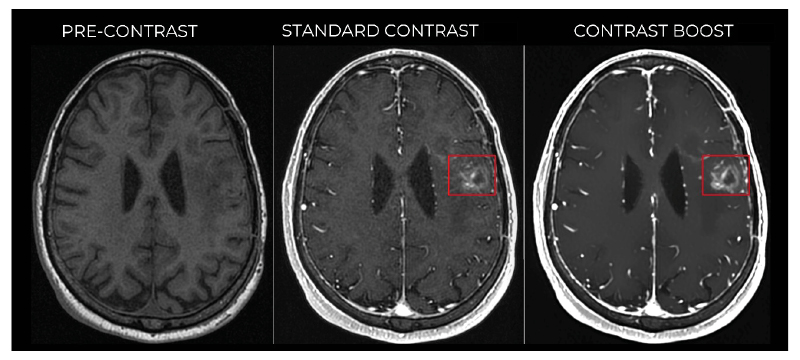
Figure 1: Representative axial T1‑weighted brain MRI showing pre‑contrast (left), standard post‑contrast
The enhancing lesion (red square) is more clearly visualised on contrast‑boosted images, with improved conspicuity and delineation compared with standard post‑contrast imaging.
LIMITATIONS
This study is limited by a relatively small sample size and its retrospective design.