BACKGROUND AND AIMS
Preventing premature luteinising hormone (LH) surge is a fundamental component of controlled ovarian stimulation during IVF. Gonadotropin-releasing hormone (GnRH) antagonist protocols have become the standard approach because of their effectiveness in suppressing premature ovulation while maintaining favourable reproductive outcomes. Progesterone-primed ovarian stimulation (PPOS) has emerged as an alternative strategy, particularly in freeze-all IVF cycles, owing to its simplicity, lower treatment burden, and reduced cost. Nevertheless, concerns remain regarding the potential effects of progesterone exposure during ovarian stimulation on embryo development and implantation. Comparative clinical data evaluating embryological outcomes between these protocols remain limited.1-4
MATERIALS AND METHODS
This retrospective observational study5 compared embryological and implantation outcomes between PPOS and GnRH antagonist protocols in women undergoing IVF/intracytoplasmic sperm injection treatment at a single tertiary IVF centre. A total of 256 treatment cycles were included, comprising 125 PPOS cycles and 131 GnRH antagonist cycles. Baseline demographic characteristics and ovarian stimulation parameters were comparable between the two groups. The primary outcomes included the number of retrieved oocytes, mature metaphase II oocytes, fertilisation rate, blastocyst quality, and implantation rate.
RESULTS
Ovarian response and fertilisation outcomes were comparable between groups. Median retrieved oocytes were 14.0 in the PPOS group versus 13.5 in the GnRH antagonist group, and median mature metaphase II oocytes were 12.0 versus 10.0, respectively. Fertilisation rates were 84.0% and 85.9%. The GnRH antagonist group had a significantly greater proportion of top-quality blastocysts (AA, AB, and BA Grades; p=0.024), whereas the PPOS group had a higher proportion of BB-Grade blastocysts (p=0.033). Implantation rate was significantly higher with the GnRH antagonist protocol (14.4% versus 9.4%; p=0.017). These findings are summarised in Table 1.
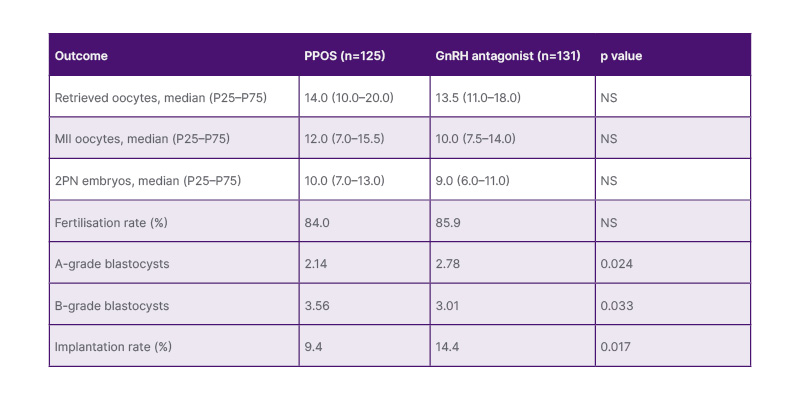
Table 1: Embryological and implantation outcomes by LH suppression protocol.
2PN: two-pronuclear; GnRH: gonadotropin-releasing hormone; LH: luteinising hormone; MII: mature metaphase II; NS: not statistically significant; P25–P75: 25th–75th percentile; PPOS: progesterone-primed ovarian stimulation.
Despite similar ovarian and fertilisation outcomes, significant differences were identified in embryo quality. The GnRH antagonist protocol produced a significantly greater proportion of top-quality blastocysts (AA, AB, and BA Grades; p=0.024), whereas the PPOS group generated a higher proportion of BB-grade blastocysts (p=0.033). Furthermore, implantation rates differed significantly between treatment strategies, with the GnRH antagonist group demonstrating a higher implantation rate than the PPOS group (14.4% versus 9.4%; p=0.017).
CONCLUSION
Progesterone-based LH suppression provides ovarian response and fertilisation outcomes comparable to those achieved with GnRH antagonist protocols, but differences in blastocyst quality distribution may translate into lower implantation potential. The observed reduction in implantation rate among women treated with PPOS warrants careful consideration when selecting ovarian stimulation protocols, particularly in patients in whom embryo competence and implantation potential are major clinical priorities. However, the retrospective design and single-centre nature of the present study limit the generalisability of these findings and do not allow causal conclusions to be drawn. Larger multicentre, prospective, randomised studies are required to determine whether these observed differences represent a true biological effect of progesterone-based suppression or reflect patient selection and other confounding factors.