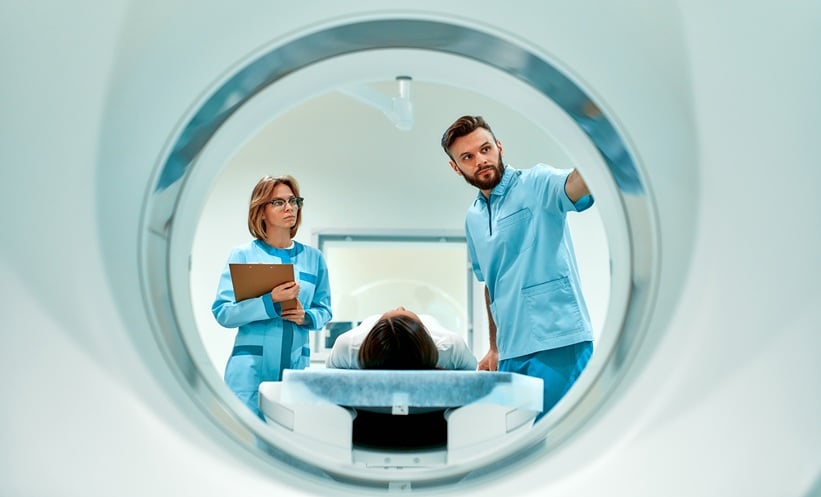
MAGNETIC RESONANCE IMAGING driven analysis of the tumour microenvironment demonstrates a novel, interpretable workflow that improves biomarker identification and enables non-invasive assessment of tumour biology.
Tumour Microenvironment Assessment Using MRI
The tumour microenvironment remains a critical determinant of prognosis and response to immunotherapy, yet its evaluation has traditionally relied on invasive pathology sampling. This approach limits comprehensive assessment, particularly in the presence of tumour heterogeneity. A newly developed workflow integrates magnetic resonance imaging with tumour microenvironment profiling to address these limitations.
By deconvoluting bulk molecular data, the model infers a robust tumour microenvironment profile and aligns it with imaging features. This allows for unsupervised lesion annotation enriched with biological context, offering a scalable alternative to conventional methods.
Interpretable Radiogenomics and Biomarker Discovery
The workflow incorporates interpretable modules linking gene expression and imaging data, supporting clinically meaningful biomarker discovery. Radiomic features derived from magnetic resonance imaging were used to identify cancer imaging biomarkers and define tumour subtypes in a manner accessible to clinicians. The model demonstrated strong predictive performance, achieving an accuracy of 0.87 in estimating the proportion of cancer associated fibroblasts. Notably, the analysis revealed an inverse association between cancer associated fibroblasts and T cell infiltration in triple negative breast cancer, providing insight into tumour immune dynamics.
Clinical Validation and Future Potential
Across multiple datasets, the customised deconvolution approach outperformed existing baseline methods, indicating improved robustness and generalisability. Radiomic features identified for tumour subtyping showed consistent distributions among patients with breast cancer and achieved an average accuracy exceeding 0.8 in five multicentre validations.
These findings suggest that magnetic resonance imaging-based tumour microenvironment assessment may offer a reliable and non-invasive strategy for patient stratification.
The integration of imaging and molecular data through interpretable radiogenomics presents a promising avenue for enhancing clinical decision making. By enabling accurate tumour microenvironment profiling without reliance on invasive procedures, this approach may support more precise therapeutic selection and improve outcomes, particularly in complex cancers such as triple negative breast cancer.
Reference
Li H et al. Deep interpretable radiogenomic workflow deciphers tumor microenvironment from breast MRI and identifies clinician-interpretable biomarkers. NPJ Precision Oncology. 2026;https://doi.org/10.1038/s41698-026-01458-2.
Featured image: Valerii Apetroaiei on Adobe Stock.
- Author: