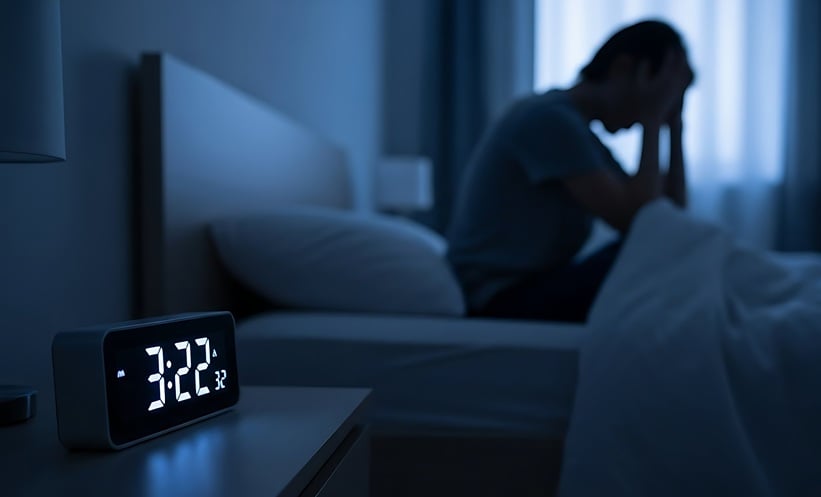
DELAYED sleep timing and weaker circadian rhythm strength have been linked to higher osteoarthritis risk in a large prospective cohort study using accelerometer data, shifting attention beyond sleep duration towards when people sleep and how robust their daily rhythms are.
Moving Beyond Self-Reported Sleep Duration and Quality
Sleep is a modifiable lifestyle factor with growing relevance to joint health. Most previous studies have relied on self-reported sleep duration or quality, leaving other dimensions poorly characterised. Accelerometry now allows sleep quantity, quality, regularity, timing and circadian rhythm strength to be measured objectively, offering a fuller view of how sleep relates to osteoarthritis risk.
Accelerometer-Derived Metrics Across 61,904 Participants
The study included 61,904 UK Biobank participants free of osteoarthritis at baseline with valid accelerometer data. Six sleep metrics across five dimensions were derived: average sleep duration, sleep efficiency, the sleep regularity index, sleep duration variability, sleep midpoint and relative amplitude. Cox models examined associations with incident osteoarthritis, restricted cubic splines (RCS) tested for non-linearity, and interaction analyses assessed whether circadian rhythm strength modified sleep timing effects. Site-specific analyses compared weight-bearing hip and knee joints with non-weight-bearing hand joints.
Sleep Midpoint and Circadian Amplitude Shape Osteoarthritis Risk
Longer average sleep duration (HR 0.93, 95% CI 0.91 to 0.95), higher sleep efficiency (HR 0.95, 95% CI 0.92 to 0.97) and stronger relative amplitude (HR 0.93, 95% CI 0.90 to 0.95) were each associated with lower osteoarthritis risk, while a delayed sleep midpoint was associated with higher risk (HR 1.08, 95% CI 1.05 to 1.11).
All four associations reached an FDR below 0.001. RCS analyses identified significant non-linear associations for every metric except sleep efficiency. Stronger circadian rhythmicity appeared to attenuate the risk linked to a delayed sleep midpoint. Associations were broadly consistent for hip and knee osteoarthritis but not for hand osteoarthritis.
Circadian Alignment as a Preventive Target
The findings extend evidence beyond sleep duration and quality, indicating that when people sleep and how robust their daily rhythms are may both matter for joint health. The contrast between weight-bearing and non-weight-bearing sites raises the possibility that mechanical loading interacts with sleep-related pathways, although the observational design cannot establish causality. Clinically, the results support asking about sleep timing alongside sleep length, and they highlight circadian alignment as a candidate target for future osteoarthritis risk reduction.
Reference
Wang G et al. Objective sleep characteristics and incident osteoarthritis risk: a prospective analysis of the UK biobank cohort. Osteoarthritis and Cartilage. 2026;DOI:10.1016/j.joca.2026.07.012.
Featured image: FOYSAL on Adobe Stock