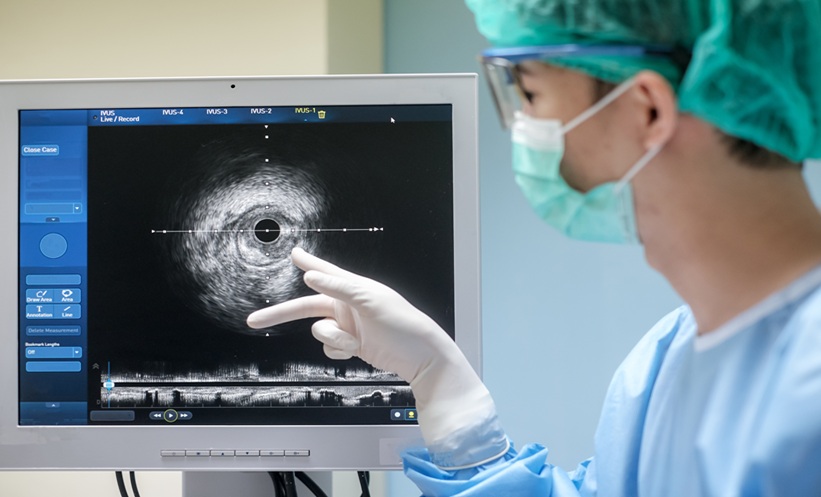
INTRAVASCULAR imaging-guided percutaneous coronary intervention (PCI) has been associated with a significant decrease in major adverse events in patients with multivessel coronary artery disease (CAD).
According to new evidence, the use of intravascular ultrasound or optical coherence tomography (OCT) during PCI may improve clinical outcomes, compared with conventional angiography imaging.
Intravascular Imaging-Guided PCI Improves CAD Outcomes
Researchers analysed five randomised controlled trials involving 3,023 patients with multivessel CAD.
Of these, 1,569 underwent intravascular imaging-guided PCI using intravascular ultrasound or OCT, while 1,454 received angiography-guided PCI.
The primary outcome assessed was major adverse cardiovascular events (MACEs).
Intravascular imaging-guided PCI was linked to a significantly lower risk of MACEs, compared with angiography-guided PCI (p<0.0001).
The reduction from imaging-guided PCI corresponded to an absolute risk reduction of 51 events per 1,000 patients.
Benefits Seen Across Imaging Modalities
Subgroup analyses demonstrated favourable outcomes for both imaging techniques.
Intravascular ultrasound guided PCI was associated with a lower rate of MACEs with angiography guidance (p<0.0001). Similarly, OCT-guided PCI also reduced event rates (p=0.014).
The researchers’ meta-analysis further suggested that both modalities outperformed angiography guidance. However, no statistically significant difference was observed between intravascular ultrasound and OCT (p=0.82).
Although OCT achieved a slightly higher score, researchers emphasised that these findings should be interpreted cautiously because of the limited available comparisons.
Evidence Supports Clinical Value
Researchers concluded that intravascular imaging-guided PCI reduces MACEs in patients with multivessel CAD, supporting the clinical value of incorporating intravascular imaging into procedural decision-making.
Similar benefits were observed across both imaging modalities, reinforcing their potential role in optimising coronary intervention outcomes in this high-risk population.
While cumulative evidence provided supporting evidence for the robustness of these findings, the required information size was not fully reached for trial sequential analysis.
Additional research could further strengthen the study’s evidence base, increasing the validity of these findings.
Reference
Mohamed AA et al. Intravascular imaging-guided versus angiography-guided percutaneous coronary intervention in multivessel coronary artery disease: a systematic review, meta-analysis, and trial sequential analysis of randomized controlled trials. BMC Cardiovasc Disord. 2026; DOI: 10.1186/s12872-026-06135-7
Featured image: Pitchy on Adobe Stock
- Author: