BACKGROUND AND AIMS
IDH-mutant Grade 4 astrocytomas are aggressive brain tumors with limited treatment options.1 According to the 2021 WHO central nervous system tumor classification, they are defined as diffuse high-grade gliomas characterized by IDH1/2, ATRX, and TP53 mutation, and sometimes CDKN2A/B deletion.2 This replaces the old nomenclature of “secondary glioblastomas” (GBM).2 Leucine-rich repeat kinase 2 (LRRK2) was first documented in a Japanese family with autosomal-dominant Parkinson’s disease.3 Park et al.4 demonstrated that LRRK2 is overexpressed in up to 40% of GBM specimens, with higher levels correlating with poor patient survival. LRRK2 is a cytoplasmic kinase that can activate the MAPK cascade, leading to uncontrolled cellular proliferation and resistance to apoptosis.5
MATERIALS AND METHODS
In silico analyses were performed using GlioVis, a web application for data visualization and analysis to explore brain tumor expression datasets.6 LRRK2 mRNA was examined in relation to overall survival and key high-grade glioma diagnostic and prognostic markers (CDKN2A/B, ATRX, PDGFRA, TERT, MGMT, TP53). Subgroup analyses were performed across transcriptional subtypes (classical, mesenchymal, and proneural).7 The proneural subtype is characterized by IDH1 and PDGFRA mutations, whereas the classical and mesenchymal subtypes are IDH– and PDGFRA-wild-type.7 GlioVis does not strictly follow the 2021 WHO classification of central nervous system tumors. As such, a GBM diagnosis in this study refers to the GlioVis classification framework rather than the WHO 2021 criteria.
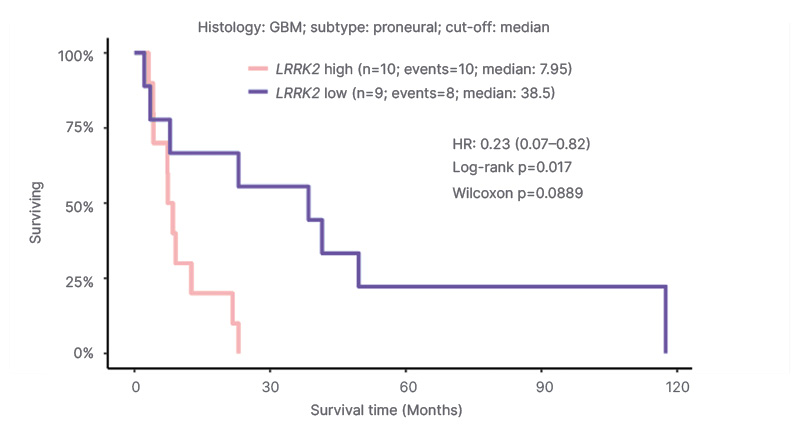
Figure 1: Kaplan–Meier survival curves for LRRK2 expression in female patients with GBM stratified by
proneural subtype.
GBM: glioblastoma.
RESULTS
In female patients with GBM, proneural subtype, low LRRK2 mRNA expression levels are associated with improved survival (hazard ratio: 0.23; p=0.017; (Figure 1). LRRK2 mRNA expression levels showed statistically significantly lower expression in the classical and mesenchymal subtypes compared to the proneural subtype (diff: 0.65, p=0.00; diff: 0.52, p=0.00) and statistically significantly higher LRRK2 expression levels in glioma-CpG island methylator phenotype (G-CIMP; diff: 0.77; p=0.00). LRRK2 mRNA expression levels revealed a correlation in the proneural subtype with CDKN2A (r=−0.37; p=0.04), ATRX (r=0.59; p=0.00), PDGFRA (r=0.26; p=0.03), TERT (r=−0.26; p=0.00), and MGMT (r=−0.49; p=0.01). No statistically significant correlations were identified with TP53 and CDKN2B.
DISCUSSION
Elevated LRRK2 mRNA expression, particularly in proneural GBM, is associated with worsened overall survival, which raises the question of LRRK2’s potential oncogenic role (Figure 1). LRRK2 mRNA expression levels appear more elevated in the proneural subtype of GBM, which is associated with IDH1 mutations.7 This evidence is solidified by the higher LRRK2 mRNA expression levels in G-CIMP, which are associated with an IDH-mutant genotype.8 In addition, a positive correlation with PDGFRA, whose higher mRNA expression levels are associated with IDH-mutant Grade 4 astrocytomas,9 and a negative correlation with CDKN2A, whose deletions are a diagnostic criterion for IDH-mutant Grade 4 astrocytomas,2 demonstrate that higher LRRK2 expression levels correlate with an IDH-mutant Grade 4 astrocytoma genotype. This is further supported by the negative correlation with TERT, whose higher expression levels are associated with TERT promoter mutation, which is atypical of IDH-mutant Grade 4 astrocytomas.10 LRRK2 has a negative correlation with MGMT in the proneural subtype. In IDH-mutant Grade 4 astrocytomas, MGMT promoter methylation is not prognostic or predictive of response to temozolomide.1 Hence, the clinical significance of the negative correlation between LRRK2 and MGMT mRNA expression levels in IDH-mutant Grade 4 astrocytomas remains unclear.
CONCLUSION
LRRK2 may represent a key oncogene in IDH-mutant Grade 4 astrocytomas. LRRK2 inhibition could represent a potential therapeutic strategy in these types of high-grade gliomas.