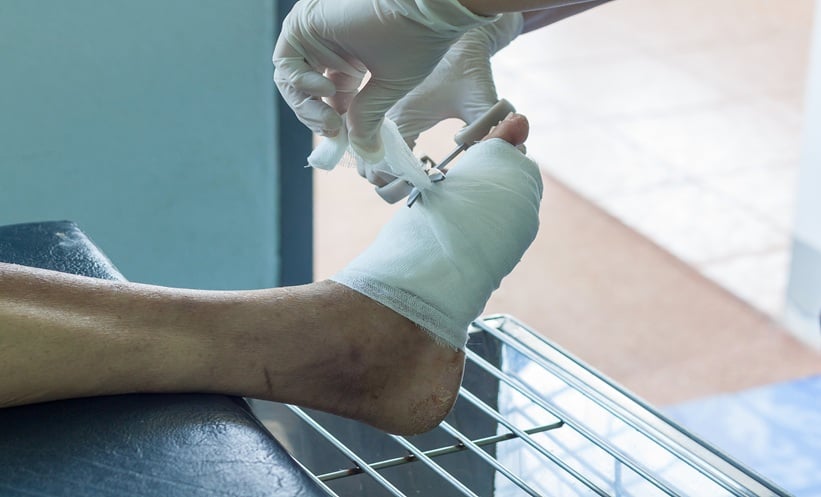
THERAPEUTIC USE of stem cells and growth factors would provide significant improvements in the healing of diabetic foot ulcers (DFU), according to a new review paper. This meta-analysis assessed the application of mesenchymal stem cells, mononuclear cells, pluripotent stem cells, and a series of key growth factors, including epidermal growth factor, platelet-derived growth factor, vascular endothelial growth factor, and platelet-rich plasma, and their efficacy at treating DFUs. The authors highlight that there is growing evidence that both stem cell and growth factor-based therapy could improve angiogenesis, reduce chronic inflammation, and restore the defective extracellular matrix associated with diabetic wounds.
Current Outlook for Patients with Diabetic Foot Ulcer
Global estimates suggest nearly 19 million people have DFUs. Infection of these wounds occurs in nearly half of patients, with around 20% of moderate-to-severe infections ultimately resulting in lower-limb amputation. The 5-year mortality rate for patients with DFU is around 30%, but this soars to 70% in patients who have undergone amputation.
The Potential of Stem Cells and Growth Factors in Diabetic Foot Ulcers
Existing treatments for DFUs are focused on slowing disease progression and easing symptoms. However, in the review, the authors highlight Mesenchymal stem cells (adult multipotent stem cells) as showing potential to heal DFUs as they can stimulate angiogenesis and skin regeneration, but also regulate immune responses and excess inflammation, which prevent the wound from healing.
Similarly, the growth factors could be highly effective at healing DFUs through fibroblast chemotaxis and other cellular migration, plus angiogenesis, endothelial cell stimulation, and regulation of inflammatory cells.
Future Applications of the Approach
The authors highlight that their literature review has shown meaningful progress in stem cell and growth factor therapies for diabetic foot ulcers, with clear evidence of improved angiogenesis and wound healing, but critically reducing the risk of amputation.
However, the authors note that while there is a growing number of comparative evaluation studies, these are often limited by small sample sizes and short follow-up times, alongside a lack of heterogeneous formulations and inconsistent delivery methods. These limitations restrict the external validation required for clinicians to broadly adopt the use of stem cells and growth factors to treat diabetic foot ulcers.
As such, the authors propose that developing standardised, clinically validated protocols to be scrutinised through larger, long-term studies is essential to ensure reliable outcomes, and thus, provide a pathway to integrate such regenerative strategies effectively into routine DFU management.
Reference
Metwaly A et al. Limb Salvage: a review of stem cell and growth factor therapies for diabetic foot ulcers. Diabetes Res Clin Pract. 2025;231:113036.
Author: Adam Michael, Director and Founder, 80th Atom, Greater Cambridge Area, UK