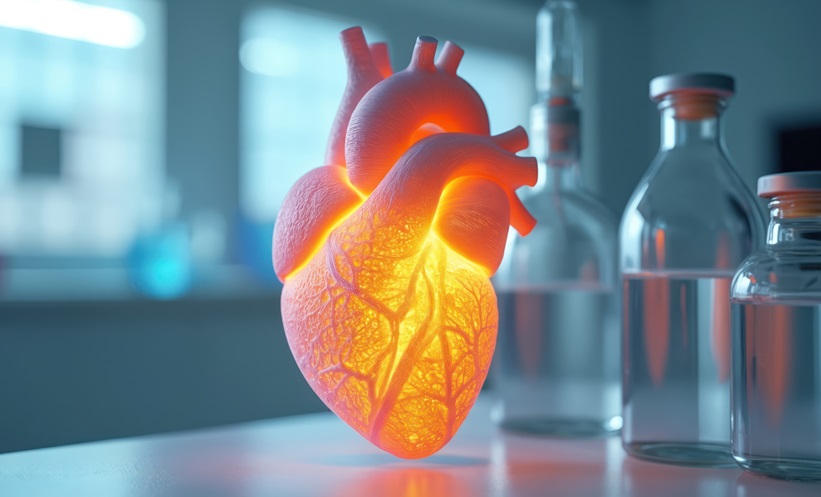
SCIENTISTS have created a lab-grown heart that beats autonomously, offering unprecedented insight into cardiac function. The lab-grown heart integrates ultrasoft sensors, allowing researchers to measure forces at cellular and tissue levels in real time, advancing drug testing and disease modelling.
Advancing Cardiac Research with Lab-Grown Heart Models
Researchers at Université de Montréal and CHU Sainte-Justine have developed a lab-grown heart using patient-derived stem cells. By 3D bioprinting heart tissue with bio-ink, the team created personalised human heart models. The lab-grown heart integrates micro-sensors that measure mechanical stresses at the cellular and tissue levels, providing a more detailed understanding than traditional heart-on-a-chip devices. This breakthrough allows scientists to observe how cardiac tissues respond to drugs and other interventions in real time.
Methods and Results of the Lab-Grown Heart Study
In the study published in Small, researchers seeded neonatal rat cardiomyocytes within a fibrin/Geltrex hydrogel containing edge-labelled microspherical stress gauges. Over time, tissues aligned, compacted, and beat spontaneously. Calcium activity was tracked, revealing real-time waves that trigger each contraction. Reduced fibrin concentration enhanced beating frequency, regularity, and contractile force. Drug testing showed norepinephrine increased contractile force, while blebbistatin inhibited contraction. This confirms the lab-grown heart can respond pharmacologically like human tissue. Local cell-scale stresses corresponded with global tissue contractions, and dual cell-seeding chambers with flexible pillars allowed multi-scale measurements. The platform offers continuous, non-destructive monitoring of contractile stress for precise drug evaluation and mechanistic studies.
Implications for Future Cardiac Treatments
The lab-grown heart represents a major step toward precision medicine. Clinicians and researchers could use this technology to model patient-specific cardiovascular diseases, including dilated cardiomyopathy and arrhythmias. It enables preclinical drug testing without invasive procedures, potentially reducing reliance on animal models. Future work may refine the system to mimic more complex disease states and test new therapies, offering safer and more effective treatment options tailored to individual patients.
Reference
Mousavi A et al. Heart‐on‐a‐chip with integrated ultrasoft mechanosensors for continuous measurement of cell‐ and tissue‐scale contractile stresses. Small. 2025;DOI:10.1002/smll.202504493.
- Author: