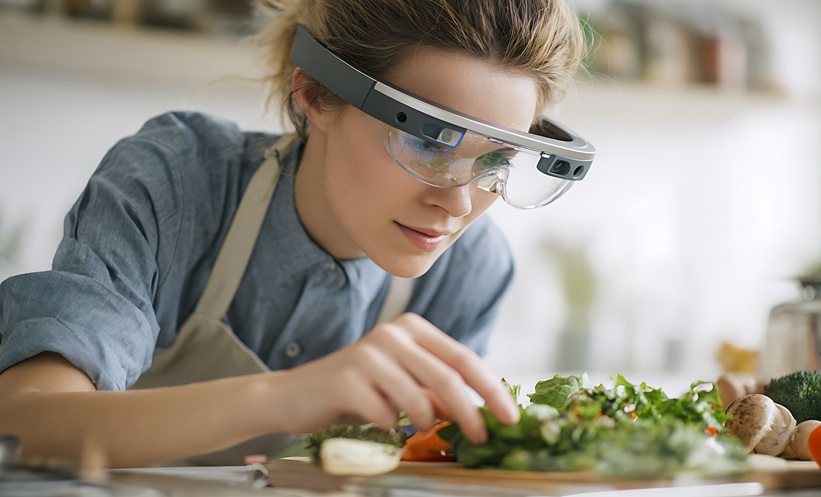
A NEW AI Assistant system using smart glasses could transform how people monitor diet and nutrition. Researchers report that the technology automatically detects meals, analyses food intake, and delivers personalised dietary insights to support healthier daily eating habits.
AI Assistant Technology for Continuous Dietary Monitoring
Traditional dietary tracking methods often rely on manual food logging, which can be time consuming and prone to inaccuracies. Other automated systems frequently struggle to recognise complex meals or analyse dietary behaviour in meaningful ways.
To address these challenges, researchers developed DietGlance, a knowledge empowered AI Assistant designed to monitor eating behaviour during daily routines. The system integrates multimodal data captured through smart eyeglasses, which detect ingestive episodes and collect privacy preserving images of meals. By identifying food items and estimating quantities, the AI Assistant can generate nutritional analysis and deliver personalised dietary recommendations based on a reliable nutrition knowledge base.
Study Evaluates Performance of AI Assistant System
The DietGlance AI Assistant was evaluated through two user studies designed to test usability and real-world performance. A short-term study involving 33 participants examined the system’s ability to identify foods and automatically log dietary intake. Results demonstrated accurate meal identification and the ability to provide detailed nutritional analysis across diverse dishes, including culturally specific cuisines.
Researchers also conducted a four-week longitudinal study involving 16 participants to evaluate behavioural impact. Participants reported that the AI Assistant improved efficiency in dietary tracking by automating food logging and analysis. Comparative testing also showed that the retrieval augmented generation module improved the relevance to the query, coherence, fluency, and accuracy of dietary suggestions.
Despite these strengths, the study identified several technical challenges. Image based recognition occasionally struggled with visually similar foods, while portion size estimation proved difficult during shared meals. Researchers also reported limitations in estimating certain micronutrients accurately.
Future Applications for AI Assistant Driven Nutrition Tools
The findings suggest that AI Assistant technologies, such as DietGlance, could play an important role in personalised nutrition and preventive healthcare. By automating dietary monitoring and delivering context-aware insights, these systems may encourage healthier eating behaviours and improve long term wellness. With further refinement, AI Assistant driven dietary monitoring systems could become valuable tools for both everyday wellness tracking and clinical nutrition support.
Reference
Jiang Z et al. DietGlance: dietary monitoring and personalized analysis at a glance with knowledge-empowered AI assistant. ACM Transactions on Computing for Healthcare. 2025;DOI:10.1145/3797883.
Featured image: gomer on Adobe Stock
- Author: