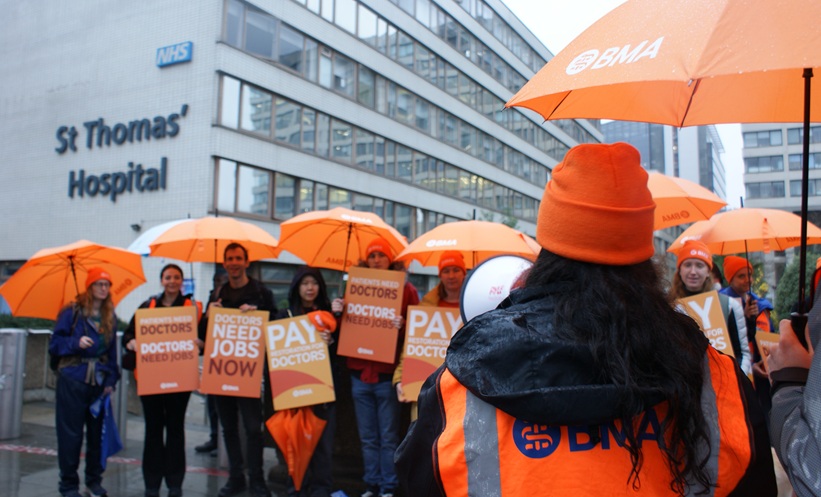
RESIDENT doctors in England have announced six days of official strike action next month, after weeks of negotiations around pay erosion and job shortages broke down between the British Medical Association (BMA) and the government.
The strike will run from 7 a.m. on 7th April to 6:59 a.m. on 13th April, marking the joint longest walkout of the dispute, which has seen intermittent discussions between the parties in the past year.
It follows the BMA’s Resident Doctors Committee’s (RDC) rejection of the Secretary of State for Health and Social Care’s most recent offer, which the BMA RDC deemed “insufficient”.
The Offer
Doctors were offered a 3.5% pay rise this year, as recommended by the independent review body and subsequently accepted by the government.
The government also proposed coverage of some expenses, such as mandatory Royal College exam fees, and an increase in the number of training posts available across a 3-year period.
Resident doctors were also given the opportunity for faster progression through pay bands.
Dr Jack Fletcher, chair of the BMA’s Resident Doctors Committee, said: “We have been negotiating in good faith for weeks to try and end the simultaneous pay and jobs crises for resident doctors.
“Frustratingly we had been making good progress right up until the point, in the last two weeks, when the Government began to shift the goalposts.
“As talks progressed it became clear that the money proposed for pay increases was now going to be spread over three years.
“This is combined with today’s pay review body (DDRB) recommendation of a 3.5% uplift pointing to yet more years in which our pay, at best, barely treads water.”
The RDC reported that any deal that does not substantially move resident doctors towards their goal of pay restoration will be rejected.
Another worry in the current climate is continual pay erosion in the context of rates of global inflation and significant levels of emigration among UK doctors, Fletcher continued.
“We also cannot ignore that, thanks to global events, economic indicators now point to years of greatly increased inflation.
“We are simply not going to put an offer to doctors that risks locking in further erosion of pay at a time when doctors continue to leave the UK for other countries.”
The BMA argues that despite pay rises over the past 3 years, when considered alongside inflation, residents doctors’ pay remains one fifth lower than it was in 2008.
The Negotiation
The government said that RDC leaders engaged in extensive talks “in good faith”, but it was nonetheless deeply disappointing that the RDC rejected the offer.
Health and Social Care Secretary, Wes Streeting, said: “This government has pulled every lever available to put forward a generous package – developed in tandem with BMA – that would have transformed the working lives and career prospects of resident doctors.
“I would like to thank the leaders of the BMA’s RDC for the constructive approach they have shown to the intensive talks we have had since the turn of the year.
“I am only sorry that this has not resulted in an agreement.”
Both parties remain willing to negotiate, and the Health Secretary has urged the resident doctors’ union to reconsider the offer.
The RDC reportedly remains open to talks and has in turn encouraged the government to act fast to prevent the industrial action.
Featured image: Anna Caldwell
- Author: