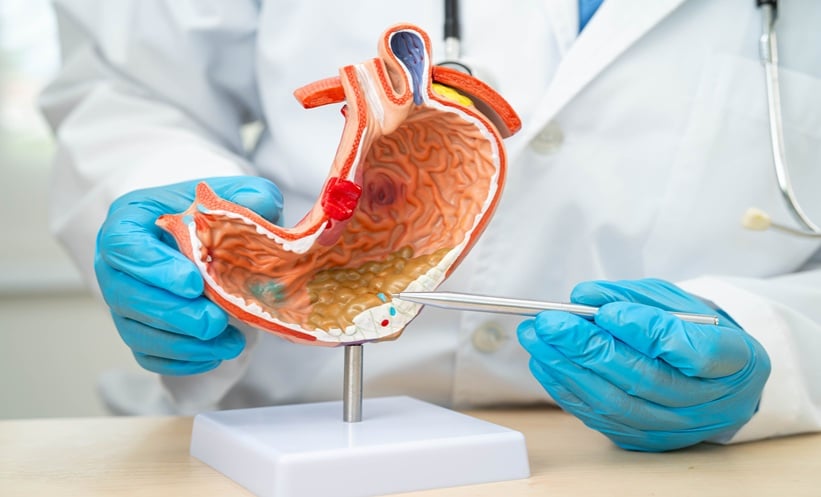
A NEW study has identified CXCL12 and eotaxin as independent gastric cancer biomarkers, offering fresh insight into predicting survival outcomes in patients with gastric cancer.
Gastric cancer remains one of the leading causes of cancer-related mortality worldwide, largely due to late diagnosis and limited treatment options for advanced disease. As a result, there is a pressing need for reliable prognostic tools to guide clinical decision-making and personalise patient care. Serum-based biomarkers, which can be measured through minimally invasive blood tests, have emerged as a promising avenue for improving risk stratification.
Gastric Cancer Biomarkers and Prognostic Value
In this retrospective cohort study, researchers analysed 240 patients who underwent surgery for histologically confirmed gastric adenocarcinoma at Helsinki University Hospital between 2000–2009. Using multiplex cytokine assays, the team evaluated 48 circulating proteins to identify potential gastric cancer biomarkers associated with disease-specific survival.
Three markers showed significant prognostic value in univariate analysis: CXCL12 (hazard ratio [HR]: 0.39; 95% CI: 0.23–0.63; p<0.001), stem cell factor (HR: 0.38; 95% CI: 0.19–0.77; p=0.007), and eotaxin (HR: 0.57; 95% CI: 0.37–0.89; p=0.013). However, in multivariate analysis, only CXCL12 and eotaxin remained independent predictors of survival, highlighting their potential clinical relevance.
CXCL12, a chemokine involved in immune cell trafficking and tumour microenvironment regulation, appeared to be strongly associated with improved survival outcomes. Similarly, eotaxin, an inflammatory mediator, demonstrated independent prognostic significance, suggesting that immune-related pathways play a critical role in gastric cancer progression.
Clinical Implications and Future Directions
These findings reinforce the importance of the tumour immune microenvironment in shaping disease trajectory. The identification of CXCL12 and eotaxin as independent gastric cancer biomarkers may support more accurate prognostic assessment and help clinicians identify patients who could benefit from closer monitoring or tailored therapeutic strategies.
Notably, CXCL12 has been implicated in pro-tumour signalling in other cancer types, highlighting the complex and context-dependent role of inflammatory pathways in gastric cancer.
The authors noted several limitations, including the retrospective design and the single-centre cohort, which may limit generalisability. Additionally, while the biomarkers showed statistical significance, their integration into routine clinical practice will require validation in larger, prospective studies.
Overall, this study provides compelling evidence that inflammatory serum markers could enhance prognostic precision in gastric cancer, potentially paving the way for more personalised oncology care.
Reference
Brodkin J et al. CXCL12 and eotaxin are independent prognostic serum biomarkers in gastric cancer. Sci Rep. 2026;DOI:10.1038/s41598-026-46511-z.
Featured image: Pakawadee on Adobe Stock
- Author: