AI or Radiologist Interpretation for Prostate Cancer Diagnosis - European Medical Journal

This site is intended for healthcare professionals

AI or Radiologist Interpretation for Prostate Cancer Diagnosis

1 Mins
Radiology
Download PDF
Authors:
* Alexander B.C.D. Ng , 1,2 Aqua Asif , 1,2 Aishwarya R. Shah , 1,2 Alexander Dudko , 1,2 Ranya Kumar , 1,2 Pawel Rajwa , 1,2 Doug Pendse , 3 Veeru Kasivisvanathan 1-4
  • 1. Division of Surgery and Interventional Science, University College London, UK
  • 2. Centre for Urology Imaging, Prostate, AI and Surgical Studies (COMPASS) Research Group, University College London, UK
  • 3. Department of Radiology, University College London Hospitals NHS Foundation Trust, UK
  • 4. Department of Urology, Comprehensive Cancer Center, Medical University of Vienna, Austria
*Correspondence to [email protected]
Disclosure:

The authors disclose that the PARADIGM trial is supported by The John Black Charitable Foundation, the National Institute for Health and Care Research, the European Association of Urology (EAU) Research Foundation, and Hadyn Cunningham. Ng is supported by the NIHR through a Doctoral Fellowship, outside of the submitted work. Asif is supported by the NIHR through an Academic Clinical Fellowship, outside of the submitted work.

Citation:
EMJ Radiol. ;7[1]:34-35. https://doi.org/10.33590/emjradiol/2E4XTRU6.
Keywords:
AI, MRI, prostate cancer.

Each article is made available under the terms of the Creative Commons Attribution-Non Commercial 4.0 License.

BACKGROUND AND AIMS

Following the PRECISION trial, prostate multiparametric MRI has been adopted as the first-line investigation for suspected prostate cancer internationally.1 However, international data demonstrates that, due to resource limitations, not every patient who requires a pre-biopsy MRI has been receiving one. The PRIME trial has recently demonstrated the non-inferiority of biparametric MRI to multiparametric MRI for clinically significant prostate cancer detection,2 and this is a step towards allowing more men to be scanned with existing resources.

With the global incidence of prostate cancer predicted to double in the next 20 years,3 the potential adoption of biparametric MRI,2 and the introduction of national MRI screening programmes,4 the demand for prostate MRI is set to rise substantially. Interpretation, however, has a steep learning curve, with optimal performance achieved by expert genitourinary radiologists.5 With a rising demand for medical imaging and a projected 40% radiologist shortfall by 2027,6 a prompt international solution is warranted.

PARADIGM aims to evaluate whether AI is non-inferior to radiologists in detecting clinically significant prostate cancer (Gleason Grade Group ≥2).7,8

METHODS

PARADIGM is an international, prospective, multicentre, non-inferiority, within-patient, level 1 evidence diagnostic study. Five hundred men will be recruited over 18 months. These men will undergo standard of care MRI with either 1.5 or 3.0 T and at least a pelvic phased array coil. The radiologist and a primary AI algorithm will report the MRI, blinded from each other. The radiologist will then be unblinded and produce a merged report, with the ability to overrule AI findings for safety. Suspicious lesions identified by either AI or the radiologist will undergo targeted biopsies, with optional perilesional and/or systematic biopsies. The primary outcome is the proportion of men with clinically significant cancer. Planned secondary outcomes include the proportion of men with clinically insignificant cancer (Gleason Grade Group 1), test performance characteristics of AI and radiologists, and health economics analysis.

RESULTS

Eighty-one centres from 25 countries (six continents) have expressed an interest in taking part and are undergoing pre-trial MRI quality control (Figure 1). PARADIGM will open to recruitment in October 2026.
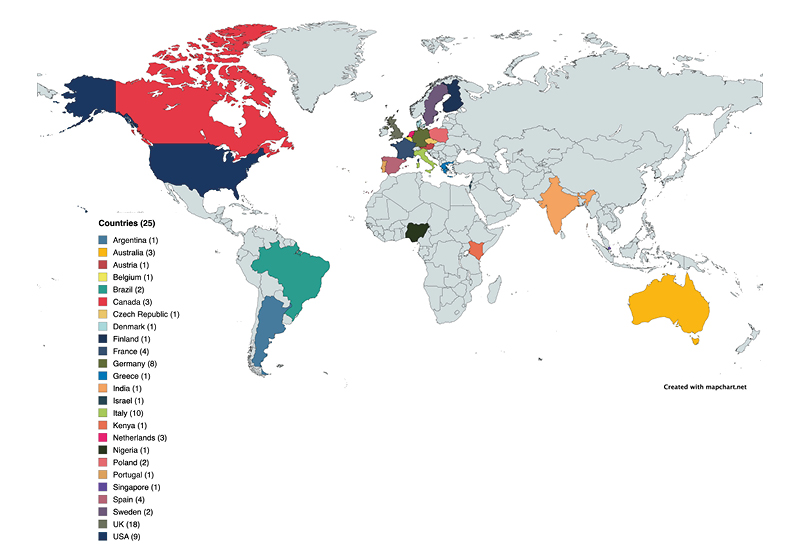
Figure 1 Eighty-one centres from 25 countries and six continents have expressed interest in taking part in the PARADIGM trial

Figure 1: Eighty-one centres from 25 countries and six continents have expressed interest in taking part in the PARADIGM trial.

CONCLUSION

PARADIGM will provide the first prospective, Level 1 evidence on the diagnostic performance of AI in the detection of clinically significant prostate cancer on MRI.


References
Kasivisvanathan V et al.; PRECISION Study Group Collaborators. MRI-targeted or standard biopsy for prostate-cancer diagnosis. N Engl J Med. 2018;378(19):1767-77. Ng ABCD et al.; PRIME Study Group Collaborators. Biparametric vs multiparametric mri for prostate cancer diagnosis: the prime diagnostic clinical trial. JAMA. 2025;334(13):1170-9. James ND et al. The Lancet commission on prostate cancer: planning for the surge in cases. Lancet. 2024;403(10437):1683-722. Burki T. Prostate Cancer UK launches the TRANSFORM trial. Lancet. 2024;403(10438):1738. de Rooij M et al. ESUR/ESUI consensus statements on multi-parametric MRI for the detection of clinically significant prostate cancer: quality requirements for image acquisition, interpretation and radiologists’ training. Eur Radiol. 2020;30(10):5404-16. The Royal College of Radiologists. Clinical radiology census reports. Available at: https://www.rcr.ac.uk/news-policy/policy-reports-initiatives/clinical-radiology-census-reports/. Last accessed: 29 February 2024. Ng ABCD et al. Artificial intelligence or radiologist interpretation for prostate cancer diagnosis. Abstract 21227. ECR, 4-8 March, 2026. Ng ABCD et al. Artificial intelligence in prostate cancer diagnosis on magnetic resonance imaging: time for a new PARADIGM. Eur Urol. 2025;88(1):4-7.

Rate this content's potential impact on patient outcomes

Average rating / 5. Vote count:

No votes so far! Be the first to rate this content.