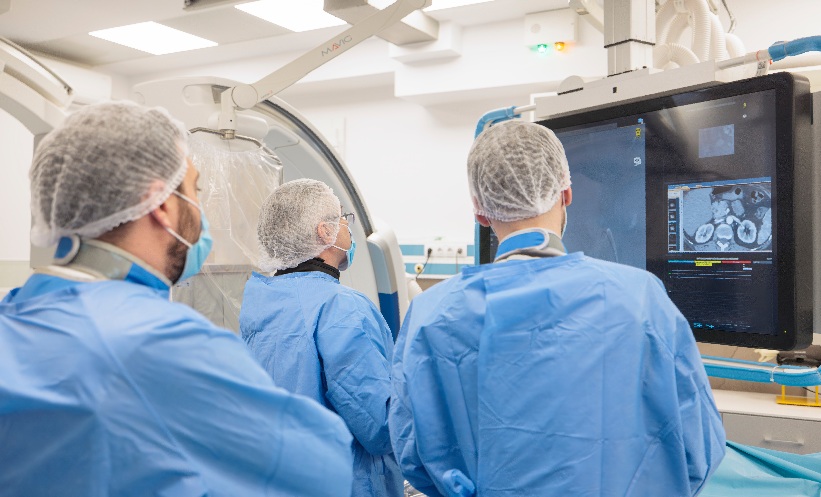
A NEW analysis suggests that transradial approach (TRA) and transfemoral approach (TFA) access routes result in comparable radiation exposure during endovascular treatment of intracranial aneurysms, offering reassurance for clinicians weighing procedural approaches in routine practice.
Endovascular aneurysm treatment is widely used for managing cerebral aneurysms. It involves navigating catheters through blood vessels to repair weakened arterial walls in the brain.
Given that many patients are diagnosed relatively early in life (with a mean age at diagnosis between 43 to 55 years) and often have favourable long-term survival, minimising radiation exposure remains a key consideration for interventional teams.
No Radiation Gap Between TRA vs TFA Approaches
The retrospective single-centre study reviewed 209 patients treated between May 2023 and April 2025. Of these, 37% underwent TRA and 63% TFA. Median radiation exposure, measured as dose area product (DAP), was 72.2 Gy∙cm2.
Multivariable analysis found no significant difference in radiation exposure between TRA and TFA. TRA has been linked to improved patient comfort, earlier mobilisation and fewer access-site complications, but catheter navigation can be more challenging in certain anatomical scenarios.
Device Choice and Patient Factors Influence Exposure
The cohort included 27% ruptured and 73% unruptured aneurysms, and median body mass index was 26.
Stent-assisted coiling was linked to markedly higher radiation exposure (p < 0.001). Female sex was also associated with increased DAP (p < 0.02), although the underlying reasons were not explored in detail.
Clinical Context and Technical Considerations
TRA can introduce procedural challenges, particularly in cases where there is high vascular tortuosity or anatomical variants such as radial loops or elongated aortic arches. These factors necessitate catheter repositioning or imaging runs, potentially affecting fluoroscopy time, therefore affecting radiation exposure.
As a retrospective, single-centre analysis, the results may only reflect local expertise, and established workflows. Furthermore, it is unclear if any patients had anatomical variants that could increase imaging run time – in these cases a comparison between TFA and TRA could be useful for interventional radiologists.
The findings suggest that operator choice between TRA and TFA can prioritise clinical and logistical considerations without increasing radiation burden. However, the observed rise in exposure with stent-assisted coiling highlights the need for continued optimisation of technique and imaging protocols.
Reference
Peter G et al. Radiation exposure in transradial versus transfemoral access in endovascular treatment of intracranial aneurysms. Eur Radiol. 2026;DOI:10.1007/s00330-026-12603-7.
Featured image: Damian on Adobe stock
- Author: