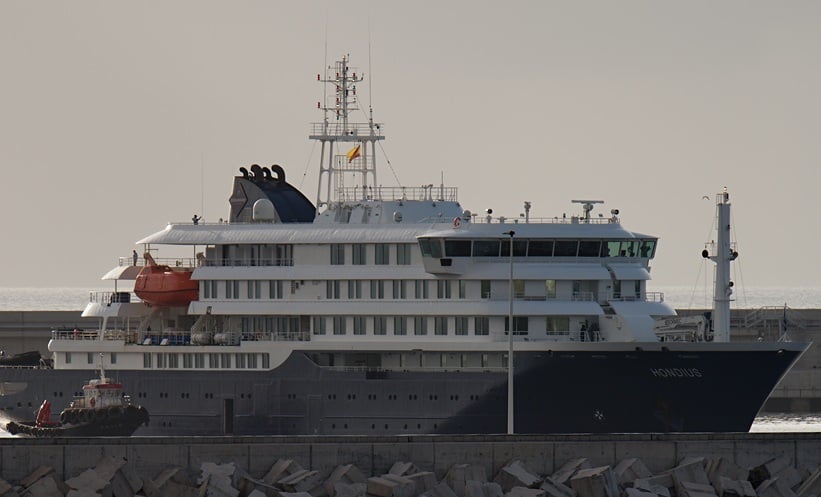
THE EUROPEAN Centre for Disease Prevention and Control (ECDC) has deployed additional experts through the EU Health Task Force on 9th May, to provide technical and operational support to the Spanish authorities as needed, amid the MV Hondius’ arrival at the port of Granadilla, Tenerife, Canary Islands, on 10th May.
This follows a recent outbreak of hantavirus aboard the multi-country cruise ship, following notification of what is now known to be the Andes virus to WHO on 2nd May.
Disembarkation and Medical Evacuation
WHO assesses the risk to the general population as low, but authorities are taking appropriate precautions as passengers and crew continue to disembark and to be medically evacuated to their countries of origin.
At disembarkation, they are all considered high-risk and repatriated, whether symptomatic or not, through non-commercial flights, ECDC has reported.
As per the authority’s scientific advice, symptomatic passengers and crew require immediate medical isolation, testing, and medical care, while those who are asymptomatic are asked to quarantine and monitor for symptoms for up to six weeks.
On 11th May, one new confirmed case was reported in France: a former passenger who developed acute symptoms on the flight returning to France and who is currently in intensive care.
Dr Pamela Rendi-Wagner, Director, ECDC, Solna, Sweden, said: “Because of remaining uncertainties and the long incubation period, it is possible that we may see additional cases in former passengers and crew in the coming weeks.
“This is why ECDC’s precautionary approach since the beginning has been very important.”
The deployment of additional experts is in addition to one ECDC expert who had been onboard the MV Hondius since 6th May.
The health authority continues to work closely with Member States, the European Commission, WHO, and other partners to support a coordinated response and information-sharing.
Source of the Outbreak
In relation to the Andes virus outbreak, ECDC rapidly engaged the EU Public Health Reference Laboratory for emerging, rodent-borne, and zoonotic viral pathogens to provide support to the Member States to ensure rapid and high-quality diagnostics.
Recent genetic sequencing strongly suggests the confirmed tested passenger samples are linked to the same original source of infection.
Genomic information also shows the virus involved in the outbreak is similar to Andes viruses already known to circulate in South America and is not a new variant.
There is currently no evidence that this variant spreads more easily or causes more severe disease than other Andes viruses, ECDC reported.
In line with WHO risk assessments, ECDC maintains that the risk for the general population in the EU/EEA is very low.
Featured image: pavel1964 on Adobe Stock
- Author: