BACKGROUND AND AIMS
Immune-checkpoint inhibitors (ICI) are an indispensable part of first-line treatment concepts for most patients with metastatic non-small cell lung cancer without targetable driver mutations.1 Still, long-term response is rare, and data on predictive biomarkers are limited, with the expression of programmed death-ligand 1 (PD-L1) being the only one used in daily clinical practice.
As part of the Daiichi Sankyo ENDEAVOUR program supporting young lung cancer researchers, the ENDEAVOUR-IMIGO working group was formed to explore novel biomarkers from imaging and genetic testing, including AI methods.
METHODS AND RESULTS
As a first exploratory analysis,2 ‘super-responders’ to first-line ICI treatment with a progression-free survival of ≥24 months were identified from three separate registries in Linz (Austria), Groningen (the Netherlands), and Milan (Italy), and compared for their baseline characteristics.
Of interest, the rate of super-responders was very similar in the three cohorts, with 50/402 (12.4%) in the Linz, 46/428 (10.7%) in the Groningen, and 45/283 (15.9%) in the Milan cohort. Baseline characteristics of the respective cohorts are shown in Table 1, showing predominantly adenocarcinomas with a high average PD-L1 expression. Of interest, nearly half of the patients across all three cohorts had KRAS mutations.
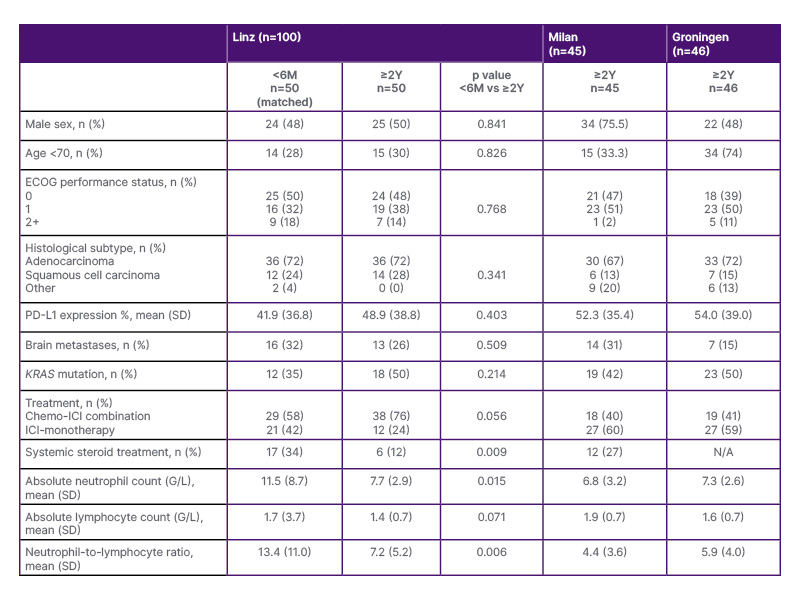
Table 1: Baseline characteristics for ICI super-responders as compared to non-responders in the Linz cohort, as well as for super-responders in the Milan and Groningen cohorts.
ECOG: Eastern Cooperative Oncology Group; M: months; ICI: immune checkpoint inhibitor; PD-L1: programmed death-ligand 1; vs: versus; Y: years.
To further elucidate possible factors associated with a ‘super-responder’ status, the Linz cohort was matched for age, sex, histology, PD-L1 positivity, stage, and Eastern Cooperative Oncology Group (ECOG) performance status with non-responders (progression-free survival <6 months). Marked differences were seen concerning a higher rate of chemo-immunotherapy combination treatment, lower use of systemic steroids at treatment initiation, and lower neutrophil-to-lymphocyte ratio in super-responders (Table 1).
CONCLUSION
The authors concluded that ‘super-responders’ to first-line ICI therapy may represent a distinct patient phenotype that showed consistent characteristics across three independent registries. Matched exploratory analyses from only the Linz cohort also showed possible implications of tumor characteristics, co-medication, and the patient’s baseline inflammatory state, which warrant further, more detailed analyses.
FUTURE DIRECTIONS
Planned next steps in the ENDEAVOUR-IMIGO project include harmonization of the national registry data and establishment of a multi-national control group, and the inclusion of broad-panel next-generation sequencing data and variables derived from CT and 18F-FDG-PET/CT into more complex models.