Key Summary:
- GAA accumulated approximately 100-fold in high-grade glioma tissue.
- Glioma-derived GAA increased neuronal activity through GABA-A receptors.
- Depleting GAA reduced neuronal activity and glioma growth in preclinical models.
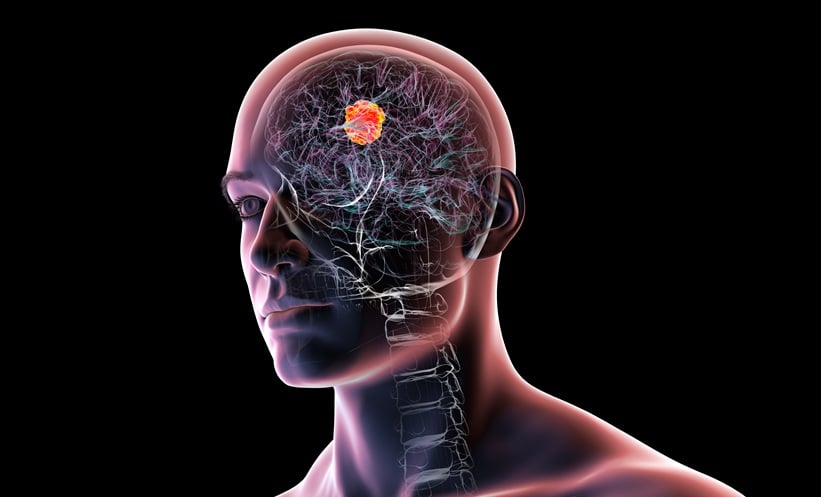
A METABOLITE produced by high-grade gliomas may stimulate surrounding neurons and promote tumour growth, revealing a potential new therapeutic target for aggressive brain cancers.
Researchers found that guanidinoacetate (GAA), an intermediate in creatine synthesis, accumulated approximately 100-fold in high-grade glioma (HGG) tissue compared with non-malignant brain. Glioma cells secreted GAA into their surroundings, where it increased neuronal activity through γ-aminobutyric acid A (GABA-A) receptors.
HGGs are aggressive brain tumours with limited treatment options. Increasing evidence suggests that interactions between gliomas and surrounding neurons contribute to tumour progression, as neuronal activity can stimulate glioma growth and invasion.
To investigate whether tumour metabolism contributes to this relationship, researchers conducted multi-omics analyses of 91 primary human brain tissue samples, including HGGs, lower-grade gliomas, brain metastases, and non-malignant tissue.
GAA emerged as a striking metabolic feature, accumulating approximately 100-fold in HGG compared with non-malignant brain. In contrast, creatine and creatinine levels were reduced, indicating that GAA accumulation did not simply reflect increased creatine production.
Further experiments showed that glioma cells produced and secreted GAA rather than converting it into creatine. This resulted from an imbalance between the creatine synthesis enzymes AGAT and GAMT. Tumour-rich tissue from the glioma margin and core also secreted substantially more GAA than normal-appearing brain tissue.
GAA also accumulates in GAMT deficiency, a rare inherited metabolic disorder associated with seizures, prompting researchers to investigate whether glioma-derived GAA could affect neuronal activity.
Experiments revealed that GAA activated GABA-A receptors. Although this signalling normally inhibits mature neurons, neurons surrounding gliomas have altered chloride regulation, changing their response to GABA-A receptor activation.
In tumour-infiltrated mouse brain tissue, GAA increased neuronal firing, but this effect was not observed in the opposite, tumour-free hemisphere. The findings suggest that gliomas exploit altered neuronal physiology to convert GAA signalling into an excitatory response.
Researchers next genetically removed AGAT, the enzyme responsible for GAA synthesis, from glioblastoma cells. This reduced GAA production without directly affecting tumour-cell growth in laboratory cultures.
However, mice implanted with AGAT-deficient glioblastoma cells survived longer than those with GAA-producing tumours. GAA depletion also reduced neuronal activity surrounding tumours and decreased tumour–neuron interactions.
Further experiments showed that GAA increased glioma-cell proliferation by approximately 50% when tumour cells were cultured alongside neurons, but had no effect when tumour cells were cultured alone, highlighting the importance of neuronal involvement.
The findings identify GAA synthesis as a potential therapeutic target linking cancer metabolism with cancer neuroscience. Further research will be required to establish whether targeting this pathway can safely and effectively treat HGG in humans.
Reference
Abdullah KG et al. Gliomas phenocopy an inborn error of metabolism to drive neuronal activity and tumor growth. Cell. 2026. doi:10.1016/j.cell.2026.08.037.
Featured image: Dr_Microbe on AdobeStock
Each article is made available under the terms of the Creative Commons Attribution-Non Commercial 4.0 License.