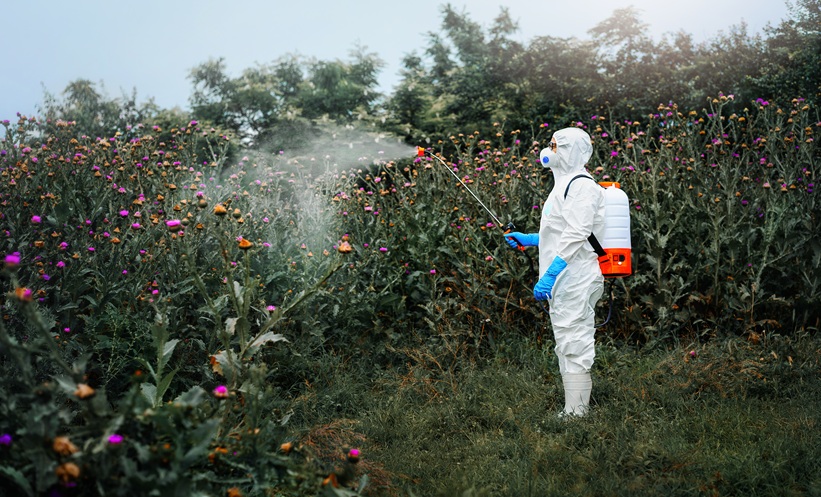
PROLONGED photosensitivity developed in a father and preschool daughter following downwind exposure to liquid glyphosate herbicide. This novel clinical report highlights a persistent light reaction lasting more than three years in the adult patient and nearly three years in the child after accidental environmental contact with spray droplets.
Clinical Presentation of Prolonged Photosensitivity
A 33-year-old man and his 4-year-old daughter experienced simultaneous acute pruritus overnight after walking roughly five meters downwind from a worker spraying weedkiller on public land during sunny, breezy weather. Within three days, both patients developed a severe erythematous, scaly, papulovesicular eruption strictly confined to sun exposed areas, including the face, neck, dorsal hands, forearms, elbows, and lower legs. Although the initial rash resolved within five days, subsequent sunlight exposures lasting 15 to 30 minutes repeatedly triggered rapid, debilitating flares.
Photobiological Assessment and Diagnostic Findings
Comprehensive monochromator phototesting confirmed severe prolonged photosensitivity in both individuals. Testing demonstrated markedly reduced minimal erythema doses across ultraviolet radiation wavelengths in the ultraviolet B and ultraviolet A spectrum between 300 and 370 nanometers, alongside papular erythema upon provocation with solar simulated radiation and broadband ultraviolet A. Standard, plant, fragrance, facial, and isothiazolinone coformulant patch and photopatch tests yielded negative results, aside from an incidental positive photopatch reaction to benzalkonium chloride in the father. Longitudinal follow up revealed gradual clinical improvement, though the father exhibited persistent abnormal minimal erythema doses at 2.5 years and mild provocation reactivity beyond three years.
Implications for Clinical Management and Prevention
Although glyphosate is a phosphonic acid derivative lacking classic structural features of phototoxic agents, individual commercial formulations or shared genetic susceptibility may drive chronic immune dysregulation. Clinicians evaluating unexplained photodistributed dermatitis should obtain detailed environmental and occupational exposure histories. Management relies on strict sunlight avoidance, broad spectrum photoprotection, topical anti-inflammatory therapy during flares, and consideration of disease modifying agents, alongside rigorous personal protective equipment for outdoor workers handling herbicides.
Reference
Ayer J et al. Prolonged photosensitivity following exposure to glyphosate herbicide. Photodermatol Photoimmunol Photomed. 2026;42:e70115.