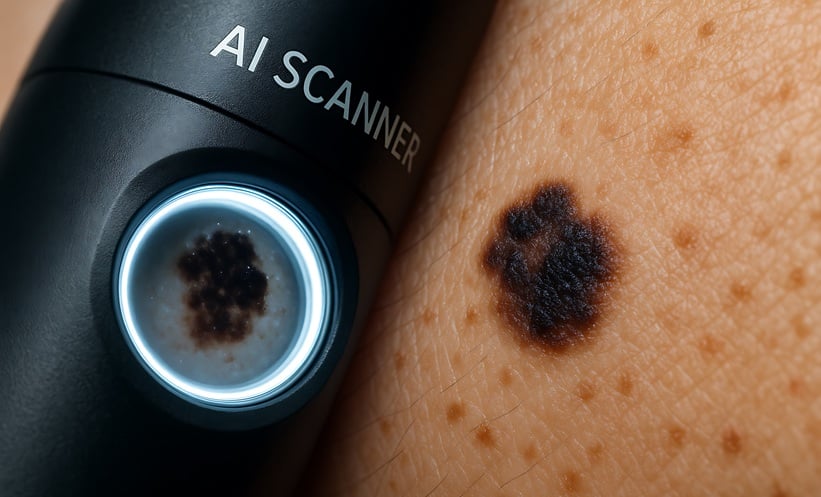
AI-ASSISTED melanoma diagnosis is showing promise in clinical settings, with new prospective evidence indicating performance comparable to dermatologists, though concerns around study quality and generalisability continue to limit immediate widespread adoption in routine dermatology practice.
Background on AI-Assisted Melanoma Diagnosis
Dermoscopy remains the standard for melanoma detection, but interest in AI-assisted melanoma diagnosis has grown rapidly as systems evolve into clinical decision support tools. Prospective evidence is critical to determine whether these technologies can match or enhance dermatologist performance in real-world diagnostic settings.
Methods and Results of AI-Assisted Melanoma Diagnosis
This systematic review and meta-analysis included 11 prospective studies with more than 2500 patients and 50 dermatologists. Data sources included PubMed, Embase, Web of Science, and Google Scholar through July 9, 2025. Eligible studies used dermoscopic images and histopathology as the reference standard. Diagnostic outcomes included sensitivity, specificity, accuracy, and balanced accuracy.
The analysis revealed that dermatologists achieved pooled sensitivity of 78.6% 95% CI 67.5% to 88.1% and specificity of 75.2% 95% CI 63.3% to 84.3%. AI systems showed sensitivity of 80.9% 95% CI 63.6% to 94.5% and specificity of 75.6% 95% CI 64.5% to 85.6%. Accuracy was 73.3% for AI versus 75.3% for dermatologists, and balanced accuracy was 78.3% versus 77.4%. In AI-assisted melanoma diagnosis, one study reported sensitivity of 91.9% and specificity of 83.7%. Head-to-head comparisons showed higher specificity for AI, including 94.0% and 98.3% versus 85.5%, 78.8% and 75.3% versus 29.3%, and 88.9% versus 72.1%, with similar sensitivity values.
Clinical Implications and Future Directions
These findings suggest AI-assisted melanoma diagnosis could support clinicians by maintaining diagnostic sensitivity while potentially reducing unnecessary biopsies through improved specificity. However, most studies showed a high risk of bias in patient selection and index test domains, often due to preselected lesions and simplified classifications. Clinicians should therefore interpret current evidence cautiously and avoid overreliance on AI tools in isolation. Larger, multicentre prospective studies in unselected populations are needed to validate safety, reliability, and clinical utility. Future work should prioritise robust study design, diverse datasets, and integration into clinical workflows to ensure AI-assisted melanoma diagnosis delivers meaningful improvements in patient care.
Reference
Laiouar-Pedari S et al. Prospective evidence on artificial intelligence−assisted melanoma diagnostics: a systematic review and meta-analysis. JAMA Dermatol. 2026;DOI:10.1001/jamadermatol.2026.0217.
Featured image: Creative Studio on Adobe Stock