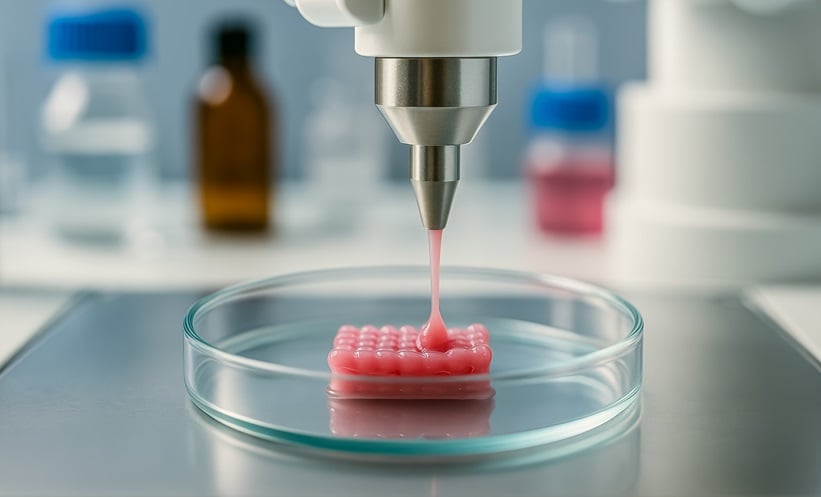
FROM LABORATORY printers to living tissue, 3D bioprinting is emerging as a powerful alternative to animal testing. New work from Vienna shows how printed human skin models could transform research into chronic inflammatory skin diseases while improving scientific reliability and ethical standards.
Why Skin Research Needs 3D Bioprinting
Chronic inflammatory skin diseases such as psoriasis, eczema, and acne affect roughly one quarter of Europe’s population and place a heavy burden on health systems. Developing effective therapies has long relied on animal experiments, yet animal skin differs markedly from human skin in structure and immune response. As a result, findings often fail to translate into clinical benefits. In vitro approaches are therefore essential, but traditional laboratory skin models struggle to replicate the immune complexity of real tissue. Researchers argue that 3D bioprinting offers a route to more realistic, immunocompetent skin models that better reflect human disease biology.
Building Immunocompetent Skin With 3D Bioprinting
In a new review published in Advanced Healthcare Materials, researchers from TU Wien and the Medical University of Vienna assessed current strategies for modelling immune mediated skin diseases. Earlier approaches, such as embedding connective tissue cells in collagen or relying on self-assembly stimulated by vitamin C, provided limited structural control and poor reproducibility. These methods also made it difficult to integrate immune cells or vascular features that are critical for chronic inflammation. The review highlights how 3D bioprinting enables precise spatial placement of multiple cell types within biomaterials, improving consistency and scalability. Advances in bioprinting technologies promise to reduce technical variability and support upscaling, addressing key limitations of manual techniques. While challenges remain, including cell variability, bioink selection, and culture media that support all cell types, the authors emphasise that overcoming these barriers could significantly enhance disease modelling. The work aligns with the 3Rs framework to reduce animal testing and supports legislation aimed at minimising animal use in research and product testing.
Clinical Implications and Future Directions
Looking ahead, the researchers argue that the next decade of 3D bioprinting should focus on fully integrated skin models that include immune components, blood vessels, appendages, and microbiome interactions. For clinicians, such platforms could accelerate drug testing, support personalised treatment strategies, and improve translation from bench to bedside. If successful, 3D bioprinting may ultimately replace animal models in skin disease research and enable precision medicine approaches for patients with chronic inflammatory conditions.
Reference
Andrea Ulloa‐Fernández A et al. Advances in bioprinting to model immune‐mediated skin diseases. Advanced Healthcare Materials. 2025;DOI:10.1002/adhm.202503806.