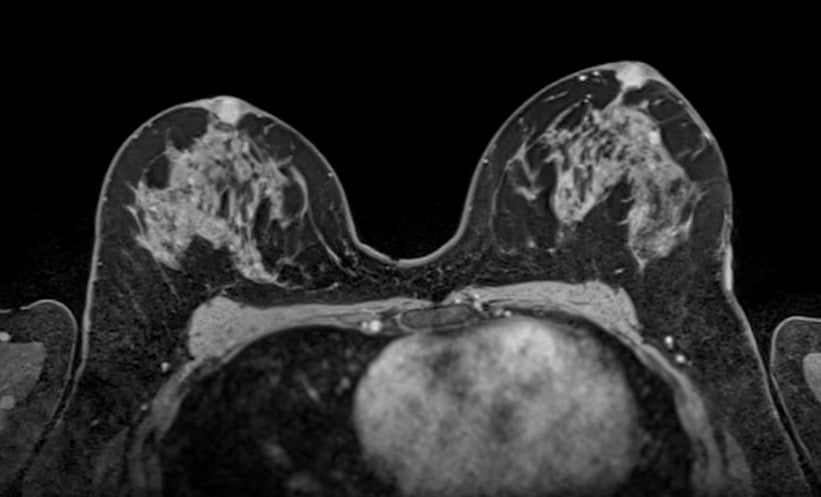
A recent study indicates that using gadopiclenol at half the standard gadolinium dose delivers comparable —or in some cases superior—contrast enhancement in breast MRI compared with full-dose gadobutrol. These findings could influence imaging protocols for high-risk patients while minimising cumulative gadolinium exposure.
Why Breast MRI Matters
Breast magnetic resonance imaging (MRI) is a critical tool for detecting and monitoring breast cancer, particularly for early detection in women with BRCA1 or BRCA2 gene mutations. Dynamic contrast-enhanced MRI, which relies on gadolinium-based contrast agents, highlights vascularised tissue, helping radiologists detect lesions with sensitivities above 90% in dense breast tissue. However, cumulative gadolinium deposition in the body and potential environmental contamination remain concerns, particularly for patients requiring with impaired kidney function.
Understanding Gadobutrol
Gadobutrol is a macrocyclic chelate designed to bind gadolinium, allowing it to pass safely through the body and be eliminated by the kidneys without releasing the toxic metal. Gadobutrol is widely used in breast MRI at a standard dose to provide reliable tissue contrast and diagnostic confidence.
Gadopiclenol vs Gadobutrol
Gadopiclenol is a next-generation macrocyclic gadolinium-based contrast agent with higher T1-relaxivity, which allows strong tissue contrast at half the usual gadolinium dose. The study assessed 145 women, most with hereditary breast and ovarian cancer risk, who underwent breast MRI with 0.05 mmol/kg gadopiclenol and had a prior standard dose gadobutrol scan for comparison. Signal enhancement was measured in the breast parenchyma, aorta, and axillary lymph nodes, while two experienced radiologists rated image quality and diagnostic confidence using a standard 5-point Likert scale.
Key Findings
Gadopiclenol produced higher absolute enhancement in all regions studied. Breast parenchyma contrast increased by approximately 25% at later dynamic phases compared with full dose gadobutrol, with improvements of 16% in the aorta and 12% in lymph nodes. Subjective assessments showed that image quality and diagnostic confidence were rated equally or slightly better for gadopiclenol in most cases. These results suggest that high-relaxivity contrast agents can maintain or enhance diagnostic performance while reducing gadolinium exposure.
Limitations and Considerations
The study was retrospective and conducted at a single centre, relying on paired comparisons of scans performed up to two years apart, which introduces the possibility of variability due to normal physiological changes over time. All measurements were performed on normal mammary gland tissue, so it remains unclear whether the same contrast advantages would apply to benign or malignant breast lesions. Minor deviations could also result from motion artefacts or differences in viscosity between gadopiclenol and gadobutrol, which may slightly affect vascular contrast. While the sample size was sufficient for the primary endpoints, larger multicentre studies including clinical outcomes are needed to validate these findings and evaluate the cost-effectiveness of reduced-dose protocols.
Reference
Gruschwitz P et al. Gadopiclenol Breast MRI With Half Standard Gadolinium Dose Maintains High Parenchymal Contrast in Intraindividual Comparison. Investig Radiol. 2026. DOI:10.1097/RLI.0000000000001271.
Featured image: Samunella on Adobe Stock