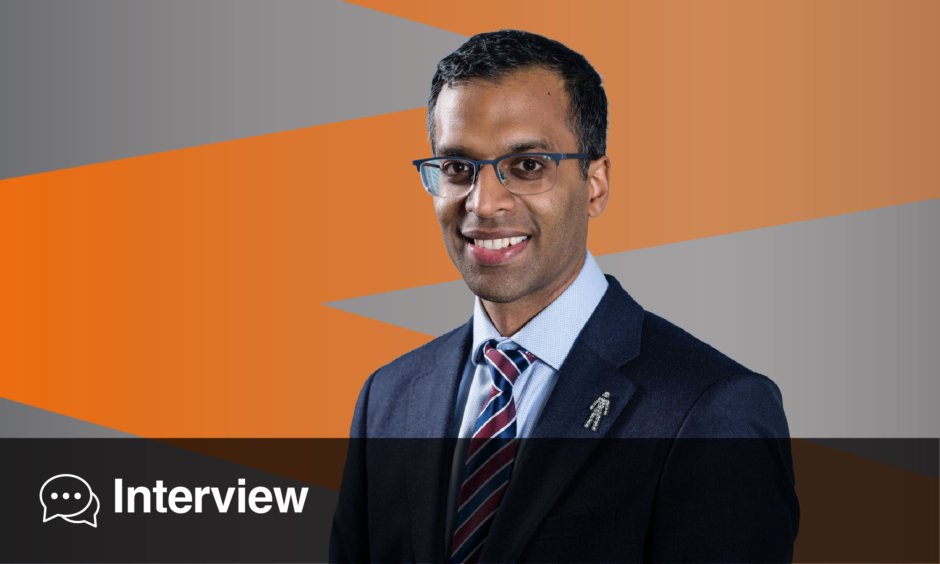
Veeru Kasivisvanathan Consultant Urological Surgeon, University College London Hospitals, NHS Foundation Trust; Associate Professor, University College London, UK; Professor of Urology, University of Vienna, Austria
Citation: EMJ Urol. 2026; https://doi.org/10.33590/emjurol/701N9G75

Your work spans prostate cancer diagnosis, focal therapy, and surgical innovation. What first drew you to urology, and particularly to prostate cancer research?
When I was a medical student, I was always interested in surgery. I liked doing things where I could see my patient getting better quite quickly, and when I started working, that was reinforced. Urology was a specialty where I could get involved in carrying out procedures even as a junior doctor, so it seemed like an attractive career from a clinical point of view. In addition to that, the strength of the academic side was really clear to see. I could see the research being carried out really influencing what we did on a day-to-day basis with our patients. The combination of a range of procedures, with lots of exciting tools in a urologist’s armamentarium, and the depth of the academic side was the reason why I chose urology.
The PRECISION Trial is widely seen as transforming prostate cancer diagnosis for the first time in 25 years. When you first began working on it, did you anticipate it would have such a global impact on clinical practice?
The answer is probably no. We knew for a long time that we wanted to change the way that we diagnosed prostate cancer, because there were problems with how it was being was being diagnosed. We’d spent a long time working on MRI, and there were some places where people felt that MRI was the right way to go forwards. The challenge was designing a trial where we could change the standard of care to something new, so we designed it initially as a feasibility study, but it became evident that the groups around the world wanted to do this as a bigger study, and the results were so clearly in favour of MRI that it led to this big change. We felt that MRI was better and hypothesised that the trial would show this, but we didn’t anticipate the impact of the work, so it was nice to see. When we saw the results, we realised this would have a big impact, and it was published in one of the world’s leading journals. As a result of that, guidelines changed in the next year for many international societies.
Building on studies like PRECISION and the PRIME Trial, how do you see prostate cancer diagnosis evolving over the next 5–10 years?
PRECISION introduced MRI into the pathway. PRIME allowed us to do shortened, abbreviated scans, because the problem was that we need more than four million scans per year, and, in many countries, not everyone who needs a scan can get one. Therefore, the shortened, abbreviated scan increased our global capacity from four to eight million scans overnight. The next challenge is ensuring we have a high-quality interpretation of the MRI. We have so many more scans coming through, we have an ageing population, and prostate cancer incidence is predicted to double in the next 20 years. My next study is called PARADIGM, which is looking at AI in diagnosing cancer on MRI scans, and we’re going to see whether it can reach the standards of these expert radiologists. If it can, then it shows that it could be used in the pathway.
Do you think we are moving towards a future where imaging could reduce, or even replace, traditional prostate biopsies in some patients?
One thing we know for the imaging we have so far is that the imaging signal and how strong it is relates to a patient’s prognosis. This is not just MRI, but also other imaging, like prostate-specific membrane antigen PET-CT, which has been heavily featured at the conference this year.
Biopsy itself carries some harms and risks of misclassification, so it’s not inconceivable to consider that, if we treat someone on the basis of imaging, it might lead to a better outcome for the patient. Part of our work over the next 4 years will be looking at a ‘virtual biopsy’. There is no evidence that it is better, but the point is to explore that pathway and its feasibility and generate evidence to say whether or not it is better than the way we currently do things.
Focal therapy is gaining increasing attention as a treatment strategy. What key advancements in focal therapy do you expect to see over the next decade?
Focal therapy is a really important treatment option for patients with localised prostate cancer. It’s an emerging treatment option, which means it’s not offered everywhere, and, when it is done, it needs to be published in a registry, which means collecting data and checking outcomes as they mature. So, what changes need to happen? Firstly, I think we need to produce more data and carry out more studies supporting its role. One of the things I talked about at the conference this year was what studies have been done so far. We have data for 7-year failure-free survival from a multinational UK study, which showed that the results of focal therapy are quite good, but it’s important that we generate more data like that from other focal therapies with even longer-term follow-up to show that focal therapy can be done well. Some of the randomised trial data comparing focal therapy to radical treatment will be available in the next few years. I believe that offering focal therapy will be a marker of quality for a unit offering treatment for prostate cancer.
Robotic surgery continues to expand worldwide. What do you see as the biggest challenges in scaling robotic surgery globally?
Robotic surgery has caught on in a big way already. In many centres around the world and many countries, robotic surgery is already the standard of care for the way that many procedures, for example, prostatectomy, are done. Now, the challenge will be to ensure that countries that don’t have as many resources can also offer robotic surgery. There are many countries in that bracket that already do offer robotic surgery, but there are many developing parts of the world that don’t, because the robot itself and the maintenance of the robot are expensive. I would say that supporting these countries in being able to get access to the technology and required training is a priority. Newer robots are bringing costs down and making robotic surgery more accessible. This is really important and needs to continue to happen.
There have been lots of cases where remote robotic surgery has been done from another country thousands of kilometres away. Has this proven to be successful? Do you think this is an effective approach?
Remote robotic surgery is an exciting recent development allowing world-renowned surgeons to offer patients in distant regions a high-quality operation. However, I think the challenge in increasing uptake of robotic surgery is not the expertise required. There is an element of training that needs to happen for successful programmes. What we typically see in countries that are starting to do more robotic surgery is they send many of their surgeons, towards the end of their training, to countries that have the robot so they can gain expertise, and then they go back to other countries to practice.
The biggest problem is getting the kit to do robotic surgery in the first place. Remote operating, with one surgeon operating from a different country, is nice, but I don’t think it’s the essential component required to make it successful, because you could just fly that surgeon out of the country to help with the procedure; they don’t need to do it remotely. It does, however, raise the possibility of closer mentorship from experts to help centres advance their skills.
You balance clinical practice, research, and teaching at a very high level. How do you manage these different roles, and do they complement each other in your work?
I’m a clinical academic, so I spend half my time doing clinical work, and the other half doing research. For me, they really complement each other. The clinical work allows me to treat patients, which is why I became a doctor. It’s what gives me satisfaction in my day-to-day life. I love seeing patients get better because of something I did. It also allows me to identify where there are problems in how we manage, diagnose, and treat patients, which then allows me to develop clinical studies to answer that question, so they both go hand in hand. They are both enjoyable in different ways, and they have different challenges. With clinical work, I can benefit hundreds of individual patients that I personally see and treat, but with the research, when you do something that changes practice, you can then affect millions of patients, so they both have their benefits.
You received the European Association of Urology (EAU) Crystal Matula Award for the top young academic urologist in Europe. What advice would you give to medical students or early trainees who are interested in pursuing academic urology?
It’s a fantastic career and I strongly recommend it. It’s really important to find someone who inspires you and receive their mentorship. When you’re given an opportunity, take it, be present, ask questions, and deliver on what you’re asked to. If you show that you can be trusted with something to a mentor, they will give you more and more, so ally yourself with a good group, show interest, dedication, perseverance, and you’ll be able to get those opportunities.
As technologies such as advanced imaging, robotics, and AI reshape clinical practice, how do you think the training of the next generation of urologists will need to evolve?
I think it starts from medical school. AI has changed our world completely and understanding how to use AI in medical healthcare is probably the first thing medical school curricula should address in training. It is important that these skills are taught. For example, , and we’ve previously introduced MRI training courses. This year, for the first time, we’ve introduced prostate-specific membrane antigen PET-reading courses. We go out of our way to teach people how to use novel imaging technology in their daily practice. With things like robotics, I think it requires syllabus training and fellowships, so surgeons can go to centres, gain the expertise, go back to their home centre, and disseminate the information locally. I think it’s a combination of changing the curriculum from very early on to changing what’s being offered when they’re a bit more senior and on top-level fellowships, with a dedicated syllabus and curriculums to train people.