Factors Associated with Inferior Outcomes in Patients with Advanced Urothelial Carcinoma Treated with First-Line Enfortumab Vedotin Plus Pembrolizumab: Results from UNITE - European Medical Journal

This site is intended for healthcare professionals

Factors Associated with Inferior Outcomes in Patients with Advanced Urothelial Carcinoma Treated with First-Line Enfortumab Vedotin Plus Pembrolizumab: Results from UNITE

2 Mins
Urology
Download PDF
Authors:
* Amanda Nizam , 1 Tanya Jindal , 2 Elise Cai , 3 Cindy Y. Jiang , 4 Zachariah Thomas , 4 Eugene Oh , 5 Charles B. Nguyen , 6 Albert Jang , 7 Jeffrey Zhong , 8 Kevin Reyes , 9 Salvador Jaime-Casas , 6 Dimitra R. Bakaloudi , 10 Ali R. Khaki , 11 Ameish Govindarajan , 1 Shilpa Gupta , 1 Sumit A. Shah , 11 Matthew I. Milowsky , 12 Petros Grivas , 10 Abishek Tripathi , 6 Jason R. Brown , 13 Irene Tsung , 14 Matthew T. Campbell , 4 Omar Alhalabi , 4 Vadim S. Koshkin 3
  • 1. Department of Hematology and Medical Oncology, Cleveland Clinic Taussig Cancer Institute, Ohio, USA
  • 2. Department of Medicine, Case Western Reserve University School of Medicine, Cleveland, Ohio, USA
  • 3. Department of Hematology/Oncology, University of California San Francisco Helen Diller Family Comprehensive Cancer Center, USA
  • 4. Department of Genitourinary Medical Oncology, The University of Texas MD Anderson Cancer Center, Houston, USA
  • 5. Department of Medicine, University of Michigan School of Medicine, Ann Arbor, USA
  • 6. Department of Medical Oncology & Therapeutics Research, City of Hope Comprehensive Cancer Center, Duarte, California, USA
  • 7. Department of Oncology, Mayo Clinic Comprehensive Cancer Center, Rochester, Minnesota, USA
  • 8. Department of Medicine, Case Western Reserve University, Cleveland, Ohio, USA
  • 9. Department of Medicine, University of California San Francisco, USA
  • 10. Clinical Research Division, Fred Hutchinson Cancer Center, Seattle, Washington, USA
  • 11. Department of Medicine, Division of Oncology, Stanford University, California, USA
  • 12. Department of Medicine, Division of Oncology, University of North Carolina School of Medicine, Chapel Hill, USA
  • 13. Department of Medicine, Case Western Reserve University/University Hospitals Seidman Cancer Center, Cleveland, Ohio, USA
  • 14. Department of Hematology and Oncology, University of Michigan Rogel Comprehensive Cancer Center, Ann Arbor, USA
*Correspondence to [email protected]
Disclosure:

Tripathi has received grants from Corvus Pharmaceuticals, EMD Serono, and Aravive; and consulting fees from Deka Biosciences, Aadi Biosciences, Seagen, Astellas, Exelixis, Bayer, and Gilead Sciences. Khaki has received grants from Acrivon Therapeutics, Johnson & Johnson, Pfizer, and 23andMe; and has acted as a consultant for Janssen, Pfizer, and Astellas (uncompensated). Nizam has held consulting or advisory roles for Astellas, AVEO Oncology, EMD Serono/Merck KGaA, Formedics, IDEOlogy Health, Medscape, Pfizer, and Seagen; received honoraria from Aptitude Health, ASCO, BioAscend, Cleveland Clinic, Doximity, Flatiron Health, Formedics, IntegrityCE, MECC Global Meetings, OncLive, SignifyMD, Targeted Oncology, and University Hospitals Seidman Cancer Center; travel and accommodation expenses from ASCO, DAVA Oncology, Formedics, and MECC Global Meetings; institutional research funding from ArteraAI, the Cleveland Clinic VeloSano Grant Program, and Valar Labs; is editor of the Bladder Cancer Section of GU Oncology Now; and serves on the Editorial Board for the Journal of Clinical Oncology. Nguyen has received consulting fees from Johnson & Johnson and Dendreon; payment for lectures, presentations, speakers’ bureaus, manuscript writing, or educational events from MJH Associates; and support for attending meetings from DAVA Oncology. Jiang has received a grant from the ASCO Conquer Cancer Young Investigator Award. Bakaloudi has received a grant from the Kurelt Cancer Research Award. Brown has held consulting or advisory roles for Pfizer, AstraZeneca, EMD Serono, and Janssen; received honoraria from Ipsen; participated in speakers’ bureaus for EMD Serono and Merck; received travel and accommodation expenses from Janssen; served on a Data Safety Monitoring Board for Roche; and received institutional research funding from Bicycle Therapeutics, Roche, and Pfizer. Campbell has received grants from AstraZeneca, Exelixis, Genentech, and Pfizer; consulting fees from Eisai, Exelixis, Merck, and Pfizer; and payment for lectures, presentations, speakers’ bureaus, manuscript writing, or educational events from Curio Science, DAVA Oncology, MJH Life Sciences, and Cancer Noetic. Milowsky has held consulting or advisory roles for G1 Therapeutics and Loxo/Lilly (both uncompensated); received honoraria from Medscape, Research to Practice, Prime Education, and OncLive/MJH Life Sciences; holds stock and other ownership interests in Pfizer and Gilead Sciences; holds a leadership or fiduciary role as a member of the Board of Directors for Alliance for Clinical Trials in Oncology; and received institutional research funding from Merck, Bristol Myers Squibb, Alliance Foundation Trials, ALX Oncology, Novartis, Acrivon Therapeutics, Prostate Cancer Clinical Trials Consortium, OncoC4, Flare Therapeutics, Loxo/Lilly, Astellas, Pfizer, Amgen, Roche, and G1 Therapeutics. Alhalabi has received grants from AstraZeneca, Ikena Oncology, Roche/Genentech, and Arcus Biosciences; and consulting fees from Seagen, Silverback Therapeutics, and Cardinal Health. Grivas has received grants from MSD, EMD Serono, Gilead Sciences, Acrivon Therapeutics, ALX Oncology, and Genentech; and consulting fees from MSD, Bristol Myers Squibb, AstraZeneca, EMD Serono, Pfizer, Janssen, Roche, Astellas, Gilead Sciences, Strata Oncology, Abbvie, Bicycle Therapeutics, Replimune, Daiichi Sankyo, Foundation Medicine, Eli Lilly, Urogen, Tyra Biosciences, Natera, and Ottimo. Gupta has received grants from Bristol Myers Squibb Foundation, Merck, Roche/Genentech, Exelixis, Novartis, Tyra Biosciences, Pfizer, Convergent Therapeutics, Acrivon Therapeutics, Flare Therapeutics, and Amgen; royalties from UpToDate; consulting fees from Pfizer, Merck, Foundation Medicine, Bristol Myers Squibb/Medarex, Natera, Astellas, AstraZeneca, Novartis, and Johnson & Johnson; support for attending meetings from Pfizer, Astellas, and Merck; and holds stock in Moderna Therapeutics, BioNTech SE, and Nektar. Jindal has declared being employed by Trial Library. Koshkin has held consulting or advisory roles for Janssen, Clovis Oncology, Astellas, Seagen, Pfizer, EMD Serono, Gerson Lehrman Group, ExpertConnect, and Guidepoint Global; is a Steering Committee Member for Pfizer/Seagen; and has received institutional research funding from Clovis Oncology, Nektar, Endocyte, Taiho Oncology, Merck, Gilead Sciences, Lilly, Seagen, Novartis, and the Prostate Cancer Foundation. Jang has received consulting fees from RealTimeCase; payment for lectures, presentations, speakers’ bureaus, manuscript writing, or educational events from MJH Life Sciences and Curio Science; and support for attending meetings from MECC Inc., Binaytara Foundation, and PSMA & Beyond Conference. The other authors have declared no conflicts of interest.

Acknowledgements:

The authors thank their patients for their contributions to research and all members contributing to data curation at each institution.

Citation:
EMJ Urol. ;14[1]:35-38. https://doi.org/10.33590/emjurol/0036A70Y.
Keywords:
Advanced urothelial carcinoma (aUC), enfortumab vedotin plus pembrolizumab (EV+P), prognostic factors.

Each article is made available under the terms of the Creative Commons Attribution-Non Commercial 4.0 License.

BACKGROUND AND AIMS

Enfortumab vedotin plus pembrolizumab (EV+P) is the preferred first-line (1L) regimen for patients with advanced urothelial carcinoma (aUC).1,2 Despite the robust efficacy of EV+P demonstrated in the landmark EV-302 clinical trial, 10% of patients experienced primary progression (PD) on 1L EV+P, highlighting the need to identify those at risk for early treatment failure.2 The authors hypothesised that the presence of mixed variant-predominant or pure variant histology (VH) in conjunction with previously described poor prognostic factors in aUC, such as Eastern Cooperative Oncology Group Performance Status (ECOG PS) ≥1, presence of liver metastases, haemoglobin (Hgb) level <10 g/dL, and elevated neutrophil-to-lymphocyte ratio (NLR), would be associated with inferior outcomes, including early PD.3-6

MATERIALS AND METHODS

UNITE is a multi-site retrospective study across 17 sites in the USA of patients with aUC treated with targeted agents, including EV. Patients who received at least 1 dose of 1L EV+P were included. Observed response rate (ORR) was assessed in patients with post-baseline imaging. Progression-free (PFS) and overall survival (OS) were calculated from EV+P start to PD or death. Early PD was defined as radiographic or clinical PD occurring within ≤12 weeks from EV+P start. Baseline clinicopathologic factors, somatic alterations by next-generation sequencing (NGS), and human epidermal growth factor receptor 2 (HER2) immunohistochemistry (IHC) score were assessed, and in an exploratory analysis, compared between patients with and without early PD using Fisher’s exact and Mann–Whitney U tests. In the overall population, associations between a priori selected baseline factors and outcomes were evaluated using univariable (UVA) and multivariable (MVA) logistic and Cox regression models.

RESULTS

Among 387 patients treated with 1L EV+P, 52 experienced early PD. NGS was available in 238 patients (32 with early PD) and HER2 IHC score was available in 83 patients (eight with early PD). At EV+P start, median age was 73 years (range: 40–99); 73% of patients were male; 81% of patients were White; 77% had ECOG PS 0–1; 74% had lower tract primary tumour; and 16% had liver metastases. Histology included pure UC in 65% of patients, mixed UC-predominant in 22% of patients, and VH in 12% of patients. Median follow-up was 12.2 months (95% CI: 11.2–15.0). ORR was 57.4% in 339 evaluable patients.

Early PD occurred in 13.4% of patients. Median PFS and OS were 12.2 months (95% CI: 8.8–17.0) and 22.8 months (95% CI: 18.6–56.2), respectively. VH, ECOG PS ≥2, lower Hgb, and higher NLR were associated with early PD (all p<0.05). Somatic alterations by NGS and HER2 IHC score were not associated with outcomes including early PD. On UVA, ECOG PS ≥2 and NLR ≥5 were associated with lower ORR and shorter PFS and OS, while VH, presence of visceral or liver metastases, and Hgb <10 g/dL were associated with shorter PFS and OS (all p<0.05). On MVA (Table 1), ECOG PS ≥2 and NLR ≥5 were independently associated with lower ORR; VH with shorter PFS; and ECOG PS ≥2, Hgb <10 g/dL, and NLR ≥5 with shorter PFS and OS.
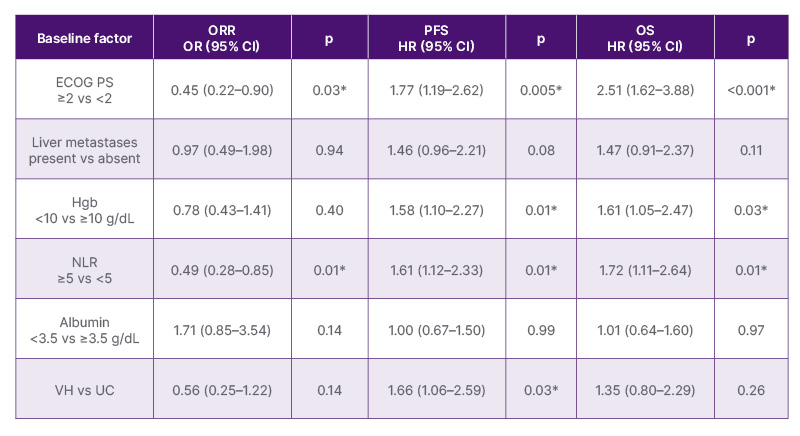
Table 1: Multivariable analysis of a priori selected baseline factors and outcomes in patients with advanced urothelial carcinoma treated with first-line enfortumab vedotin plus pembrolizumab.
*Statistically significant (p<0.05).
ECOG PS: Eastern Cooperative Oncology Group Performance Status; Hgb: haemoglobin; HR: hazard ratio; NLR: neutrophil-to-lymphocyte ratio; OR: odds ratio; ORR: observed response rate; OS: overall survival; PFS: progression-free survival; UC: urothelial carcinoma; VH: mixed variant-predominant or pure variant histology; vs: versus.

CONCLUSION

Inferior outcomes, including early PD, on 1L EV+P occurred more frequently in patients with VH and adverse prognostic features previously identified in platinum- and immune checkpoint inhibitor-treated cohorts. The persistence of these prognostic factors across therapeutic classes suggests that poor outcomes in aUC are largely driven by treatment-agnostic, tumour-intrinsic biology. Integration of circulating tumour DNA, histologic, and molecular correlates may refine future risk stratification models.


References
Nizam A et al. Factors associated with inferior outcomes in patients with advanced urothelial carcinoma treated with first-line enfortumab vedotin plus pembrolizumab: results from UNITE. Abstract A0861. EAU Congress, 13-16 March, 2026. Powles T et al. Enfortumab vedotin and pembrolizumab in untreated advanced urothelial cancer. N Engl J Med. 2024;390:875-88. Bajorin DF et al. Long-term survival in metastatic transitional-cell carcinoma and prognostic factors predicting outcome of therapy. J Clin Oncol. 1999;17:3173-81. Bellmunt J et al. Prognostic factors in patients with advanced transitional cell carcinoma of the urothelial tract experiencing treatment failure with platinum-containing regimens. J Clin Oncol. 2010;28:1850-5. Abuhelwa AY et al. Enhanced Bellmunt risk score for survival prediction in urothelial carcinoma treated with immunotherapy. Clin Genitourin Cancer. 2022;20:132-8. Khaki AR et al. A new prognostic model in patients with advanced urothelial carcinoma treated with first-line immune checkpoint inhibitors. Eur Urol Oncol. 2021;4:464-72.

Rate this content's potential impact on patient outcomes

Average rating / 5. Vote count:

No votes so far! Be the first to rate this content.