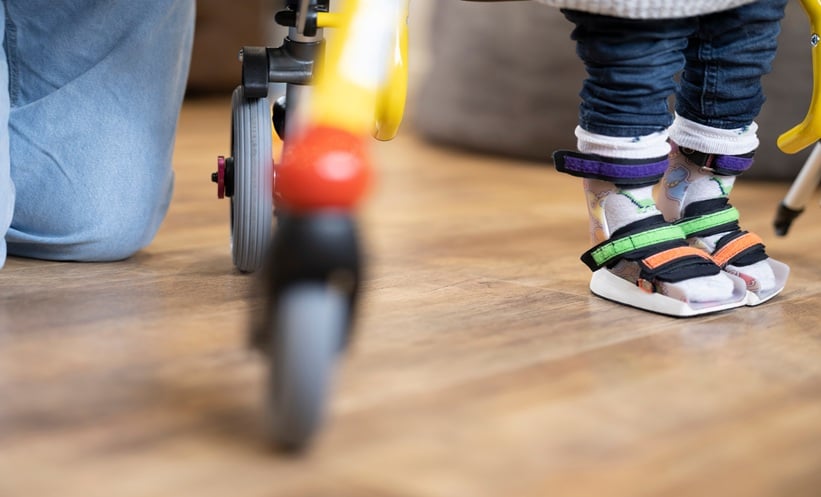
LOWER extremity weights improved balance and gait measures in ambulant children with ataxic cerebral palsy.
Children with ataxic cerebral palsy often experience impaired motor control, tremor, shakiness, reduced precision of movement, balance deficits, and disturbed gait patterns. These impairments can affect walking stability, step control, and functional mobility, making targeted rehabilitation strategies clinically important for pediatric care teams.
A randomized controlled trial has found that adding small fixed lower extremity weights to a structured treatment protocol was associated with greater improvements in balance and gait disturbances than standard care alone. The findings suggest that lower extremity weights may offer a practical adjunct to rehabilitation programs for ambulant children with ataxic cerebral palsy.
Lower Extremity Weights Improved Balance Outcomes
The trial enrolled 60 children with ataxic cerebral palsy aged 7–12 years following eligibility assessment. Participants were randomly allocated into two equal groups. The standard care group received a designed treatment protocol, while the added weight group received the same protocol with lower extremity weights incorporated.
Both groups completed treatment three times per week for 3 consecutive months. Balance was assessed using the Biodex balance system, with overall, mediolateral, and anteroposterior stability indices evaluated as primary outcomes. Gait was assessed using 3D motion analysis, including walking speed, cadence, base width, step length, stride length, step time, and percentage of double support.
After the intervention period, both groups showed significant improvements across balance and gait measures. However, outcomes favored the added weight group. Children receiving lower extremity weights demonstrated greater reductions in stability indices, base width, step time, and percentage of double support, alongside greater increases in walking speed, cadence, step length, and stride length.
Clinical Relevance for Ataxic Cerebral Palsy Rehabilitation
The results indicate that lower extremity weights may help reduce gait disturbances and improve postural control in ambulant children with ataxic cerebral palsy when used alongside a structured rehabilitation protocol.
For clinicians, the findings support further consideration of weighted lower limb strategies as part of individualized pediatric neurorehabilitation. The study also reinforces the value of objective balance and gait assessment, including stability indices and 3D motion analysis, when evaluating rehabilitation response in children with ataxic cerebral palsy.
Reference
Abo-Zaid & Nehad AA et al. Efficacy of adding lower extremity weights on balance and gait disturbances in children with ataxic cerebral palsy: a randomized controlled trial. NeuroRehabilitation. 2026;DOI:10.1177/10538135261444038.
Featured Image: child physical therapy on Adobe Stock.
- Author: