BACKGROUND
Epidemiological studies have shown associations between pandemic H1N1 2009 influenza A infection and vaccination (only using Pandemrix®, GSK, London, UK)1 and the onset of narcolepsy,2 an autoimmune disease associated with HLA-DQB1*06:02.3 The authors tested whether patients with recent-onset Type-1 narcolepsy have increased flu antibody titers compared with well-matched controls.4
METHOD
Sera of 173 patients with recent-onset Type-1 narcolepsy (12 [1–25] months) and 185 healthy controls matched by sex, age, and year and season of sample collection were used. Sera were tested for influenza A and B antibodies using hemagglutinin inhibition assays5 and neuraminidase inhibition assay6 against the dominant strains known to circulate at the time of collection. Hemagglutinin inhibition results are shown as %, with titers ≥40, while neuraminidase inhibition titers are shown as geometric mean titers (GMT). Further analysis using multiple variable linear and logistic regression was done to analyze the association between disease status and hemagglutinin/neuraminidase (HA/NA) antibody titers. Pearson correlation analysis was performed between anti-HA and anti-NA antibodies titers against the same strain of the same samples.
RESULTS
Increasing GMT of HA antibody against H1N1pdm09 (odds ratio [OR]: 1.77 [1.001–3.100]; p=0.05), H1N1pre2009 (OR: 2.32 [1.21–4.44]; p=0.01), and B/Victoria (OR: 3.63 [1.17–11.1]; p=0.03] was associated with narcolepsy by logistic regression. For NA antibodies, elevated GMT of NA antibody against H1N1pdm09 (co-eff: 1.27 [0.56–1.99]; p<0.01) and B/Victoria (co-eff: 1.28 [0.74–1.83]; p<0.01) was found in patients by multivariate linear regression, whereas no association was found with HA and/or NA antibodies against H3N2 and B/Yamagata (Table 1). HA and NA antibody titers against different strains on the same samples were weakly correlated (Pearson coefficient: -0.01–0.26).
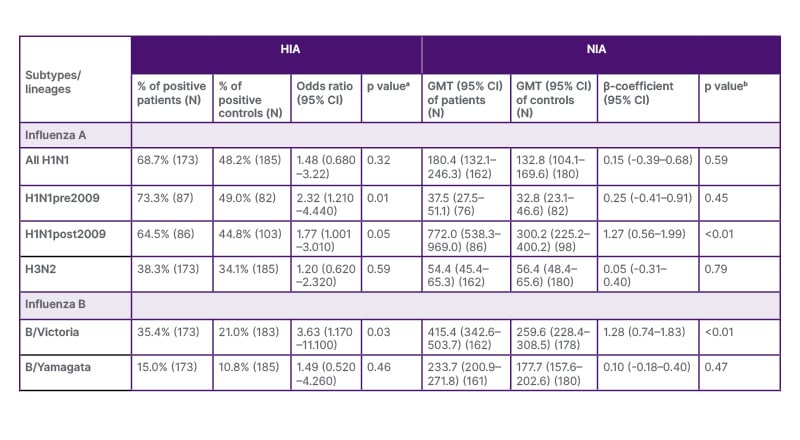
Table 1: Hemagglutinin and neuraminidase antibody levels in patients with recent onset Type-1 narcolepsy and controls.
aUsing ≥40 as a cut-off value for being positive for HIA.
bAdjusted by age, sex, or other covariates when significant.
GMT: geometric mean titers; HIA: hemagglutinin inhibition assay; NIA: neuraminidase inhibition assay.
CONCLUSION
Both H1N1pdm09 and B/Victoria, but not other strains, may trigger narcolepsy onset. This result is in line with a recent epidemiological study in Europe that reported a strong increase in narcolepsy onset in 2010 (following the 2009 H1N1 pandemic)2 and a secondary peak in 2013 following a season with a dominant B/Victoria infection.7 Further studies of flu-specific immune responses in DQB1*06:02 individuals may help understand how these infections trigger autoimmunity, offering a pathway to prevention.