Elevated Influenza Antibodies in Recent Onset Type-1 Narcolepsy - European Medical Journal

This site is intended for healthcare professionals

Elevated Influenza Antibodies in Recent Onset Type-1 Narcolepsy

1 Mins
Neurology
Download PDF
Authors:
Han Yan , 1 Bruna de Freitas Dias , 1 Ling Lin , 1 Jing Zhang , 1 Claudia I.P. Macaubas , 1 Giorgio Ricciardiello Mejia , 1 * Emmanuel Mignot 1
  • 1. Center for Narcolepsy, Department of Psychiatry and Behavioral Science, School of Medicine, Stanford University, Palo Alto, California, USA
*Correspondence to [email protected]
Disclosure:

Mignot has received institutional support for the present manuscript from NIH grants R01-AI144798 and P50-NS23724; received institutional grants or contracts from Jazz Pharmaceuticals, Takeda Pharmaceuticals, Avadel Pharmaceuticals, ResMed, Vanda, and Eisai; personal consulting fees from Jazz Pharmaceuticals, Takeda Pharmaceuticals, Avadel Pharmaceuticals, Lundbeck, Centessa Pharmaceuticals, and Alkermes; personal honoraria from Takeda Pharmaceuticals, Alkermes, and Paladin Labs; travel support from Harmony Biosciences, Takeda Pharmaceuticals, and Alkermes; and stock or stock options in Centessa Pharmaceuticals; participated on an advisory board for Takeda Pharmaceuticals. Mejia has received institutional grants or contracts from the ResMed Foundation for funded studies and an RA position. The other authors have declared no conflicts of interest.

Acknowledgements:

The authors would like to thank all study participants.

Citation:
Neurol AMJ. ;3[1]:42-43. https://doi.org/10.33590/neurolamj/3MT6I88N.
Keywords:
Hemagglutinin, influenza, neuraminidase, Type-1 narcolepsy.

Each article is made available under the terms of the Creative Commons Attribution-Non Commercial 4.0 License.

BACKGROUND

Epidemiological studies have shown associations between pandemic H1N1 2009 influenza A infection and vaccination (only using Pandemrix®, GSK, London, UK)1 and the onset of narcolepsy,2 an autoimmune disease associated with HLA-DQB1*06:02.3 The authors tested whether patients with  recent-onset Type-1 narcolepsy have increased flu antibody titers compared with well-matched controls.4

METHOD

Sera of 173 patients with recent-onset Type-1 narcolepsy (12 [1–25] months) and 185 healthy controls matched by sex, age, and year and season of sample collection were used. Sera were tested for influenza A and B antibodies using hemagglutinin inhibition assays5 and neuraminidase inhibition assay6 against the dominant strains known to circulate at the time of collection. Hemagglutinin inhibition results are shown as %, with titers ≥40, while neuraminidase inhibition titers are shown as geometric mean titers (GMT). Further analysis using multiple variable linear and logistic regression was done to analyze the association between disease status and hemagglutinin/neuraminidase (HA/NA) antibody titers. Pearson correlation analysis was performed between anti-HA and anti-NA antibodies titers against the same strain of the same samples.

RESULTS

Increasing GMT of HA antibody against H1N1pdm09 (odds ratio [OR]: 1.77 [1.001–3.100]; p=0.05), H1N1pre2009 (OR: 2.32 [1.21–4.44]; p=0.01), and B/Victoria (OR: 3.63 [1.17–11.1]; p=0.03] was associated with narcolepsy by logistic regression. For NA antibodies, elevated GMT of NA antibody against H1N1pdm09 (co-eff: 1.27 [0.56–1.99]; p<0.01) and B/Victoria (co-eff: 1.28 [0.74–1.83]; p<0.01) was found in patients by multivariate linear regression, whereas no association was found with HA and/or NA antibodies against H3N2 and B/Yamagata (Table 1). HA and NA antibody titers against different strains on the same samples were weakly correlated (Pearson coefficient: -0.01–0.26).
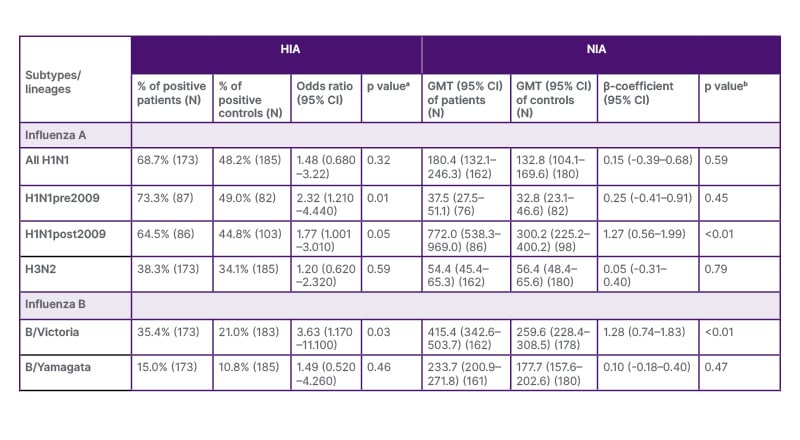
Table 1: Hemagglutinin and neuraminidase antibody levels in patients with recent onset Type-1 narcolepsy and controls.
aUsing ≥40 as a cut-off value for being positive for HIA.
bAdjusted by age, sex, or other covariates when significant.
GMT: geometric mean titers; HIA: hemagglutinin inhibition assay; NIA: neuraminidase inhibition assay.

CONCLUSION

Both H1N1pdm09 and B/Victoria, but not other strains, may trigger narcolepsy onset. This result is in line with a recent epidemiological study in Europe that reported a strong increase in narcolepsy onset in 2010 (following the 2009 H1N1 pandemic)2 and a secondary peak in 2013 following a season with a dominant B/Victoria infection.7 Further studies of flu-specific immune responses in DQB1*06:02 individuals may help understand how these infections trigger autoimmunity, offering a pathway to prevention.


References
Partinen M et al. Increased incidence and clinical picture of childhood narcolepsy following the 2009 H1N1 pandemic vaccination campaign in Finland. PLoS One 2012;7:e33723. Han F et al. Narcolepsy onset is seasonal and increased following the 2009 H1N1 pandemic in China. Ann Neurol 2011;70:410-7. Matsuki K et al. DQ (rather than DR) gene marks susceptibility to narcolepsy. Lancet 1992;339:1052. Yan H et al. Elevated influenza antibodies in recent onset Type-one narcolepsy. Abstract 14-012. AAN Annual Meeting, April 18-22, 2026. Webster R et al. WHO manual on animal influenza diagnosis and surveillance. WHO/CDS/CSR/NCS, 2002, Geneva: World Health Organization, pp.1-105. Bernard MC et al. Validation of a harmonized enzyme-linked lectin assay (ELLA-NI)–based neuraminidase inhibition assay standard operating procedure (SOP) for quantification of N1 influenza antibodies and the use of a calibrator to improve the reproducibility of the ELLA-NI with reverse genetics viral and recombinant neuraminidase antigens: a FLUCOP collaborative study. Front Immunol 2022;13:909297. Zhang Z et al. New 2013 incidence peak in childhood narcolepsy: more than vaccination? Sleep. 2021;44(2):zsaa172.

Rate this content's potential impact on patient outcomes

Average rating / 5. Vote count:

No votes so far! Be the first to rate this content.