Meeting Summary
The Bronchiectasis Understanding and Research on Daily Experiences and Needs (BURDEN) survey is the first multinational initiative assessing the impact of bronchiectasis from the perspectives of people living with the condition and their caregivers. This poster review article highlights a presentation from the American Thoracic Society (ATS) International Conference, which took place in Orlando, Florida, USA, between May 15–20, 2026, where results from the BURDEN survey were presented. Eva Polverino, Pneumology Department, Vall d’Hebron Institut de Recerca (VHIR), Barcelona, Spain, presented realworld evidence of the social and emotional burden associated with bronchiectasis (BE) for both patients and their caregivers, highlighting the impact of exacerbations on disease burden and daily living. BE has an increasing prevalence worldwide and is associated with a socioeconomic burden. Findings serve to reframe BE as a condition with persistent emotional and societal impact, highlighting the importance of managing and reporting exacerbations effectively.
Bronchiectasis
BE is a chronic, progressive, inflammatory lung disease characterized by abnormal dilatation of the bronchi, impaired mucociliary clearance, neutrophilic inflammation, and structural lung damage.1 BE, as a chronic disorder, includes symptoms such as cough, purulent sputum production, and bronchial infection, and in many patients is marked by recurrent pulmonary exacerbations.2,3 Exacerbations are associated with progressive disease burden, lung function decline, impaired quality of life, hospitalizations, and an increased risk of mortality.4,5 The primary goal of treatment is to prioritize airway clearance and prevent exacerbations.6 Despite the significant burden of bronchiectasis, there is limited information on patient-reported impact of the disease and exacerbations on their physical and emotional wellbeing.6
Real-World Impact
Eva Polverino
Polverino presented the results of the BURDEN study, the first multinational initiative assessing the impact of BE from the perspectives of people living with the condition and their caregivers, duringATS 2026.7
Methods
Findings were presented from a mixed-methods research study, whereby qualitative interviews were conducted to inform the development of a quantitative online survey, co-created with both healthcare providers and patient experts. Study participants included adults from the EU (France, Germany, UK, Italy, and Spain) and the US, with a diagnosis of BE (excluding BE caused by cystic fibrosis), and who experienced ≥1 exacerbation in the past year.7 Recruitment lasted from December 2024–April 2025, and included family members and caregivers who lived with and provided daily support to people with BE.7
To extract data specific on the impact of exacerbation burden, participants with BE were required to have experienced ≥1 exacerbation in the past year (Figure 1). Impacts associated with exacerbations, such as daily activities, emotional wellbeing, work, and finances, were rated on a scale of 1 (“No additional negative impact at all”) to 10 (“Extreme additional negative impact”).7 Differences among patients with 1, 2, or ≥3 exacerbations were evaluated.7
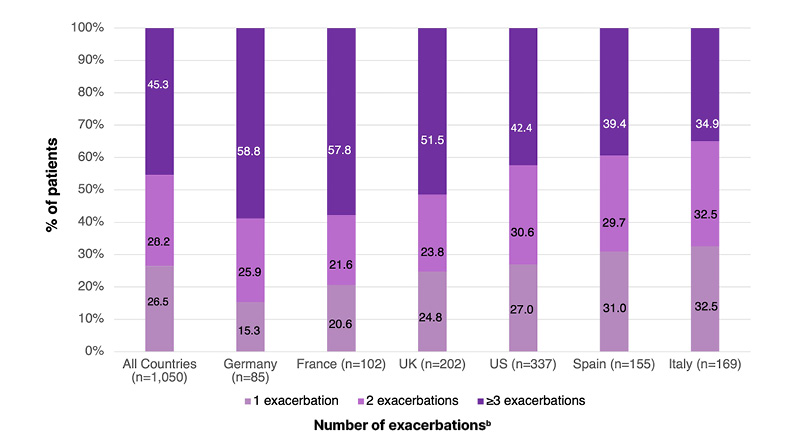
Figure 1: Proportion of patients with 1, 2, or ≥3 exacerbationsa over the previous 12 months by country.
aExacerbations were defined as “a change in therapy suggested by your doctor and could be associated, among others, with the following signs: increased coughing; increased sputum production; bloody sputum production; change of color and viscosity of sputum; bouts of severe breathlessness/dispnea and/or discomfort in the chest; increased fatigue.”
bExacerbation frequency in the past 12 months.
Results
Demographics
In total, 1,050 people with bronchiectasis and 88 caregivers were included, representing a diverse cohort reflective of the heterogeneity of the disease (Table 1).7 Participants included a mix of retired and employed individuals, covering a range of day-to-day experiences when considering the impact of exacerbations on daily life. Approximately half (54.2%) of patients had been living with BE for 5+ years, and one in three for 10+ years. Common comorbidities included asthma, gastroesophageal reflux disease, joint disease, hypertension, COPD, sinusitis, and non-tuberculous mycobacterial lung disease
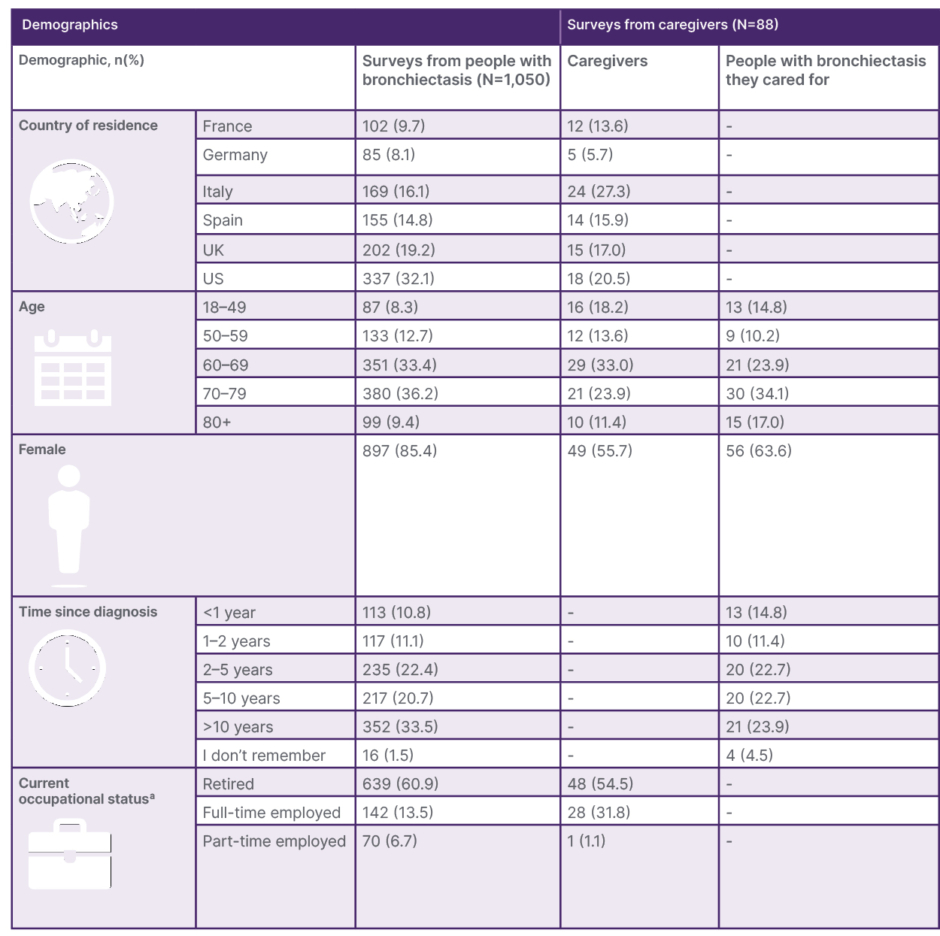
Table 1: Demographics.
ªCategories with >5% of people with bronchiectasis.
‘-‘ indicates not applicable or data not available.
Key Findings
Impact of exacerbations on daily living, emotional wellbeing, and caregiver burden
Among patients surveyed, 73.5% reported ≥2 exacerbations in the past year, and 45.0% experienced ≥3 exacerbations annually.7 Exacerbations imposed an additional negative impact across all dimensions of daily living, with emotional well-being and social life most affected. Negative impact of emotional well-being and social life increased progressively with exacerbation frequency, with statistically significant differences observed between patients with one exacerbation and those with ≥3 exacerbations (Figure 2).7
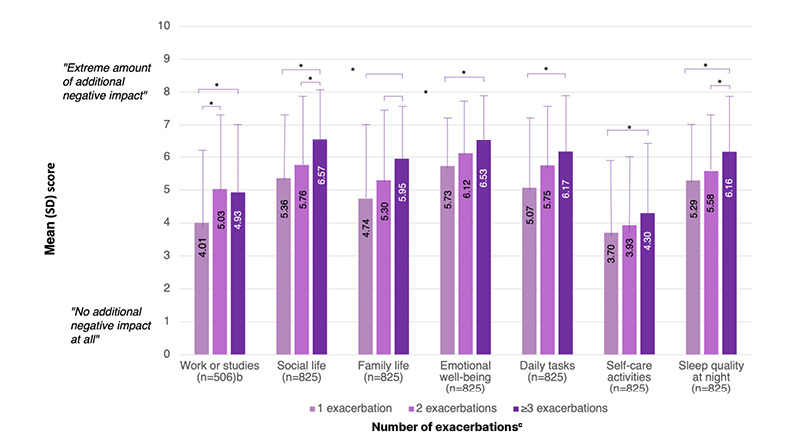
Figure 2: Additional negative impacta of exacerbations on dimensions of daily living in people with bronchiectasis.
*p<0.05.
aPeople with bronchiectasis were asked: “Compared to the times when you are NOT experiencing a bronchiectasis flare/exacerbation, is there any additional negative impact of bronchiectasis flares/exacerbations on any of the following aspects of your life?” They were asked to rate each dimension of daily living on a scale from 1 (“No additional negative impact at all”) to 10 (“Extreme amount of additional negative impact”).
bIncludes only people who have worked or studied since their bronchiectasis diagnosis.
cExacerbation frequency in the past 12 months.
Emotional wellbeing had a mean (SD) of 6.2 (2.8), and 40.5% of patients rated the additional negative impact of an exacerbation as extremely high (8 or more).7 Exacerbations also impacted all areas of daily functioning; participants missed an average of 13.2 days of work in the previous 6 months as a result of an exacerbation, and 31.5% of them had to make lifestyle or financial adjustments.7 A clear relationship was observed, with increasing exacerbation frequency associated with progressively greater emotional, social, and quality-of-life impacts. Prevention and effective management of exacerbations, therefore, is an important area of clinical focus, as each exacerbation is associated with a worsening quality of life. Notably, Polverino and co-authors reported that 76.8% of people with BE felt that every exacerbation worsened their condition.
The study also reported that even in the absence of exacerbations, bronchiectasis symptoms imposed a substantial negative impact on both patients and caregivers, with a particularly pronounced emotional burden driven by anxiety about future exacerbations and insecurity regarding the future.7 Caregivers reported that the impact of supporting someone with BE included an increase in feeling anxious or nervous (53.6%) and depressed or sad (53.7%).7
Conclusion
The BURDEN study found that exacerbations in BE carry a profound and lasting impact on patients and caregivers alike. The cumulative physical, emotional, and functional toll underscores the critical importance of exacerbation prevention and optimized disease management. Evaluation of patient-reported outcomes and evidence-based strategies in exacerbation management can help meaningfully improve quality of life in patients with BE as well as their caregivers
Limitations of Research
Diagnoses and exacerbations were
self-reported and medical records were not verified. Participants may have been subject to recall bias. It may have been difficult for participants to distinguish between experiences with and without pulmonary exacerbations.