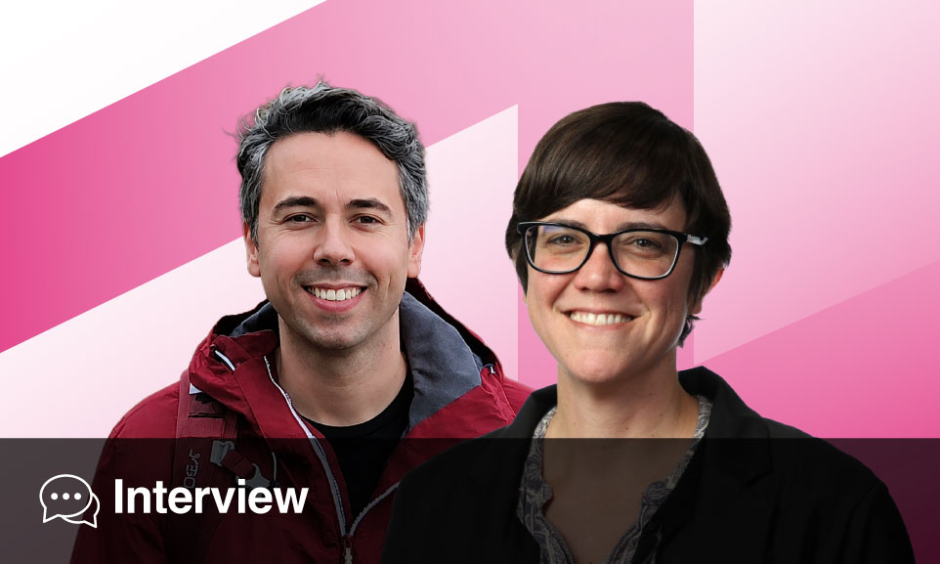
Nuno Borges | Haematology Registrar and Clinical Research Associate, Newcastle University, UK
Alba Maiques-Diaz | Ramon y Cajal Group Leader, Faculty of Medicine and Health Sciences, Universitat de Barcelona, Spain
Citation: EMJ Hematol. 2026;14[1]:45-48. https://doi.org/10.33590/emjhematol/953LFV7G

What motivated each of you to get involved with the Young EHA Committee, and how did your own career paths lead you to this point?
Maiques-Diaz: I’ve been a member of the European Hematology Association (EHA) since I did my PhD, so quite a long time ago now. And then in 2018, at the Congress in Stockholm, Sweden, there was the first call for the committee to be officially launched. I had no idea what it was about, but I thought it could be interesting. So I applied to join, and it has been a fundamental piece of my career. It has opened my eyes to many things I was not aware I could do to get involved within the community. It has also given me a lot of friends and contacts of different ages, because you get to know people at all stages of their careers. Being part of the committee has really been a game changer for me.
Borges: It was similar for me. I was aware of EHA, and while I’d never been to the Congress, I used to go on the website for educational content. I saw that there was a call for applications, and I thought, why not? I was mainly trying to be a part of the community more actively and make some positive change, because at the time, Young EHA wasn’t quite as well developed as it is now. The great thing about it is the networking aspect. You get to meet so many different people, which is great from a career perspective, but it’s also great to really connect with everyone within the community.
Borges, looking at the current generation of haematologists in training, what do you think are the biggest opportunities and pressures they are facing compared with when you started?
Borges: There are lots of opportunities, and everything feels very accessible. No matter where you are or where you come from, there are many opportunities in terms of research funding, grants, mobility, education, training, and mentorship. Obviously, not everyone gets them all the time, but nowadays, the opportunities are much more tangible and accessible, which is a positive thing. Of course, there is still room for improvement because there aren’t always opportunities for everyone. One of the challenges is that haematology is expanding so much all the time, and there are constantly new developments happening. So, it’s hard to stay on top of everything and to navigate different fields within the field of haematology.
There’s also a lot of pressure, especially from a clinical standpoint, to subspecialise in something within the field. And that can be hard to figure out when you’re just starting out. Everyone is asking you: “What kind of haematologist are you going to be?” How do you know that when you’re so early on in your career? One of the challenges is that as the specialty grows exponentially, it’s becoming a very difficult field to navigate.
The Young EHA Committee plays a role in education and community building. Diaz, what initiatives have had the most impact so far, and where do you see room for growth?
Maiques-Diaz: If I have to choose one initiative that I’m very happy and proud about, it’s the Mentorship Program, which was launched last year. It is now the second edition, but it took us a while to convince the association that it was important. It is key to build a community and peer-to-peer support, and make people aware that they’re part of a community that they can contribute to as mentors or be helped by as mentees.
We had to make this accessible to anyone, so while the EHA trainees’ programmes are usually based on merit, this is completely transversal, and you can apply no matter where you are. I think it’s been a very great success within the Young EHA community.
Our room for improvement at the moment is how to have more people engaged and contributing. Two-thirds or even more of the association consists of young members. There is no easy way to make these things happen, so we need to find ways to encourage people to actively and proactively participate in the things we develop, because it will be richer if we have more people.
How do you balance maintaining scientific depth in education while making content and programmes accessible for early career clinicians and researchers?
Borges: It’s really important to tailor the content you are delivering to the audience. You need to ask your target audience what they want and what they need across career stages. Obviously, someone who is early on in their career has different needs to someone who’s a bit further along, but it’s also true across different aspects of haematology.
There’s plenty of really good quality content for clinical education within EHA, but we’ve had lots of feedback over the years, from researchers working in basic and translational haematology, saying that there’s an area of unmet need there, and that the educational content isn’t available. As a result of that, we’re now putting changes in place and working with the relevant teams within the organisation to deliver that.
We’re lucky that we’re very well supported by the whole organisation, so when we pass that on to the office and the board, they’re always very receptive, and we’re able to make changes.
Borges, what are the key skills or experiences you think are essential for young haematologists who want to build a career in academic or translational medicine?
Borges: I think it’s important to be open, to be receptive to opportunities, to say yes more than no, and to have an open mind, even if something doesn’t perfectly fit into the plan that you had for yourself. The road to a successful, varied career with clinical work and academic work has lots of different ways to it. It’s just about being receptive to different things.
Going back to what Maiques-Diaz was saying about the mentorship programme, I think it’s really important to find a good mentor, which is more easily said than done. It goes a long way to find someone who can take you under their wing, recognise your strengths, and hopefully guide you a little bit more in what you’re doing.
How important is international collaboration for early career researchers today, and how does the Young EHA Committee help facilitate that in practice?
Maiques-Diaz: That’s something that is key, and I was thinking of this when you asked the question about challenges for the generation of researchers today. Because science is becoming very complex, you need expertise across many interconnected specialties, so you need to be able to access this network to develop your science.
EHA and Young EHA try to promote this as much as possible; we try to foster spaces where people can network, because that’s very difficult when you start. Once you become more senior and more established, you already have your contacts, so it’s easier to approach someone you want to collaborate with. But when you’re just starting out, you will never do it.
That’s what we’re trying to create with the Young Experimental Research Meeting (YERM) extended, which is a session we organise where young researchers, PhDs, postdocs, and also junior group leaders show their science. We make a space where there is time for networking and collaboration, and we add a mixer moment afterwards to encourage people to connect.
We’ve been very cautious with choosing Young EHA committee members, and have included representatives from many countries because we believe that if you have representation from many countries, it will expand the network that we can target with our activities. It’s a way of promoting these international interactions.
At a meeting like EHA, there is a huge concentration of science and networking. Diaz, what advice do you give to trainees to make the most of their time here?
Maiques-Diaz: I met my mentee this afternoon, and she said: “I want to talk with this person.” I replied, “Yes, don’t think twice.” So, as Borges was saying, just say yes.
If you see the person, just go and say hello. Because if you see this researcher you want to talk to, someone whose lab you want to go to, but you let them go past, they are gone. It’s a very big congress, so you need to be open; don’t wait to have the skills to do it. Just approach people and try to be as open and friendly as possible.
Someone senior once told me that for him, a good conference was a conference that he would come back from with new friends. So that’s the advice I take now for conferences.
To you both, what are the biggest gaps you still see in mentorship or career support for young haematologists across Europe?
Borges: It’s tricky; mentorship is so different across countries. Some countries are better than others at providing formal platforms for mentorship and engaging with the national societies or institutes, so it’s a very heterogeneous kind of situation. I think we could do with more formal mentorship platforms and training. When we were setting up the mentorship programme, we realised that to be a mentor, you need to understand how to do it. It’s not rocket science, but it’s about knowing how to fulfil your mentees’ needs, wherever they might be within their career.
Another thing is time. Everyone is so busy that, especially from the mentor’s point of view, it can be hard to find the time to really sit down and take a genuine interest in someone. Despite people’s best intentions, sometimes things don’t quite work out because people are so caught up in whatever else they’re doing that from the mentee’s perspective, they might feel that they’re not quite as engaged as they would like them to be. But I think that’s changing. People are recognising that mentorship is really important, and we’re not the only organisation that has a mentorship programme, so I think it will get better.
Maiques-Diaz: If I might add, I think it’s a mindset change from the mentees. When you’re a trainee, you can proactively look for help. I’m a big fan of peer-to-peer mentoring; I have a group of PhD friends and we meet every month. It’s a peer mentoring group, so we support each other.
EHA promotes programs such as Translational Research Training in Hematology (TRTH), Clinical Research Training in Hematology (CRTH), and Computational Biology Training in Hematology (CBTH). These training groups can become your peer mentoring groups. It’s not only about looking for support from someone more senior; you can also look for support from your peers, which may be easier to get as you are in the same stages of your careers.
How is the Young EHA Committee thinking about emerging areas such as AI, data science, and personalised medicine in shaping future training?
Borges: Precision medicine is a key priority for the whole of EHA, and there’s a ‘Precision in Hematology’ specialised working group. I think people are still trying to work out: is it a good thing? It’s a grey area, and I think that because people are still feeling their way through it, it’s not something that we have prioritised as an activity as such, but again, we’re very open to it.
If early career haematologists start saying that we need more haematology-based AI tools, then we would work on this, but that’s not something that we’ve had fed back to us. I think people still have different priorities to that, and the AI subject still feels very immature. It’s hard to really commit to something where you don’t know where it’s going.
Maiques-Diaz: It’s true that we will have to decide this at some point, because it’s going to have an impact on the world. Not only on the science, but probably on the clinical side as well. So that’s definitely something EHA has to have a voice on, and Young EHA too. The younger generation could put it forward for next year’s Congress, so we can do a session on AI.
Looking ahead, what would success look like for the Young EHA Committee over the next 5 years, both for the organisation and for the community it supports?
Maiques-Diaz: Mandy Lauw, who was a previous chair of the committee, always said that for her, success would be when there is no need for a Young EHA committee because junior members are a part of the whole association. I’m not 100% certain I would support that, because I think we need this way of entering a community, where you start on a committee with people of a similar age. However, it is true that it would be a success to have more junior members within the different layers of the association, from the board to the different committees. That, for me, would be a success.
Borges: I agree. I think Young EHA and other early career groups within organisations will still be needed, even when there are lots of early career haematologists in different committees. It’s not only an entry route, but it’s also a single platform that can provide a voice for an entire community with very specific needs.
If I were to think about 5–10 years’ time, I think it would be great if Young EHA was still doing what we’re currently doing, and have been doing well for the past 10 years or so, and still delivering what the community needs.
Hopefully, those needs will continue to be addressed. And yes, we might get to the point where they won’t need a specific early career platform anymore. But I want to make sure that we continue to serve the community and deliver what it needs for as long as it needs it.