SUMMARY OF KEY FINDINGS
Background
Functional neurological disorder (FND) is a common and disabling condition with diverse presentations, such as motor (weakness, tremor, dystonia, gait), sensory, cognitive, and seizure-like symptoms, often in combination.1 It is understood as a disorder of brain network dysfunction, in which the brain generates overly strong predictions about body states that override incoming sensory and motor signals, and symptoms arise from this mismatch.2 Historically, FND has been conceptualised in terms of psychological stress or traumatic experiences, often arising in childhood.3 However, contemporary models situate it within a broader biopsychosocial framework, in which early-life biological influences are poorly characterised compared to psychosocial factors. Previously reported inherited and neurodevelopmental associations with FND include Ehlers–Danlos syndrome and hypermobility spectrum disorders,4 autism spectrum disorder,5 and ADHD.6 FND may be more likely to emerge in individuals with less reliable bodily signalling and regulatory systems, which may become apparent in the context of co-existing disease (e.g., FND emerging in Parkinson’s disease).7 Similarly, disturbances of motor, sensory, or integrative processing earlier in life could predispose to FND. The authors compared the prevalence of early-life biological vulnerability factors in FND against comparator cohorts, and examined whether distinct vulnerability profiles are associated with specific FND phenotypes.
Findings
Using TriNetX™ (TriNetX, LLC, Cambridge, Massachusetts, USA), a large electronic health records database, the authors assessed rates of genetic, congenital, perinatal, and neurodevelopmental diagnoses, selected to capture a range of early-life conditions, including those that may affect the integrity of the sensory and motor systems. Comparisons were performed between 188,868 individuals with FND and sociodemographically matched migraine and depression cohorts. The prevalence of these factors was also compared between matched cohorts of 42,015 individuals with motor FND and functional seizures. Compared with migraine and depression, FND was associated with increased odds of heritable connective tissue disorders, heritable neuromuscular disorders, and congenital malformations, including those of the musculoskeletal system and sensory organs (odds ratio [OR]: 1.7–3.0). Apart from ADHD, which was more prevalent in the depression cohort, neurodevelopmental disorders were consistently more prevalent in FND (OR: 1.9–5.4), alongside increased rates of perinatal adversity related to short gestation, low birth weight, and newborn respiratory distress (OR: 1.8–2.6; Figure 1A). In the comparison of different clinical phenotypes, motor FND showed stronger associations with connective tissue, neuromuscular, and musculoskeletal conditions, whereas functional seizures were more strongly associated with chromosomal abnormalities and neurodevelopmental disorders (Figure 1B).
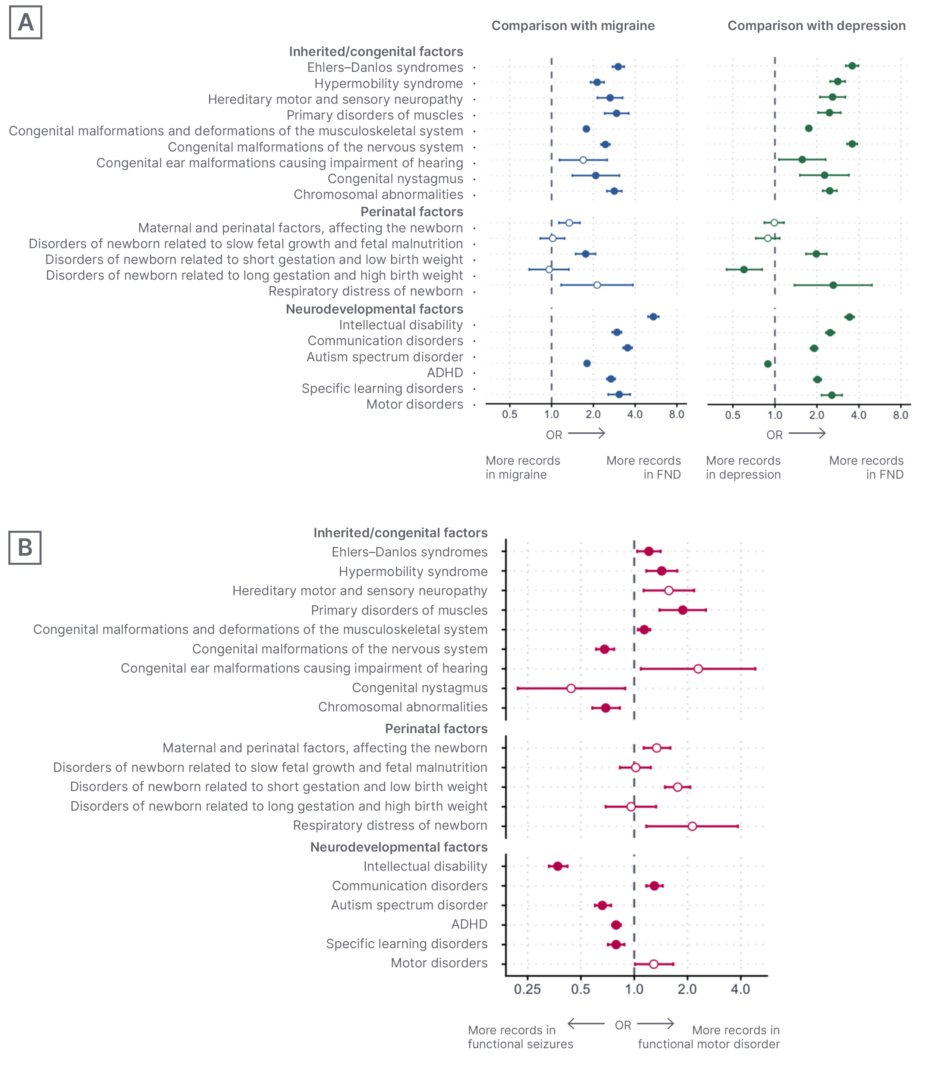
Figure 1: Early life biological vulnerability factors in FND versus migraine and depression (A) and early life biological vulnerability factors in functional motor disorder versus functional seizures (B).
ORs (95% CI) are shown on a logarithmic scale. Filled dots indicate significance after Bonferroni correction (p<0.0025).
FND: functional neurological disorder; OR: odds ratio.
Conclusion
FND showed higher rates of early-life biological vulnerability factors than control cohorts with migraine and depression. These factors spanned several domains, indexing a broad early-life and developmental susceptibility. Distinct associations were observed for functional motor and seizure presentations. The authors’ findings support the current move from dichotomous ‘psychogenic–organic’ to more nuanced and biologically informed vulnerability–resilience models of FND accounting for the full range and varying combinations of potential biopsychosocial aetiologies.
WHAT CHALLENGE DOES THIS ADDRESS?
FND research has traditionally focused on psychological stress and trauma as key predisposing factors. While these remain important, this framing may inadvertently reinforce stigma and the outdated psychogenic–organic dichotomy. To move towards a genuinely biopsychosocial model, a better understanding of the biological underpinnings is needed. The authors’ findings represent a step in that direction, suggesting that early-life biological vulnerability factors are more prevalent in FND than in matched control conditions.
RELEVANCE TO EUROPEAN PRACTICE
FND remains under-recognised and under-resourced, with stigma a persistent barrier to care. Evidence of early-life biological vulnerability may support a more comprehensive assessment and strengthen the case for appropriately resourced, multidisciplinary care.
WHAT ARE THE NEXT STEPS FOR THE RESEARCH?
Replication in prospectively recruited FND cohorts is needed, given the limitations of electronic health records. Future studies could assess whether early-life biological vulnerability factors act synergistically, how these profiles influence symptom trajectories and outcomes, and why similar vulnerabilities lead to different clinical presentations.