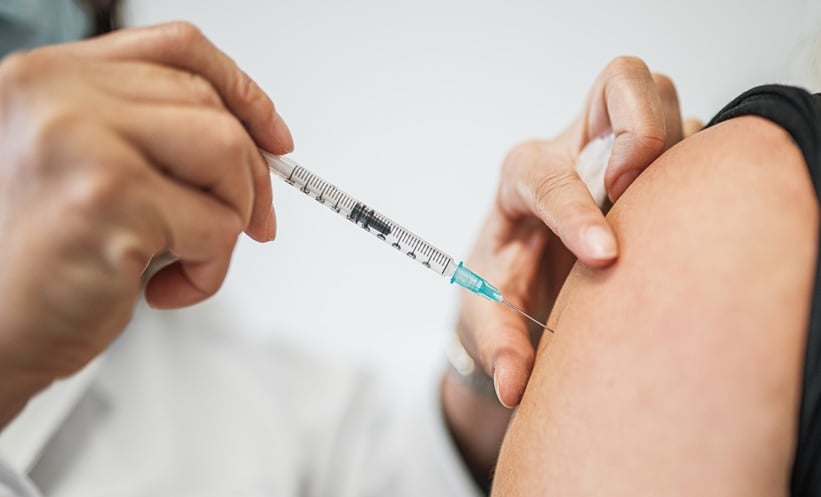
PAUSING arthritis drugs around a COVID-19 vaccine dose did not strengthen antibody response, but it did make flares more likely.
The finding comes from a multicenter, pragmatic randomized clinical trial of 840 patients with rheumatoid arthritis, psoriatic arthritis or axial spondyloarthritis. Conducted from November 2021 to May 2024, the study tested whether temporarily holding targeted therapy could improve humoral immunogenicity after a supplemental COVID-19 vaccine dose, and whether the interruption would worsen disease activity.
All patients had completed a primary messenger RNA vaccine series and were on stable treatment with an anti–tumor necrosis factor agent, an anti–interleukin-17 agent, abatacept or a Janus kinase (JAK) inhibitor. They were randomized to continue therapy or hold it for 2 weeks after their next supplemental dose. The primary outcome was the change in anti–SARS-CoV-2 spike immunoglobulin G levels from baseline to 6 weeks.
Pausing Arthritis Drugs for COVID-19 Vaccine: Antibodies and Flares
Antibody levels rose substantially in every group. The geometric mean fold rise ratio for hold versus continue was 0.96 (95% CI, 0.36-2.56), indicating no significant difference, and results were consistent across drug subgroups and half-life categories.
Holding therapy, however, carried a clear cost. It was associated with significantly higher odds of disease flare (odds ratio, 2.27; 95% CI, 1.41-3.65), most pronounced among JAK inhibitor users. On a rheumatoid arthritis flare questionnaire, 21.1% of patients in the hold group (54 of 256) reported worsening of 10 points or more, compared with 9.1% (23 of 253) in the continue group, a risk difference of 12.0%.
Flares resolved fully in both arms by the 6-week follow-up. Adverse events were comparable between medication arms and more frequent in the hold group.
What It Means for Rheumatology Practice
Because holding therapy brought transient but clinically meaningful flares without a measurable immunogenicity benefit, the authors conclude that routine interruption of these therapies at the time of a supplemental dose is likely not warranted. The results do not support pausing arthritis drugs for COVID-19 vaccine optimization in these patients.
Researchers compared patients based on the group they were originally assigned to, and they used statistical methods to estimate any missing data. A second analysis, which included only patients who followed the study plan exactly, was also run. The findings apply only to the arthritis medicines tested in the trial.
Reference
Curtis JR et al. Temporary cessation of DMARD therapy and COVID-19 supplemental dose vaccine immunogenicity in patients with inflammatory arthritis: the COVER randomized clinical trial. JAMA Intern Med. 2026. DOI: 10.1001/jamainternalmedicine.2026.4894.