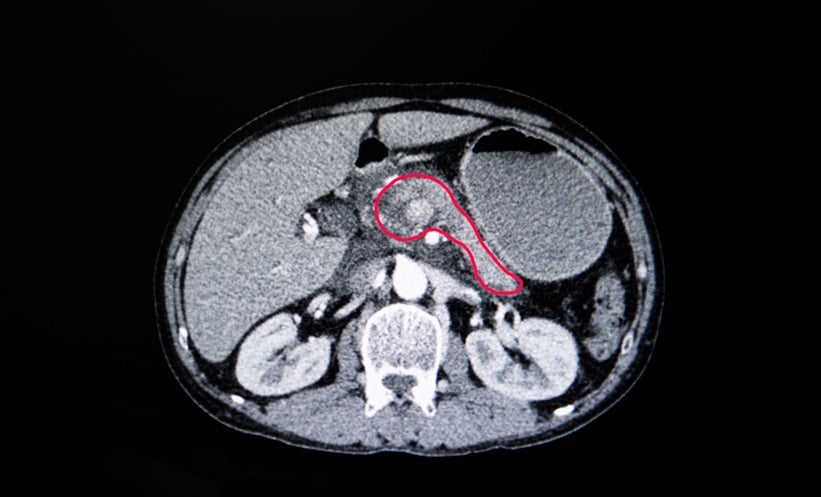
EXPERTS have labelled a new pancreatic cancer treatment the ‘biggest breakthrough in decades’ as study findings reveal remarkable results.
Rasonque (daraxonrasib), given as a daily pill alongside chemotherapy, achieved disease control in over 90% of patients with a recent diagnosis of advanced pancreatic cancer that had spread to other parts of the body in an early phase trial.
The treatment, which made tumours undetectable on scans in nearly 10% of participants, is being hailed as significant progress for pancreatic cancer, which is notoriously very difficult to treat and has the lowest survival rate of all common cancers in the UK.
Tumours Shrank or Disappeared in Six in 10 Patients
Pancreatic cancer is particularly difficult to treat once it has spread and is often caught late due to mild symptoms in its early stages. Chemotherapy can shrink tumours, but the cancer often starts growing again.
Most patients with metastatic pancreatic cancer treated with standard chemotherapy survive for between eight to eleven months, and only three per cent are alive five years after diagnosis.
Researchers tested whether adding daraxonrasib at the start of treatment could keep the disease under control for longer.
During the Phase I/II trial, 61 patients participants who had yet to receive treatment for metastatic disease, received daraxonrasib alongside gemcitabine and nab-paclitaxel, two chemotherapy drugs used to treat pancreatic cancer.
Tumours shrank or disappeared in 60.7% of patients. This included five patients, or 8.2%, whose tumours were no longer visible on scans. Overall, 90.2% of patients achieved disease control, meaning their tumours shrank, disappeared or remained stable.
Tumour shrinkage is typically only seen in between 23% 42% of patients treated with conventional chemotherapy alone, and most tumours start to grow again after five to six months.
The median follow-up for participants was 18.3 months and median progression-free survival – the time patients lived before their cancer worsened or they died – was 12.8 months, already outpacing standard treatment.
Daraxonrasib works by blocking the activity of RAS proteins, which help regulate cell growth. More than 90% of pancreatic cancers have these RAS mutations that can keep growth signals switched on, allowing cancer cells to continue dividing.
Similar mutations occur in some other type of cancer, including lung and ovarian cancers, meaning the drug has the potential to treat many variants of the disease, although the combination would need to be tested separately.
Despite the promising findings, doctors have warned that longer follow-up is needed to see how long patients whose tumours disappeared from scans remain in remission.
‘Potentially transformative’ for Patients with Metastatic Disease
Revealing the results at the EORTC–NCI–AACR Symposium 2026, Dr Wungki Park, a gastrointestinal medical oncologist at Memorial Sloan Kettering Cancer Center, New York City, USA, called them “potentially transformative”.
He said: “Pancreatic cancer remains one of the most challenging cancers to treat, particularly because more than half of patients present with disease that has already spread to other organs.
“What is particularly encouraging about these new and updated results I am presenting today is that we are beginning to see not only a higher percentage of tumour response rates, but also deeper responses and a near doubling in the duration of disease control, which may eventually translate into longer survival,” he said.
The global Phase III RASolute-303 trial is already evaluating daraxonrasib both as a standalone treatment and in combination with gemcitabine and nab-paclitaxel, comparing it with chemotherapy alone.
The results will help establish whether starting treatment with daraxonrasib delays disease progression and improves overall survival in the lobger term.