Key Summary:
- Atopic dermatitis developed in 8.2% of infants by age 2 years.
- Family allergy history and higher household income were linked to increased risk.
- Regular moisturiser use was associated with reduced eczema risk.
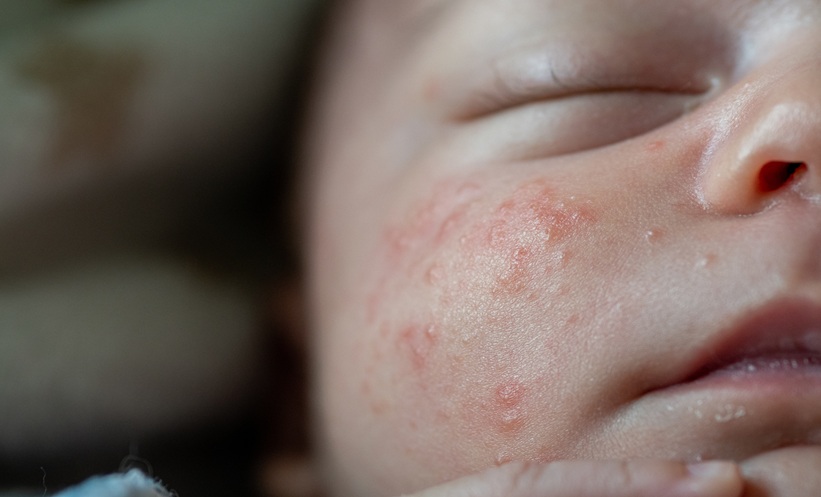
EARLY-LIFE clinical characteristics could help identify infants at increased risk of developing atopic dermatitis (AD), according to findings from a prospective cohort study involving 671 children.
Researchers developed two prediction models using demographic and clinical information collected during early infancy. Both demonstrated moderate predictive performance, highlighting the potential for early risk assessment to support preventive counselling and monitoring during the first 2 years of life.
AD, commonly known as eczema, is the most prevalent chronic inflammatory skin condition in childhood and frequently develops during infancy.
Early identification of children at increased risk could help clinicians provide targeted guidance to families and potentially reduce the burden of subsequent allergic disease.
To investigate whether routinely collected clinical information could predict early-onset AD, researchers analysed data from a prospective cohort of healthy infants enrolled at Songklanagarind Hospital between August 2020 and October 2021.
Participants were aged 42–90 days at enrolment, with demographic and clinical characteristics recorded at baseline. AD was subsequently assessed at 12 and 24 months using the Hanifin and Rajka diagnostic criteria.
Researchers developed multivariable logistic regression models using two variable-selection approaches: stepwise selection and least absolute shrinkage and selection operator (LASSO).
Model performance was evaluated using sensitivity, specificity, area under the receiver operating characteristic curve (AUC), F1 score, and calibration.
Among the 671 infants included in the analysis, 55 developed AD during the first 2 years of life, representing an incidence of 8.2%.
Several early-life characteristics were significantly associated with subsequent disease development.
Infants with a family history of allergy were more likely to develop AD, supporting the importance of familial allergic predisposition in early childhood eczema risk.
Higher household income was also significantly associated with increased AD risk, although the study did not establish the reasons underlying this relationship.
Conversely, regular moisturiser use was associated with a reduced likelihood of developing AD.
While this finding suggests a potential relationship between skin care practices and eczema risk, the observational analysis cannot establish that moisturiser use directly prevents the condition.
The two prediction models demonstrated different strengths in identifying infants who subsequently developed AD.
The LASSO-selected model achieved higher sensitivity than the stepwise-selected model, identifying 74% of infants who developed AD compared with 68%.
However, the stepwise model demonstrated greater specificity, reaching 75% compared with 66% for the LASSO model.
The stepwise approach also achieved a higher AUC of 0.74, compared with 0.67 for LASSO, indicating better overall discrimination between infants who did and did not develop AD.
Despite these differences, both models achieved an F1 score of 26% and demonstrated similar calibration.
These findings suggest that the models could provide useful information for early risk stratification, although their predictive limitations mean they are not sufficiently reliable to determine individual outcomes with certainty.
The researchers concluded that prediction models incorporating early-life clinical characteristics may help identify infants at increased risk of developing AD.
Such tools could support discussions with families about eczema risk and help clinicians consider which infants may benefit from closer monitoring or prevention-oriented counselling.
However, the relatively small number of AD cases and moderate model performance highlight the need for further evaluation before these approaches can be incorporated into routine clinical practice.
Additional validation in independent and more diverse populations would help establish whether the models can reliably predict early-onset AD across different healthcare settings.
Reference
Eakpanit, E., Laoprasopwattan, K., Sangsupawanich, P. et al. Prediction models for early-onset atopic dermatitis in infancy: a prospective cohort study. Allergy Asthma Clin Immunol (2026). https://doi.org/10.1186/s13223-026-01068-4
Adobe Stock
Each article is made available under the terms of the Creative Commons Attribution-Non Commercial 4.0 License.