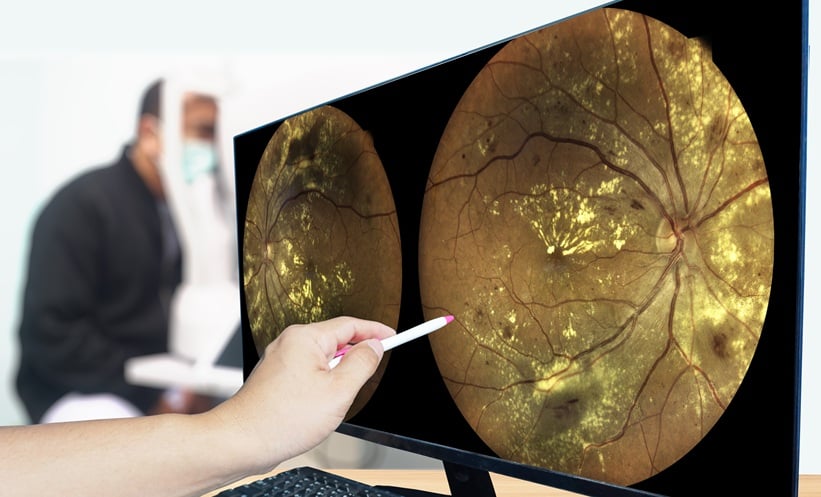
DEEP LEARNING models combining retinal photographs with clinical data show promise for detecting diabetes-related kidney disease, but evidence for predicting future disease remains limited, a systematic review and meta-analysis has found.
Combining Eye Images With Clinical Data
Researchers searched eight databases through 14 July 2026 and identified six eligible studies. These assessed models using retinal images alone, clinical information alone or a hybrid of both.
Three cross-sectional studies of hybrid models contributed to the meta-analysis of existing disease detection. The pooled area under the receiver operating characteristic curve (AUC) was 0.88, with sensitivity of 80% and specificity of 81%.
These figures describe how well models distinguished participants with and without the defined kidney outcome in the assessed datasets. They should not be interpreted as proof that the models improve diagnosis or patient outcomes in routine screening.
Prediction Evidence Remains Sparse
The pooled studies varied considerably, with heterogeneity estimates ranging from 93.7% to 99.8%. Two further cross-sectional studies used narrower or more severe kidney disease definitions and were assessed separately.
Only one study examined future risk, predicting diabetes-related kidney disease over five years. Its AUC was approximately 0.81 during internal validation, but fell to approximately 0.72 when tested externally in UK Biobank participants. Sensitivity also fell from approximately 70% to 42%.
This distinction matters because identifying disease already present and predicting disease that has yet to develop are different clinical tasks. The pooled detection results cannot establish equivalent performance for future risk prediction.
Across external datasets, hybrid models performed better than retinal-only approaches. However, their advantage over models using clinical data alone was inconsistent, leaving uncertainty about how much additional value the retinal images provide.
Validation Needed Before Routine Use
Five of the six studies developed models predominantly in Asian populations, and performance across sex and ethnic subgroups was rarely reported. The review also identified limited reporting of calibration, which assesses whether predicted risks match observed outcomes.
Albuminuria data were incorporated in only one included study, further limiting assessment across the full spectrum of diabetes-related kidney disease. Definitions based mainly on reduced filtration may overlook clinically relevant disease identified through urinary markers.
The findings suggest that routine eye images could provide additional information about kidney health, although substantial variation between studies and inconsistent external performance limit immediate clinical application.
Therefore, authors call for larger, more diverse validation studies and prospective clinical evaluation. Retinal AI remains a potential adjunct to assessment, rather than an established replacement for conventional kidney testing or a validated route to better patient outcomes.
Reference
Otabir SAG et al. Detection and risk prediction of diabetes related kidney disease using retinal images: a systematic review and meta-analysis. J Diabetes. 2026;18:e70271. doi:10.1111/1753-0407.70271.