This content was funded by Vitalograph.
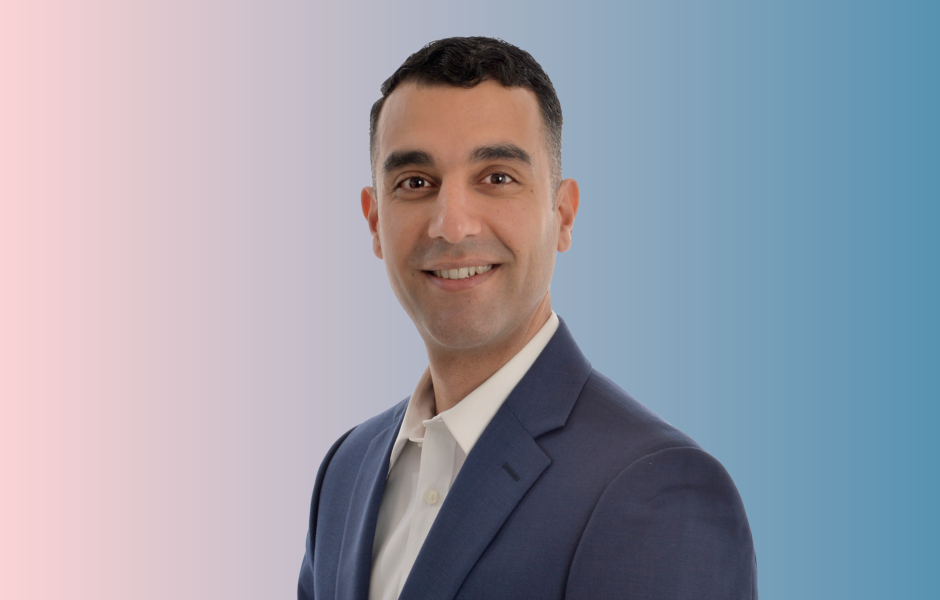
In a new Catalyst interview, Furat Shawki, Vice President, Digital Health Technologies, Vitalograph, explores a key question in clinical research: how can digital health technologies keep people at the centre, while helping the industry move faster and work smarter?
Interview by Isabel O’Brien
Our latest Catalyst, Furat Shawki, is driven by a straightforward idea: “At a satellite level, it’s about helping people.” In his role at Anglo-Irish-based respiratory diagnostics company Vitalograph, that means many things, from growing the organisation and creating jobs to reaching more people with innovations.
There is a strong sense of momentum behind that outlook. Shawki admits that he can find the pace at which things move in the world frustrating. “I’m not sure if it’s me who’s moving too fast or if it’s the world that’s moving too slow,” he says with a smile. Yet for all that focus on progress, it is the people around him that he values most about his work. “The people” is his immediate answer when asked what he loves about his job. Organisations may change, but relationships endure; when the right people are around, he says, “it’s like a family”.
In this conversation, Shawki comes across as a personable and action-oriented leader, with little patience for broad generalisations or grand claims. He is more interested in the granular: the small changes that can remove friction, improve a process and, collectively, make a meaningful difference to people’s lives.
Your background is in engineering and computer science. What did you see in digital health that made you think, this is where I want to be?
Fundamentally, I’m a problem solver. I like to find solutions to problems. That’s my defining characteristic.
When I was very young, I had a close family friend who was my age and had a rare disease, fibrodysplasia ossificans progressiva (FOP). At that time, there were no treatments, and his condition progressively got worse. I never understood why he couldn’t just get the treatment he needed.
As I grew up healthy, he didn’t. What I took with me is the saying ‘you have a million problems until you have a health problem, then you only have one’. So, when I looked at the problems that would be worthwhile for me to spend time solving, healthcare for those who need it most was a natural choice.
I started by bringing technology into healthcare. My first job was building applications to digitise clinical trials. From then on, it grew into: how can we operationalise better? How can we present value to customers better? And now I’m in a place where I’m building solutions that optimise the site staff and participant journey throughout the trial.
Digital health technologies (DHTs) are becoming a bigger part of clinical trials. Why are they so important to the future of clinical research?
I think the clinical research industry is still catching up. However, if you compare it to other industries, that’s understandable because healthcare and life sciences are highly regulated, and rightly so. DHTs are driving innovation in this environment, and leveraging these tools will enable better treatments to reach more patients faster.
The definition of DHTs includes pretty much all the technology we routinely use in healthcare and daily life. This could be your phone, a spirometer, or a pulse oximeter. The purpose of these tools should be to simplify industry workflows, reduce the time it takes to reach conclusions and minimise the risk profile of conducting trials.
By utilising DHTs, we can create an ecosystem where data can flow freely and securely and inform decisions. Essentially, these technologies enable us to digitise large amounts of data to give greater visibility and enable faster decision-making.
A technology can work well on paper and still fall short in practice. How should the needs of sites and participants shape how DHTs are designed?
The main thing to think about is that we’re dealing with people first. A site staff member is a person who cares for patients in a clinic, looks after participants in a trial, and is also a member of their own family. They have busy schedules and personal appointments, and they need to support patients who are not feeling well.
Participants in a trial also have jobs, children and family members to look after, maybe even birthdays to organise. So, as providers, we must consider the lives of site staff and participants, the same as if they were part of our extended family.
We should ask ourselves, “What is the problem that our site staff and participants need to solve?” And then we can utilise technologies to create those solutions for them. The reality is that too often, an innovative product or service claims to be revolutionary, to which I respond, “but what human problem does it solve?”
We should ask ourselves, ‘What is the problem that our site staff and participants need to solve?’
Clinical research is a traditionally risk-averse industry. How do you convince a sponsor to embrace a new technology when sticking with what’s tried and tested feels like the safer choice?
I think it’s important to separate innovation from novelty. What we should think about is: does this solution improve workflow efficiency, scalability, or end-user experience? And does it provide value to those users? That value could be adherence, time, cost, endpoint quality, whatever it is.
These solutions should be more than just a great marketing story. For example, you may come across a startup company that says, “We can improve your trial recruitment by 95%”, which sounds impressive. However, in clinical trials, credibility comes from evidence, experience and a proven ability to deliver.
For me, it’s about creating enduring relationships and combined strategies with reliable partners – partners who have been tried and tested within the industry.
The focus should be on companies that have the experience to understand the challenges involved and have the resources to solve them. Then you’re more likely to get an honest answer that has longevity behind it, rather than leaning on a make-or-break startup whose commercial teams are desperate to generate revenue.
AI is moving at remarkable speed across healthcare. Where do you see it having the greatest impact on DHTs and their use in clinical trials?
AI will adjust how we work across multiple touchpoints in the journey. I think its value will come from improving many different parts of the workflow of a clinical trial.
However, what it won’t do is replace the clinical judgment of sites, monitors, clinical research organisations (CROs) and so on. Nor can it replace the information gathered from participants.
What it can impact is the way we get to the data we need to take key decisions in the process. Really, what AI will do is reduce manual effort and cumulatively improve efficiency across multiple touchpoints.
Ultimately, successful AI implementation is AI that you’re not aware of. If I know that AI is in play, then most likely it hasn’t been implemented properly. We should be asking: what are the touch points that are very manual, very workload intensive, or very error prone? Is there a way for AI to slot into the background of those processes to improve the accuracy and reliability of the outcome? That’s the AI we should be implementing.
If you could change one thing about healthcare tomorrow, what would it be, and why?
I’d answer that by going back to where I started, and I would say speed. From a young age, I saw firsthand what it meant for someone to be waiting for treatment, while progress simply wasn’t moving fast enough.
One of the main ways to reduce time is to create aligned and combined decision-making processes. The challenge we have now is that the clinical trials environment is very fragmented. You have sponsors, CROs and multiple vendors and each one has their own standard operating procedures and processes.
If we could create shared decision-making frameworks between partners, where everyone understands how a particular type of question should move from issue to decision, we could refine that process over time and make decisions much quicker.
Over time, pre-approved frameworks could empower partner teams to act within clearly agreed sponsor parameters, reserving escalation for the decisions that genuinely require it. That would reduce friction, accelerate execution and help us deliver value to sites and participants faster.