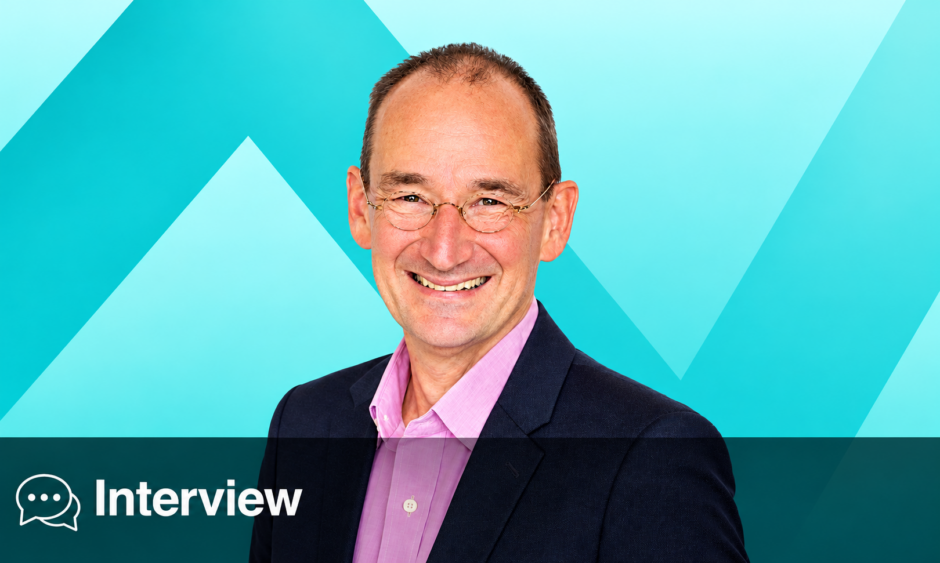
Joost P.H. Drenth | Professor of Hepatology, Department of Gastroenterology and Hepatology, Amsterdam UMC, the Netherlands; President, United European Gastroenterology (UEG), Vienna, Austria
Citation: EMJ Gastroenterol. 2026; https://doi.org/10.33590/emjgastroenterol/RHQ2HFHR

When you began your 2-year term, you described your vision for United European Gastroenterology (UEG) as moving “from reflecting to taking concrete action.” How would you say that vision is taking shape so far, and where do you still want to drive change?
When I began my term, we had already laid the groundwork during my time as Vice President. We carried out a deep governance review, taking a close look at what we are, how we act, and how effective we are. There was a lot of reflection and description, but I felt that we had reached the point where we needed to jump into action.
UEG describes itself as a transparent, agile, and effective organisation, and I think it truly is. What you will now see is our upcoming strategy plan, which we have developed carefully both internally and through outreach to our community. It sets out where we are, what we want to be, and where we want to go in the future.
For me, the priority is our community. We now have more than 40,000 UEG Associates and counting, which represents a massive pool of talent. I want to offer them more opportunities to engage, not only through UEG Week, but also through activities and touchpoints outside the annual conference.
That is still a work in progress, and we expect to bring elements of the conference to our community so that there is low-threshold access to UEG, closer to home. I think that will allow us to engage much better with our community.
With UEG Week 2026 now just around the corner, how will some of these priorities be reflected in this year’s conference, and what are you most looking forward to sharing with the UEG community?
This will be the 34th edition of UEG Week, and what I would like to emphasise is that we learn from every experience: we plan, we do, we check, and we act.
I go to many conferences in Asia, the Americas, and elsewhere, and when I come home to UEG Week, the strongest element that stands out to me is its innovative character. We always try something new. Whether it works or not, we evaluate it and then move forward.
With UEG Week, I want us to get as close as possible to the heart, mind, and brain of the participant. To do that, we use everything available to us: technology, infrastructure, and different approaches to education, including hybrid, blended, hands-on, and classroom learning. Together with the UEG Education Committee, we really try to be at the forefront of educational innovation.
In terms of content, last year we introduced the Digestive Disease Mechanisms Summit, and I think that was a great success. It is important for us to attract basic researchers who investigate the mechanisms underlying digestive health problems and offer clinicians and others working in digestive health new targets and potential druggable options to reduce the burden of disease.
This year, we will focus on the cellular drivers of inflammation, particularly fibrosis and regeneration. I believe this is a very exciting area, because we are seeing many new therapeutic options emerging. It is not only the major diseases driving innovation, such as MASLD, but also rare liver diseases and conditions outside the liver, including rare small-bowel disorders and enteropathies driven by inflammation. We need to move forward in these areas, hone our diagnostic skills, educate ourselves better, and find solutions for these patients.
The scientific programme, driven by Jörn Schattenberg (University of Saarland, Homburg, Germany) is also focused on looking beyond the mainstream of digestive health. During the postgraduate programme, which will be attended by more than 4,000 participants, there will be a special focus on coeliac disease, but also on lesser-known enteropathies.
The opening session will also feature novel vaccination therapies in oncology, which I think will be highly exciting. We are seeing the rapid development of vaccination programmes, including approaches where T cells can be modified. These are advances that clinicians may use not in 3 years, perhaps, but in 5 or 10 years. Educating our participants about them now is crucial.
There is also an important community element. Together with the European Association for the study of the Liver (EASL), we will bring the ‘Love Your Liver’ initiative to Barcelona, offering free liver health checks and education to the local community. This is also what UEG is about: working with our members to bring digestive health initiatives directly to the local population.
Ultimately, I want to improve the health of European citizens and use UEG as an instrument to do that. Step by step, I believe we will get there.
UEG brings together thousands of professionals from across Europe and beyond. As president, what do you think UEG can do particularly well to strengthen collaboration across countries, specialties, and career stages, and how important is that collaborative approach to advancing digestive health?
At its core, UEG is a platform organisation that brings together different medical associations and national societies. What I would really like to emphasise is that we want to offer all our associates a home where they feel comfortable, where they can meet like-minded people, and where they can find their tribe.
What UEG offers, unlike many other organisations, is a multidisciplinary perspective. Digestive health is not just about surgery, dietetics, or any one particular organ. It is about looking at the whole system. A patient with a digestive health problem may be seen by a radiologist, a pathologist, a gastroenterologist, and other specialists, each bringing a different perspective to their care.
We know from clinical practice that working together in teams is essential, and UEG wants to replicate that during UEG Week and through our other activities. So, emphasising the multidisciplinary perspective that we offer is a unique strength.
A good example is colorectal cancer screening. Today, screening programmes exist in many European countries, and we are very thankful for that. But the knowledge that colonoscopy could identify and remove polyps and reduce the risk of colorectal cancer was already there 25 or 30 years ago.
The challenge was not necessarily the science. We knew that colonoscopy worked. The question was how do we influence the system so that European governments actually implement colorectal cancer screening?
Around 20 years ago, UEG’s Public Affairs Committee made colorectal cancer one of its major policy projects. We brought together the expertise within our community, including the European Society of Gastrointestinal Endoscopy (ESGE) and the epidemiological evidence, and tried to influence the European policy landscape.
We developed a multichannel advocacy strategy. We needed to move our gastroenterologists to recognise that colorectal cancer was a problem we could influence through colonoscopy, while also creating awareness in the European policy environment and raising public awareness.
We worked with members of the European Parliament on declarations recognising the importance of colorectal cancer screening for citizens of the EU. A written declaration on fighting colorectal cancer in the EU was ultimately signed in 2010.
That was not the end; it was just the beginning. Europe subsequently implemented colorectal cancer screening programmes step by step, and we are now picking the fruits of that work, with publications showing that screening saves lives.
For me, this demonstrates what UEG should be about: taking knowledge that already exists and finding ways to turn it into action. It is not simply about asking whether something is true. It is about asking how we can actually implement it.
Building on that example of turning evidence into action, UEG is also advocating for digestive health to become a greater strategic priority at European level, including through the next EU budget and FP10 prescriptions. What would you like policymakers to understand about the wider burden of digestive disease across Europe, and where do you think greater investment could make the biggest difference?
I believe that screening should be a priority for national health systems. The EU or European Commission cannot enforce national health initiatives, but they can set a standard and show that something needs to be done for European citizens.
Then you can ask member states that have not implemented colorectal cancer screening to explain to the EU and also to their own citizens why they have not done so. I think that is an important role for European policy.
Colorectal cancer screening is not specifically part of FP10, but UEG published a statement earlier this year calling on policymakers to recognise the role of digestive diseases within the next European multiannual financial framework.
We want digestive diseases to be an explicit priority, including the prevention of digestive cancers, liver diseases, and immune-mediated disorders, as well as the interaction between nutrition, the microbiome, and metabolic diseases.
We also need strong funding for translational health research, because we can see that this brings real benefits to European citizens. A good example, highlighted at UEG Week last year, is the development of glucagon-like peptide-1 agonists. That came from research focused on identifying targets, understanding what they do, and then translating that knowledge into drugs and, ultimately, clinical applications.
Alongside your role at UEG, you continue to lead clinical research at Amsterdam UMC. You were the coordinating investigator for the POSITANO trial of CAM2029 in symptomatic polycystic liver disease.1,2 With the results now reported, what do you see as the most important next step towards bringing this approach into clinical practice?
There have been a number of independent clinical trials examining these drugs in polycystic liver disease, and they all point in the same direction. Liver growth stops or even reverses in the majority of patients.
The question is why there has not yet been widespread adoption. I think there are three major hurdles that we need to overcome.
The first is formulation. Classic long-acting somatostatin analogues cannot be self-administered; they require somebody else to administer them because they are given by deep subcutaneous injection. That creates a practical barrier for patients.
Secondly, these drugs are not labelled for this indication. Whether you can prescribe them off-label depends on the healthcare. The Netherlands is quite well known for allowing off-label use, and that is what I do in my clinical practice. I use somatostatin analogues off-label and they are reimbursed. But that is not the case in other European healthcare systems.
That highlights the importance of obtaining a formal indication. We need to get to the FDA in order to start a Phase III study, and the FDA asks a simple question: do you have an endpoint where patients feel better, function better, or survive better?
This is difficult with polycystic liver disease, because if you do nothing, patients will live on. In severe polycystic liver disease, approximately 10–20% of patients may eventually require liver transplantation, but the majority will live on.
Would you say that because patients can live with the disease for many years, making meaningful improvements with treatment harder to capture, it is difficult to use patient wellbeing or quality of life as a primary endpoint?
This is the disconnect that we have at this point in time. We do have validated questionnaires, and I personally use the Polycystic Liver Disease Questionnaire to identify patients who are in need of therapy. The options may include liver transplantation, somatostatin analogues, or procedures such as aspiration and sclerotherapy.
The challenge is whether the patient-reported outcome measure is sufficiently sensitive to capture the changes these patients actually experience. What I see in clinical practice is that patients feel meaningfully better and experience a better quality of life. But the challenge is to capture that in a quantitative way so that we can convince the authorities to use somatostatin analogues.
I have patients who have been on long-term somatostatin analogues, and I believe that, by starting early, I have prevented some of them from going down the path towards liver transplantation.
That is very important because you save a liver for another indication, and you also prevent the complications and burden that come with liver transplantation for the patient.
I am simply trying, in my role as a clinician, to improve the quality of life of my patients. That is why I do clinical trials and why I see patients every day. I want to see CAM2029 progress into a Phase III trial, and ultimately towards regulatory approval.
This is also where UEG plays a role. We use UEG as a platform to present innovations in research. At the same time UEG offers clinicians a platform to connect with others and learn from them, and to hone our skills when it comes to, for example, policymaking.
Simply put, UEG can be a bridge to policy. By creating as many examples as we can, we can also inform others in our community that this can be done.
Clinicians are very comfortable in their outpatient offices, and, yes, they can make a difference there. But on the European stage, the message can be amplified enormously. I believe this is where UEG can be used as a platform, as a home, and as a tribe.
Looking ahead to the end of UEG Week 2026, if we speak again afterwards, what would make you feel that the conference had achieved what you wanted it to?
First of all, it is very important that people who come to UEG Week feel at home. I want them to feel that UEG is taking care of them, that they are among like-minded people, and that they can make connections.
I’m convinced that, in October, new connections will be made. We offer many opportunities for networking, and it is wonderful to see how those connections can start with a small meeting and then blossom and snowball. We need to provide the environment for that to happen.
And, of course, I want to see new science, happy faces, and a well-run conference.
The great thing is that we have a UEG Headquarters Management team working behind the scenes. You do not see them very often, but they do an amazing job. Everything you see at UEG Week is coordinated by the people working in the UEG Headquarters Management. Of course, we bring in expertise from external companies where needed, but the thinking, the content, the organisation, and the way we create those interactions and touchpoints all come from UEG.
So, afterwards, if you ask me whether we achieved our goal, I can say we did when we saw happy faces, new science, and measurable progress.