BACKGROUND AND AIMS
Chronic lymphocytic inflammation with pontine perivascular enhancement responsive to steroids (CLIPPERS) is a rare central nervous system inflammatory disorder primarily affecting the pons and cerebellum.1,2 It responds to corticosteroids, but alternative diagnoses should be considered if there is no improvement. The authors present a case of Erdheim–Chester disease (ECD), a histiocytosis that can mimic CLIPPERS,3 highlighting diagnostic and treatment challenges.
CASE PRESENTATION
A 61-year-old woman with an 8-month history of gradually worsening symptoms, including slurred speech, diplopia, and ataxia, was found to have multifocal enhancing lesions in the pons (Figure 1A). She was treated with pulse steroids based on a presumed diagnosis of CLIPPERS, followed by a prolonged steroid taper. One month later, she reported worsening gait difficulty that required support with a walker. Repeat brain imaging showed persistent enhancement and the emergence of new lesions (Figure 1B, 1C, and 1D), prompting further investigation for an alternative diagnosis. Fluorodeoxyglucose-PET imaging revealed increased radiotracer uptake in multiple areas, including the bones and kidneys. A biopsy of an iliac crest lesion showed histiocyte infiltration of the bone marrow, suggesting ECD. Negative results for the BRAF-V600 mutation prompted additional biopsies of lesions in the mandible and kidney, which did not yield different results. She was empirically treated with cobimetinib, a mitogen-activated extracellular kinase (MEK) inhibitor. The patient’s clinical course has since stabilized, though residual arm and leg weakness persists, and she is currently undergoing intensive physical therapy.
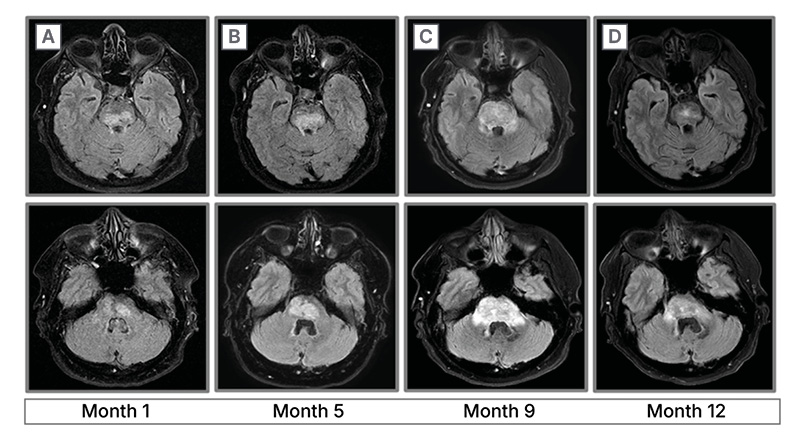
Figure 1: MRI demonstrated multifocal, patchy T2/FLAIR hyperintensities within the central pons extending into the medial aspects of the bilateral middle cerebellar peduncles, consistent with CNS involvement from BRAF-negative Erdheim–Chester disease (A-B). Follow-up imaging showed persistent enhancement and interval development of new lesions despite steroid treatment (C), while subsequent MRI 3 months after treatment with comebinitib, a MEK inhibitor, demonstrated marked reduction in enhancement and decreased extent of T2/FLAIR hyperintensities (D).
CNS: central nervous systemt; FLAIR: Fluid-Attenuated Inversion Recovery; MEK: mitogen-activated extracellular kinase.
CONCLUSION
ECD can resemble CLIPPERS and presents with a clinical phenotype consistent with infratentorial involvement. This case emphasizes the need to consider alternative diagnoses when pontine lesions are patchy rather than curvilinear, unresponsive to steroids, and show increased perfusion.4 Diagnosing ECD requires tissue analysis and BRAF-V600E testing; if these are negative and there is nervous system involvement, empiric MEK inhibitor treatment can be considered.5