Daily Light Exposure Habits of Youth with Migraine and the Association with Headache Frequency - European Medical Journal

This site is intended for healthcare professionals

Daily Light Exposure Habits of Youth with Migraine and the Association with Headache Frequency

2 Mins
Neurology
Download PDF
Authors:
* Carlyn Patterson Gentile , 1,2 Ryan Shah , 3 Blanca Marquez De Prado , 1 Nichelle Raj , 1 Christina L. Szperka , 1,2 Andrew D. Hershey , 4 Geoffrey K. Aguirre 2
  • 1. Children’s Hospital of Philadelphia, Pennsylvania, USA
  • 2. University of Pennsylvania, Philadelphia, USA
  • 3. Sidney Kimmel Medical School, Thomas Jefferson University, Philadelphia, Pennsylvania, USA
  • 4. Cincinnati Children’s Hospital Medical Center, University of Cincinnati Medical College, Ohio, USA
*Correspondence to [email protected]
Disclosure:

Aguirre has received support for the present manuscript through institute grant funding (R01EY036255), with payment to the individual; grants or contracts from NIH NINDS, the United States-Israel Binational Science Foundation, NIH NEI, and Johnson & Johnson; payment or honoraria from the Burroughs Wellcome Foundation; payment for expert testimony from the U.S. Department of Justice and Shulman Rogers; and holds stock or stock options in Nia Therapeutics.

Hershey has received grants or contracts from NIH/NINDS, NIH/NICHDS, Amgen, Biohaven, Eli Lilly, Theranica, Upsher-Smith, Pfizer, Teva, and Lundbeck; consulting fees from AbbVie, Amgen, Biohaven, Eli Lilly, Lundbeck, Supernus, Teva, Theranica, and Upsher-Smith; support for attending meetings and/or travel from the American Headache Society and International Headache Society; and held leadership or fiduciary roles with the American Headache Society and International Headache Society.

Szperka has received grants or contracts from PCORI, NIH, AbbVie, Amgen, Biohaven/Pfizer, and Teva; consulting fees from Teva, AbbVie, Lundbeck, and Pfizer through their institution; payment or honoraria from the American Academy of Neurology, donated to a related charity; support for attending meetings and/or travel from the American Headache Society; participated on data safety monitoring boards for Eli Lilly and Upsher-Smith; and held a leadership role with the American Headache Society.

Marquez de Prado has received support for attending meetings and/or travel from AHS; and payment from TEVA for testimony as a parent of a patient with migraines.

Gentile has received support for the present manuscript from the Children’s Hospital of Philadelphia Foerderer Grant and NINDS grant funding (K23NS124986), with payment to the individual; payment or honoraria from the Headache Conference of the Northeast; support for attending meetings and/or travel from the American Headache Society, American Academy of Neurology, and American Neurological Association; participated in an unpaid role with Global Light Commons; and held an unpaid leadership role as Chair of the Post-Traumatic Headache Special Interest Group of the American Headache Society. The other authors have declared no conflicts of interest.

Citation:
Neurol AMJ. ;3[1]:39-41. https://doi.org/10.33590/neurolamj/6266960D.
Keywords:
Adolescent, circadian, daily light exposure, migraine, photophobia.

Each article is made available under the terms of the Creative Commons Attribution-Non Commercial 4.0 License.

BACKGROUND AND AIMS

Eighty percent of youth with migraine report photophobia.1 It is unknown if photophobia leads to light avoidant behavior, which may further worsen light sensitivity and lead to sleep disruption. The technological development of wearable continuous light loggers makes it possible to address these open questions. Furthermore, these devices can distinguish light that stimulates the melanopic (i.e., circadian, or ‘blue light’) and photopic (i.e., image forming) visual pathways. The authors conducted an exploratory study2 in 20 youth with migraine to determine the feasibility of measuring daily light exposure with wearable light loggers and explore its relationship to migraine burden.

METHODS

Adolescents and young adults aged 15–21 years with a headache specialist-confirmed International Classification of Headache Disorders (ICHD)-3 diagnosis of migraine were recruited from Children’s Hospital of Philadelphia (CHOP) headache clinics. Each participant recorded 7 consecutive days of light logging data from the ActLumus (Condor Instruments, São Paulo, Brazil) light logger, worn as a pendant around the neck, paired with a text-based daily migraine symptom diary during a typical school week between November 2024–March 2025. Melanopic equivalent daylight illuminance (mEDI) was derived from light logger measurements and used to calculate percent time spent within recommended light exposure levels for the day (>250 lux mEDI), 3 hours prior to bedtime (<10 lux mEDI), and at night (<1 lux mEDI), optimal for circadian entrainment.3 To measure shifts in daily light exposure, 24-hour light exposure patterns for each participant were compared to the mean across participants.

RESULTS

Twenty participants (median age: 17 years; interquartile range [IQR]: 16–19; 70.0% female) completed 7 days of continuous light logger recording and daily headache diary. Data completion rates were high, with 136/140 (97.1%) useable days of light logger data and 100% adherence on the daily headache diary. While a range of disease burden was represented in the authors’ sample, participants tended towards more severe symptoms (Table 1).4-7
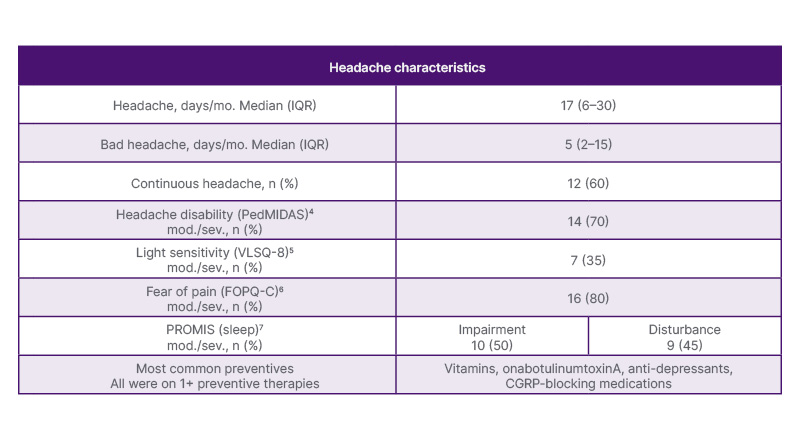
Table 1: Participant headache characteristics (n=20).4-7
CGRP: calcitonin gene-related peptide; FOPQ-C: Fear of Pain Questionnaire, Child report; IQR: interquartile range;
mo.: month; mod./sev.: moderate-to-severe; PedMIDAS: Pediatric Migraine Disability Assessment;
PROMIS: Patient-Reported Outcomes Measurement Information System; VLSQ-8: Visual Light Sensitivity Questionnaire-8.

Light exposure patterns were delayed on the weekends compared to weekdays and were consistent with reported sleep and wake times. Participants spent an average of 15.1% ± SD 8.0 of daylight hours getting the minimum recommended light exposure, while they were more consistently under the maximum light levels recommended 3 hours prior to bed (78.1% ± 20.8 of the time), and at night (99.1% ± 2.9 of the time). Youth whose light exposure was delayed to later in the day reported a greater number of any headache days per month (Spearman correlation coefficient: 0.66; p=0.002) and bad headache days per month (Spearman correlation coefficient: 0.60; p=0.005). The authors also evaluated the effects of weather and daylight length on daily light exposure: days with precipitation, but not colder weather or shorter daylight length, was associated with decreased light exposure.

CONCLUSION

The authors’ exploratory data indicate that youth with migraine get low levels of daylight exposure. Participants in this study spent an average of 1.6 hours a day at or above recommended daylight levels, which was less than half that of a cohort of healthy adults in a similar study done in Manchester, UK.8 While case control comparison is needed to account for other confounding factors (e.g., geography, age, season), the authors’ findings indicate that this is an important direction for future research. Additionally, the authors’ results indicate that delayed daily light exposure should be explored as a potentially modifiable contributor to migraine burden. For more details on this study, please see the publication.2,9

References
Gentile CP et al. Cluster analysis of migraine‐associated symptoms (CAMS) in youth: a retrospective cross‐sectional multicenter study. Headache. 2024;64(10):1230-43. Gentile CP et al. Daily light exposure habits of youth with migraine and its association with headache frequency. Abstract 15-015. AAN Annual Meeting, April 18-22, 2026. Brown TM et al. Recommendations for daytime, evening, and nighttime indoor light exposure to best support physiology, sleep, and wakefulness in healthy adults. PLoS Biol. 2022;20(3):e3001571. Hershey AD et al. PedMIDAS: development of a questionnaire to assess disability of migraines in children. Neurology. 2001;57(11):2034-9. Verriotto JD et al. New methods for quantification of visual photosensitivity threshold and symptoms. Transl Vis Sci Technol. 2017;6(4):18. Simons LE et al. The Fear of Pain Questionnaire (FOPQ): assessment of pain-related fear among children and adolescents with chronic pain. J Pain. 2011;12(6):677-86. van Kooten JAMC et al. Validation of the PROMIS sleep disturbance and sleep-related impairment item banks in Dutch adolescents. Qual Life Res. 2018;27(7):1911-20. Didikoglu A et al. Associations between light exposure and sleep timing and sleepiness while awake in a sample of UK adults in everyday life. Proc Natl Acad Sci U S A. 2023;120(42):e2301608120. Gentile CP et al. Daily light exposure habits of youth with migraine: a prospective exploratory study. NPJ Biol Timing Sleep. 2025;2(1):39.

Rate this content's potential impact on patient outcomes

Average rating / 5. Vote count:

No votes so far! Be the first to rate this content.