BACKGROUND AND AIMS
The goal of this educational initiative was to assess knowledge about the determination of brain death (BD) through surveys completed before, immediately after, and 10 months following a BD workshop.1
BD occurs less frequently than cardiopulmonary death, and determination of BD requires different skills then the determination of cardiopulmonary death. Guidelines for the determination of BD were first published in 1995, and underwent revisions in 2010 and 2023.2-4 In spite of these guidelines, there is variable uniformity of BD testing policies across institutions.5 Educational programs regarding BD determination have proliferated with unknown effect. This study assessed whether a BD workshop led to improved and retained knowledge of participants regarding the process for determination of BD.
MATERIALS AND METHODS
This prospective observational study was conducted in the United Arab Emirates. A survey pertinent to BD determination in children and adults based on the 2023 American Academy of Neurology (AAN) guidelines was administered to all participants at the beginning and end of the workshop. Participants were then asked to complete the survey 10 months later to assess knowledge retention.
RESULTS
The pre-workshop survey had 250 respondents who were predominantly 20–59 years old (95%), with a slight male majority (53%; Table 1). Most participants were physicians (56%) or nurses (30%) and identified as critical care specialists. Prior to the workshop, 47% reported not performing BD evaluations, and 64% had not performed one in the last 6 months. At the 10-month follow-up, 42% had not performed a BD evaluation. Before the workshop, 62% felt comfortable explaining BD. This increased to 75% immediately after the workshop and remained high at 75% at the 10-month follow-up. Prior to the workshop 48% of respondents faced opposition from families when testing for BD, and 46% faced opposition from family when withdrawing care, with 19% citing legal restrictions. On follow-up, opposition decreased to 28% for BD testing and 38% for withdrawing care.
Average BD knowledge-based test scores improved from 48% pre-workshop to 71% immediately post-workshop, but declined to 50% on 10-month follow-up.
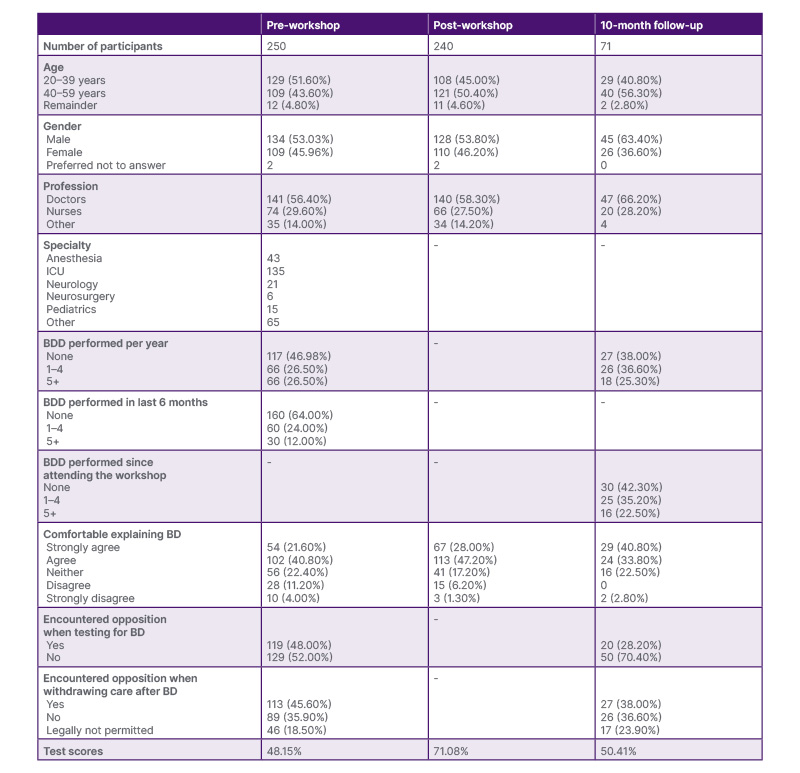
Table 1: Survey results.
CONCLUSION
The BD workshop provided education that persisted. Test scores on BD knowledge significantly improved immediately after the workshop, but declined to almost pre-test levels on 10-month follow-up. However, there was a sustained gain in comfort when explaining BD over the study period.